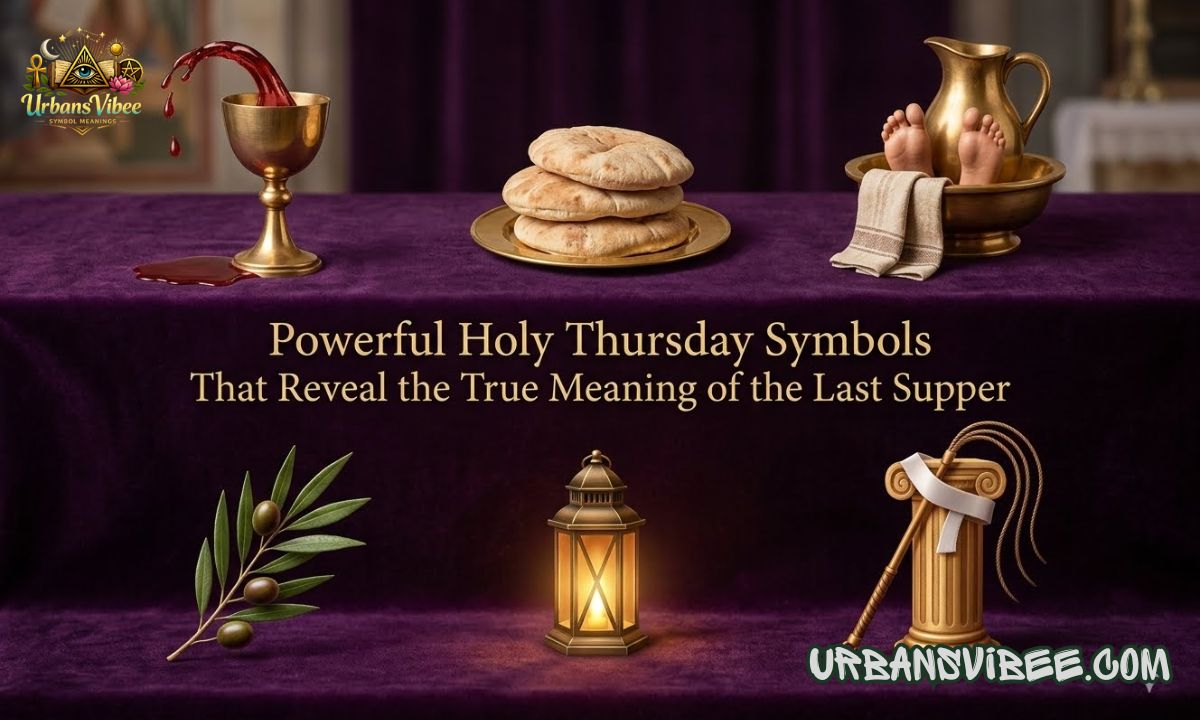
There is one night in the entire Christian calendar that holds more symbolic power than almost any other. It is not Christmas Eve. It is not Good Friday. It is Holy Thursday — the night Jesus gathered His disciples around a table, washed their feet, broke bread, and changed the meaning of everything.
Every gesture from that evening became a symbol. Every object on that table carries a message. And two thousand years later, those symbols are still observed in churches across the world on this single sacred night.
This guide breaks down the most powerful Holy Thursday symbols, what they mean, where they come from, and why they continue to move people so deeply today.
What Are Holy Thursday Symbols?
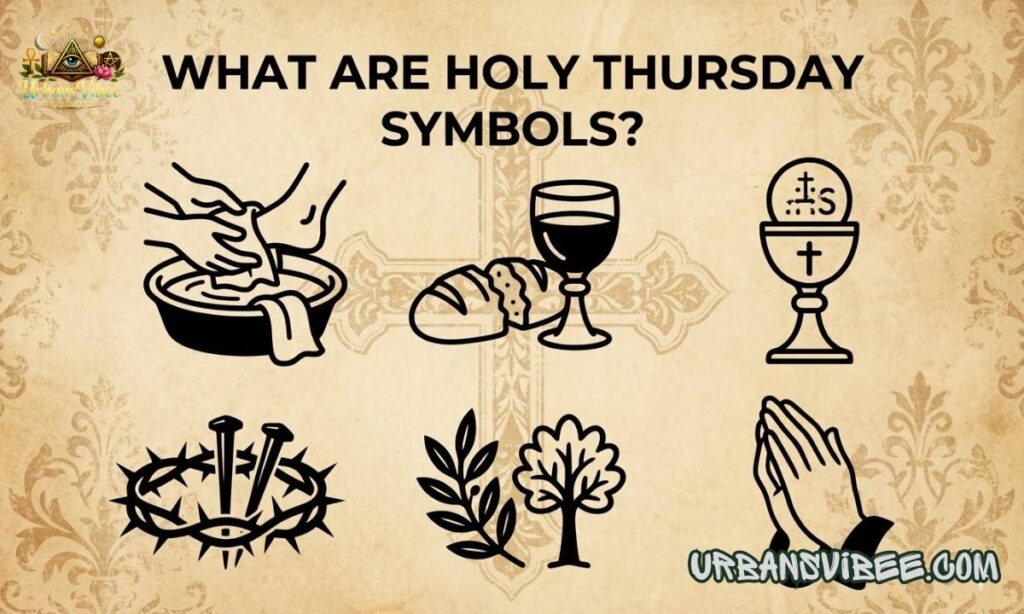
Holy Thursday symbols are the sacred images, objects, rituals, and actions connected to the events of the Last Supper and the liturgical observance of Maundy Thursday. They include visible objects like the chalice, the bread, and the basin of water — as well as ritual acts like the washing of feet and the stripping of the altar.
Each symbol carries a compressed theological meaning. Together they form a complete picture of what Jesus came to do: serve, sacrifice, and give himself entirely to the people he loved.
Holy Thursday Meaning And Symbolism
Holy Thursday Meaning
Maundy Thursday, also referred to as Holy Thursday, or Thursday of the Lord’s Supper, is a Christian feast during Holy Week that marks the beginning of the Paschal Triduum, and commemorates the Washing of the Feet and Last Supper of Jesus Christ with the Apostles.
The term “Maundy” is thought to derive from a Latin anthem, “Mandatum novum do vobis” — meaning “a new commandment I give to you” — sung in Roman Catholic churches on that day. The word mandatum is also the root of the English word “mandate.” Holy Thursday is therefore literally the night of the New Commandment: to love one another as Christ loved us.
This day is extremely important to Catholics because Christ instituted two very important Sacraments on Holy Thursday: the priesthood (Holy Orders) and the Eucharist.
Thursday Symbolism
In the broader Christian liturgical week, Thursday carries the weight of transition. It stands between the ordinary time of Lent and the extraordinary solemnity of the Triduum. It is the last evening of Lent and the first hour of the Paschal mystery — a hinge point between fasting and passion, between waiting and fulfillment.
Happy Holy Thursday
“Happy Holy Thursday” is a greeting used by Catholics and Christians to acknowledge this day with both joy and solemnity. The Mass of the Lord’s Supper is genuinely joyful — white vestments are worn, the Gloria is sung, church bells ring for the last time until Holy Saturday, and the altar is adorned with flowers.
The day commemorates the institution of the sacraments of Holy Orders and the Holy Eucharist — the celebrants are clothed in white vestments and the bells magnificently ring as the Gloria resounds throughout the church.
Holy Week Symbols And Meanings
Holy Week is rich with symbolism from Palm Sunday through Holy Saturday. Holy Thursday sits at its most sacred heart. The symbols of Holy Week broadly include:
| Symbol | Day | Meaning |
| Palm branches | Palm Sunday | Welcome of the King, triumph before suffering |
| Anointing oil / Chrism | Holy Thursday (morning) | Consecration, healing, priestly ministry |
| Bread and wine | Holy Thursday (evening) | Body and Blood of Christ, the Eucharist |
| Basin and towel | Holy Thursday (evening) | Humility, servant leadership |
| Chalice | Holy Thursday (evening) | The New Covenant in Christ’s blood |
| Stripped altar | Holy Thursday (night) | Abandonment and arrest of Christ |
| Cross / Crucifix | Good Friday | Sacrifice, redemption |
| Easter candle | Holy Saturday vigil | Resurrection, Christ as Light of the World |
Good Friday Symbol
The cross is the defining symbol of Good Friday — the day that immediately follows Holy Thursday. The transition from Thursday to Friday is deeply symbolic. On Thursday night, the altar is stripped bare. The tabernacle is empty. The church falls silent. This liturgical emptiness directly mirrors Christ’s arrest in the Garden of Gethsemane and prepares hearts for the desolation of Good Friday.
Holy Thursday Symbols Catholic
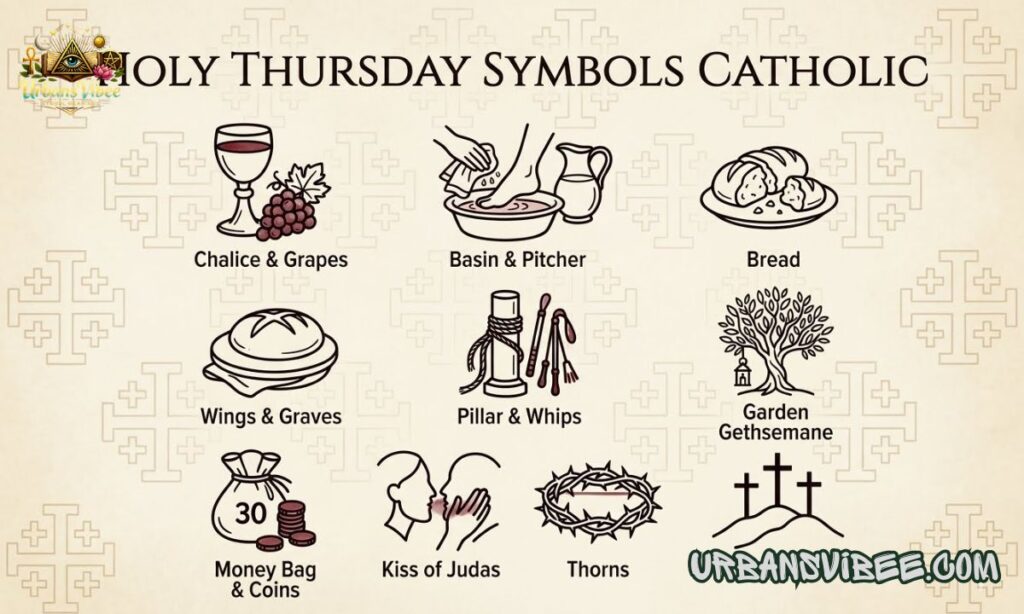
In the Catholic tradition, Holy Thursday is observed with particular liturgical richness. The Holy Thursday liturgy, celebrated in the evening because Passover began at sundown, shows both the worth God ascribes to the humility of service, and the need for cleansing with water — a symbol of baptism — in the Mandatum, or washing of Jesus’ washing the feet of His disciples, and in the priest’s stripping and washing of the altar.
Catholic Holy Thursday symbols specifically include:
- The white vestments of the priest
- The ringing of the Gloria bells (the last bells until Holy Saturday)
- The consecrated hosts reserved for Good Friday communion
- The Chrism oil blessed at the morning Chrism Mass
- The procession of the Blessed Sacrament to the Altar of Repose
- The silent adoration that continues through the night
Maundy Thursday Symbols Explained
Maundy Thursday Symbol
The single most defining symbol of Maundy Thursday is the act of foot washing — the Mandatum itself. It is the symbol from which the day gets its name. When Jesus knelt before his disciples with a basin of water and a towel, he was not simply washing dirt from their feet. He was turning the entire social order upside down. The Lord was serving the servant. The Teacher was cleaning the feet of the student.
The washing of the feet of chosen men which, according to tradition, is performed on this day, represents the service and charity of Christ, who came “not to be served, but to serve.”
Last Supper And Eucharist Symbols
Last Supper Holy Thursday Symbols
The Last Supper is the central event of Holy Thursday. Everything that happened at that table is symbolic. By sharing the bread and wine with his disciples, Jesus foreshadowed his sacrifice on the cross and the redemption of humanity through his death and resurrection.
The table itself is symbolic — a place of gathering, equality, and shared life. The Passover setting is symbolic — Holy Thursday occurs within the Jewish Passover celebration, connecting the Old Covenant’s deliverance from Egypt to the New Covenant’s deliverance from sin.
Holy Eucharist Holy Thursday Symbols
The Eucharist — the bread and wine transformed into the Body and Blood of Christ — is the greatest gift to emerge from Holy Thursday. During the Passover meal, Jesus breaks bread and gives it to his Disciples, uttering the words, “This is my body, which is given for you.” Subsequently, he passes a cup filled with wine. He then says, “This is my blood.” It is believed those who eat of Christ’s flesh and blood shall have eternal life.
Every Mass celebrated since that night is a re-presentation of this moment. The Eucharist is the living symbol of Holy Thursday, renewed every day in every Catholic church across the world.
Washing Of Feet Symbols
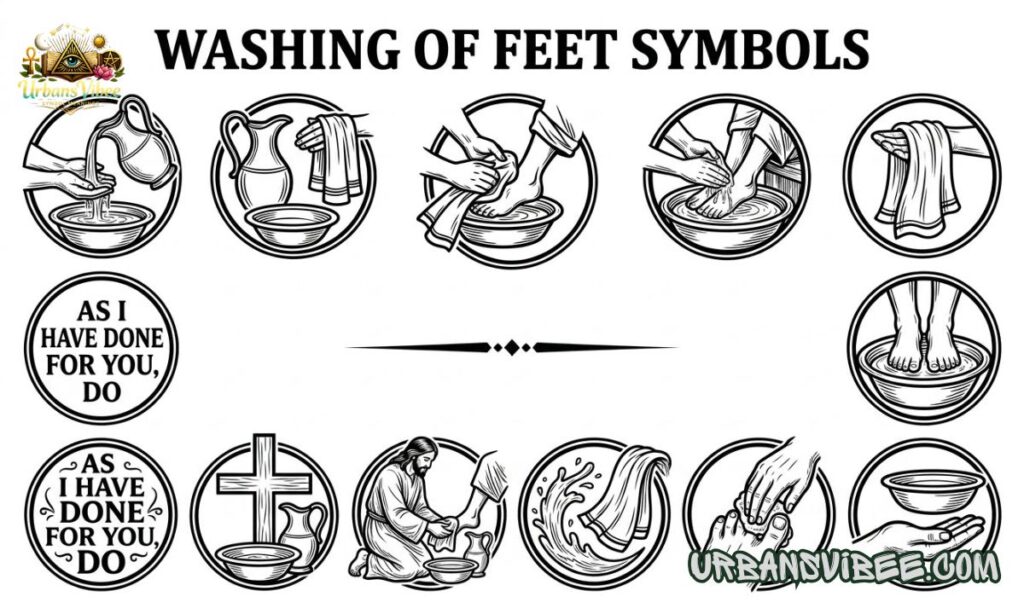
Jesus Washing Feet Holy Thursday Symbols
When Jesus washed the feet of his disciples, he encoded several layers of meaning in a single act:
- Humility — the greatest act of service from the greatest person in the room
- Purification — cleansing from sin, connected symbolically to baptismal water
- Servant leadership — the model for all who would lead in his name
- Love made visible — not love as an idea but love as a physical, kneeling act
- The New Commandment — this act was the demonstration of “love one another as I have loved you”
The act has also come to symbolize the cleansing of sin from fellow Christians — Jesus’s new commandment was urging his disciples to show forgiveness to all. Today, this act is reenacted during Holy Thursday services worldwide, with priests washing the feet of parishioners in living memory of that night.
Deep Symbolic Meaning
Holy Thursday is layered with meaning at every level — liturgical, theological, and human. There is such an abundance of symbolism in the solemn celebration of the events of Holy Thursday layer upon layer that we can no more than hint at it in these few words.
What makes Holy Thursday symbols particularly powerful is that they are not abstract. They are enacted. The bread is broken. The feet are washed. The altar is stripped. These are physical, embodied actions that carry their meaning in the body, not just the mind.
Types / Variations of Holy Thursday Symbols
The Bread and Wine
Bread and wine are the oldest and most universal symbols of Holy Thursday. They appear on the altar at every Mass, but on Holy Thursday their origin is specifically commemorated. Unleavened bread — the same type eaten at the Jewish Passover — connects the Last Supper to the Exodus story. The wine in the chalice recalls the cups of the Passover Seder.
Together, bread and wine say: I am giving you everything. My body is broken for you. My blood poured out for you. No symbol in Christianity is more central than this one.
The Basin and Towel
The basin (bowl of water) and the towel Jesus used to dry his disciples’ feet are among the most intimate symbols in Christian theology. They represent a God who kneels. A leader who serves. A Lord who gets his hands dirty out of love.
In many churches, these objects are prominently displayed or used on Holy Thursday evening. Some parishes place an actual basin and towel near the altar as a visual reminder of what this night means before the foot-washing ceremony begins.
The Chalice
The chalice — the cup used by Jesus at the Last Supper — is one of the most recognized symbols in all of Christianity. The loop symbolizes the womb or eternal spirit, while the cross represents physical existence. In the chalice’s case, the cup holds what Christ called his blood — the New Covenant sealed not in the blood of animals, as in the Old Testament, but in the blood of God himself.
The chalice also carries undertones of suffering. In the Garden of Gethsemane, just hours after the Last Supper, Jesus prayed: “Let this cup pass from me.” The chalice is both gift and cost.
The Twelve Disciples
The presence of twelve disciples at the Last Supper is itself symbolic. Twelve corresponds to the twelve tribes of Israel — Jesus was deliberately reconstituting Israel around himself, establishing a new covenant community. When the priest washes the feet of twelve people on Holy Thursday, he ceremonially washes the feet of 12 people in memory of Christ’s washing the feet of his disciples.
Twelve also points to completeness and divine order. The community gathered around the table is the full representation of the new people of God.
The Stripped Altar
Perhaps the most dramatic symbol of Holy Thursday is the one that happens after Mass ends. All linens, candles, and portable crosses are removed from all altars and side chapels. Unmovable crosses are veiled in red or violet. No votive candles or lamps burn again until the singing of the Gloria at the Easter Vigil.
A stripped altar is a shocking thing to see. The church suddenly looks bare, even desolate. This is entirely intentional. The altar is stripped, lit candles remain the only source of light, and incense is used to prepare the Church for the upcoming procession of the Eucharist. The stripping visually enacts Christ’s abandonment — his arrest, his being stripped of his garments, his utter vulnerability in the hours that follow.
Holy Thursday Symbols Across Cultures
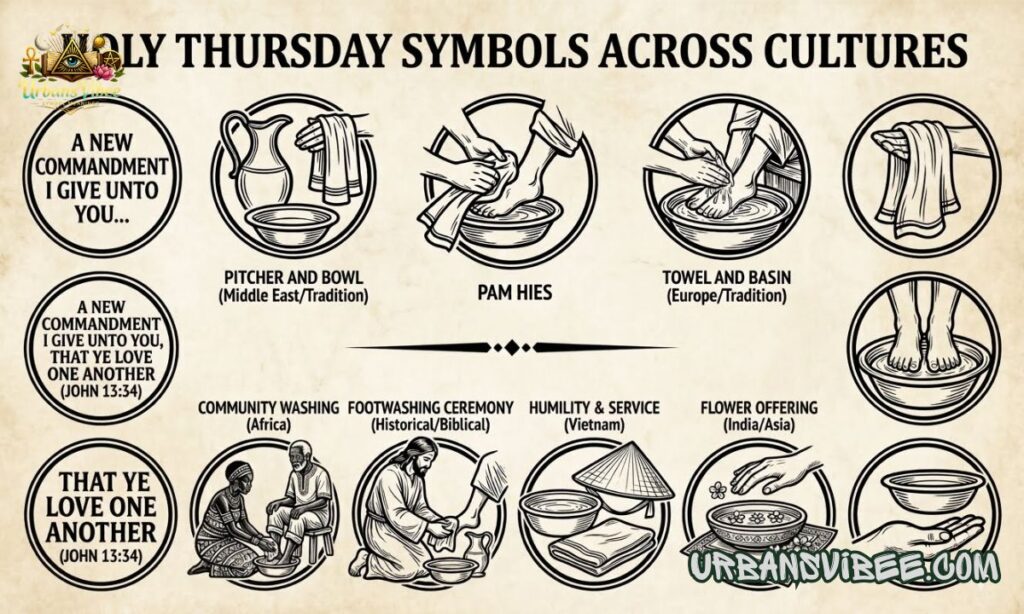
Holy Thursday is observed across diverse Christian traditions, each bringing its own cultural expression to the same core symbols.
- In Roman Catholic tradition, the day is anchored in the evening Mass of the Lord’s Supper, the Chrism Mass in the morning, the foot-washing ceremony, and the procession of the Eucharist to the Altar of Repose.
- In Eastern Orthodox tradition, Holy Thursday (called Great and Holy Thursday) includes a foot-washing ceremony performed by the bishop, often in an open square for the entire congregation to witness.
- In Anglican and Protestant traditions, the day is known as Maundy Thursday. The British Royal Maundy service dates back centuries — in the United Kingdom, the Royal Maundy service involves the Monarch offering “alms” to deserving senior citizens — one man and one woman for each year of the sovereign’s age, distributed in red and white purses.
- In Germany, the day is called Gründonnerstag (Green Thursday), with a tradition of eating green vegetables to mark the completion of Lenten penance. The color green symbolized the new life that was coming with Easter.
- In the Philippines, Holy Thursday is part of the Semana Santa — a deeply emotional Holy Week featuring elaborate street processions, the Visita Iglesia (visiting seven churches for prayer), and communal fasting.
- In Latin America, Holy Thursday processions often fill the streets with people bearing candles, statues of Christ, and representations of the Last Supper.
Holy Thursday Symbols in Art, Movies and Pop Culture
Holy Thursday’s symbols — especially the Last Supper — have produced some of the most iconic images in the history of human civilization.
Leonardo da Vinci’s The Last Supper (1495–1498) is the most recognized painting in the world connected to Holy Thursday. Every detail is symbolic: the triangular groupings of disciples, Judas clutching his bag of silver, the bread and wine on the table, the window of light behind Jesus.
In film, the Last Supper has been depicted in The Passion of the Christ (2004), Jesus of Nazareth (1977), and The Young Messiah (2016). Each film uses Holy Thursday’s symbols to draw audiences into the intimacy of that final evening.
In pop culture, the Last Supper composition has been recreated and referenced in countless works — from Andy Warhol’s Last Supper series to parody versions in advertising and social media. The power of the image is so strong that even secular culture reaches for it when it wants to convey betrayal, sacrifice, or a final gathering.
Holy Thursday tattoos are chosen by believers to carry the day’s core symbols on their bodies — the chalice, the bread and fish, the basin and towel, the words “Do this in memory of me.” These tattoos mark the wearer as someone shaped by the meaning of that night.
Spiritual and Dream Meaning of Holy Thursday Symbols
In spiritual reflection and dream symbolism, the images of Holy Thursday carry specific meanings:
- Dreaming of bread being broken — an invitation to share yourself generously with others; a season of self-giving is at hand
- Seeing a chalice in a dream — a call to accept both the gifts and the costs that come with your calling
- Washing someone’s feet in a dream — an invitation to humble service; a prompt to lay down pride in a relationship
- A table set for many — community, belonging, a time of gathering and nourishment approaching
- A bare, empty altar — a season of stripping away what is unnecessary; something is being cleared to make room for resurrection
- A candle being extinguished — the need to sit in darkness before light returns; a period of waiting is spiritually productive
Positive vs Negative Meaning
| Symbol | Positive Meaning | Shadow or Difficult Meaning |
| Bread and wine | Nourishment, divine presence, communion | The cost of the body broken and blood poured out |
| Foot washing | Humility, love, servant leadership | The discomfort of being served; accepting help is hard |
| The chalice | The gift of the New Covenant | “Let this cup pass from me” — the cup of suffering |
| Twelve disciples | Completeness, community, the new Israel | One of the twelve will betray; trust is not always returned |
| Stripped altar | Preparation, simplicity, vulnerability | Abandonment, desolation, the silence before grief |
| The Garden vigil | Faithful waiting, solidarity with Christ | The disciples fell asleep; we often fail at the hardest moments |
Why Humans Are Attracted to This Symbol
People are drawn to Holy Thursday symbols because they deal honestly with the deepest human experiences: love, betrayal, sacrifice, and the desire to be remembered.
The Last Supper is not a symbol of religious triumph. It is a symbol of a man who knew he was about to be betrayed — and still sat down to eat with the person who would betray him. Still washed the feet of those who would abandon him. Still gave everything he had before anyone took anything from him.
That combination of love and vulnerability is almost unbearable in its beauty. It speaks to something in every human being who has ever loved someone they knew might let them down. It speaks to every person who has ever served without guarantee of return.
The symbols of Holy Thursday are not merely religious. They are mirrors of the human condition at its most honest.
Conclusion
Holy Thursday is not a single event. It is an entire theology compressed into one evening — and every symbol from that night still speaks. The bread broken. The cup passed. The feet washed. The altar stripped. The garden vigil begun.
These are not just memories of something that happened two thousand years ago. They are living symbols, re-enacted every Holy Thursday in churches across the world, because the truths they carry are still urgently needed: that love serves without condition, that sacrifice is the price of new life, and that the most important thing any person can do is show up at the table and give what they have.
Frequently Asked Questions
What is the main symbol of Holy Thursday?
The Eucharist — the bread and wine consecrated at the Last Supper — is the primary and most enduring symbol of Holy Thursday, instituted by Christ on this night.
Why is Holy Thursday called Maundy Thursday?
“Maundy” comes from the Latin mandatum (commandment), referring to Christ’s words: “I give you a new commandment — love one another as I have loved you” (John 13:34).
What does the foot washing symbolize on Holy Thursday?
The foot washing symbolizes humility, servant leadership, and the cleansing of sin — Jesus demonstrated that true love means serving others without regard for status.
What happens to the altar on Holy Thursday?
After Mass, the altar is completely stripped of all linens, candles, and decorations — a powerful symbol of Christ’s abandonment, arrest, and vulnerability in the hours that followed.
What is the significance of the chalice on Holy Thursday?
The chalice represents the cup of the New Covenant — filled with wine that Jesus called his blood, poured out for the forgiveness of sins and the sealing of a new relationship between God and humanity.
What is the Altar of Repose?
The Altar of Repose is the side chapel or sacred space where the Eucharist is transferred after the Holy Thursday Mass, where the faithful pray in vigil through the night — imitating the disciples’ watch with Jesus in the Garden of Gethsemane.
What color is worn on Holy Thursday?
White vestments are worn by the priest on Holy Thursday, symbolizing joy and the holiness of the feast being commemorated — the institution of the Eucharist and the priesthood.
What are the twelve disciples symbolic of at the Last Supper?
The twelve disciples represent the twelve tribes of Israel — Jesus was establishing a new covenant community, and the number twelve signifies completeness and divine order.

Stephen Miller is a language enthusiast and symbol researcher at UrbansVibee. He specializes in uncovering the meanings, origins, and cultural significance of symbols, helping readers understand signs, icons, and symbolism from around the world.