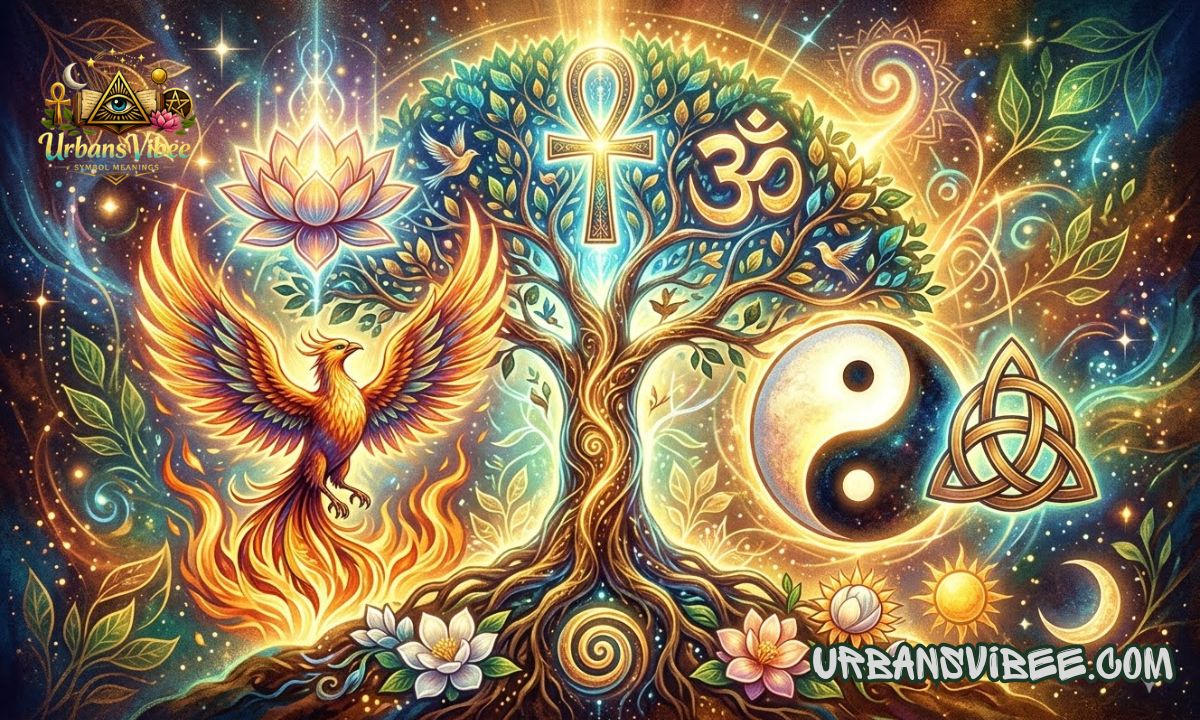
Life symbols carry thousands of years of human wisdom, emotion, and culture in a single image. Every civilization — from ancient Egypt to Celtic tribes to Eastern empires — created symbols to capture what words alone could never fully explain: the meaning of being alive.
In this guide, you will explore 89+ powerful life symbols and their deep meanings, including their origins, spiritual significance, and cultural stories. Whether you are searching for a meaningful tattoo, studying symbolism, or simply curious about the language of life — this article will genuinely shift how you see the world around you.
What Are Life Symbols?
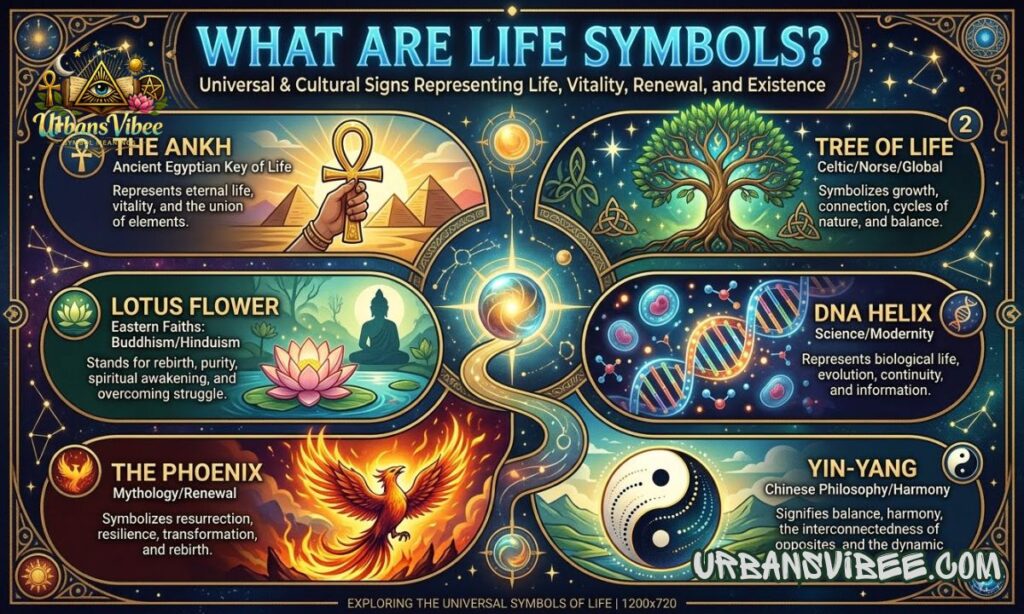
Life symbols are special signs, images, or objects that represent the concept of existence, growth, renewal, and the journey of living. They are found in every culture across every time period.
A life symbol can be:
- A shape (like a circle or spiral)
- A natural object (like a tree or flower)
- A mythical creature (like a phoenix)
- An ancient hieroglyph (like the Ankh)
People use life symbols in art, jewelry, tattoos, architecture, and spiritual practice. They help us express what words sometimes cannot — the beauty, mystery, and meaning of being alive.
Life Symbols and Meanings
Every life symbol carries layers of meaning. On the surface, a symbol may look simple. But underneath, it holds stories of civilizations, beliefs, and human experiences passed down for generations.
Here is a quick overview of some of the most widely recognized life symbols and what they mean:
| Symbol | Core Meaning | Origin |
| Tree of Life | Growth, connection, eternity | Universal |
| Ankh | Eternal life, immortality | Ancient Egypt |
| Infinity Symbol | Endless existence | Mathematics / Spiritual |
| Lotus Flower | Rebirth, purity | Eastern cultures |
| Phoenix | Resurrection, transformation | Greek / Egyptian |
| Spiral | Growth, personal development | Celtic / Indigenous |
| Circle | Cycle of life, wholeness | Universal |
| Butterfly | New beginnings, freedom | Global |
| Scarab Beetle | Renewal, resurrection | Ancient Egypt |
| Ouroboros | Eternal cycle of life and death | Greek / Egyptian |
Tree of Life Symbols
The Tree of Life is one of the oldest and most universal life symbols in human history. It appears in Celtic culture, Norse mythology, Christianity, Judaism, and ancient Mesopotamia.
The image shows a large tree with deep roots stretching into the earth and wide branches reaching toward the sky. This design is not just beautiful — it carries powerful meaning.
Tree of Life Symbols and Meanings
- Roots — Connection to the earth, our ancestors, and the past
- Trunk — Strength, stability, and personal growth
- Branches — Reaching toward new possibilities, the divine, and the future
- Leaves — Individual lives within the greater whole of existence
The Tree of Life also represents the four elements — earth, water, air, and fire — which are considered essential for all life. In Celtic tradition, the tree was so sacred that cutting one down was considered a great offense. In Norse mythology, it is called Yggdrasil — the World Tree that connects all realms of existence.
Eternal Life Symbols
Eternal life symbols focus on the idea that existence does not end at death. It simply transforms. These symbols have brought comfort to people across centuries.
The most powerful eternal life symbols include:
- The Ankh — the Egyptian key of life and immortality
- The Ouroboros — a serpent eating its own tail, representing the endless cycle
- The Circle — no beginning, no end
- The Infinity Symbol (∞) — limitless existence
- The Phoenix — dying and rising again from its ashes
Symbols of Life
What Symbolizes Life?
Almost anything in nature can symbolize life. But certain symbols have stood the test of time across cultures because they capture the universal experience of being alive. Water symbolizes renewal and the flow of life. The sun represents energy and the life force that allows all beings to grow. Seeds represent potential — life waiting to begin.
Symbol of Life Meaning
At its core, a symbol of life points to three things: existence, growth, and continuity. Whether it is a tiny seed or a giant tree, a sunrise or a flame — the most powerful life symbols remind us that living is precious, temporary, and worth celebrating.
Symbol for Change in Life
Change is one of the most significant parts of human existence. Several symbols have come to represent transformation and change:
- Butterfly — the most widely known symbol of life change and transformation
- Phoenix — radical change through destruction and rebirth
- Spiral — gradual, continuous growth and evolution
- Chrysalis — the quiet period before major transformation
- River — constant movement, never the same water twice
Symbols That Have Deep Meaning
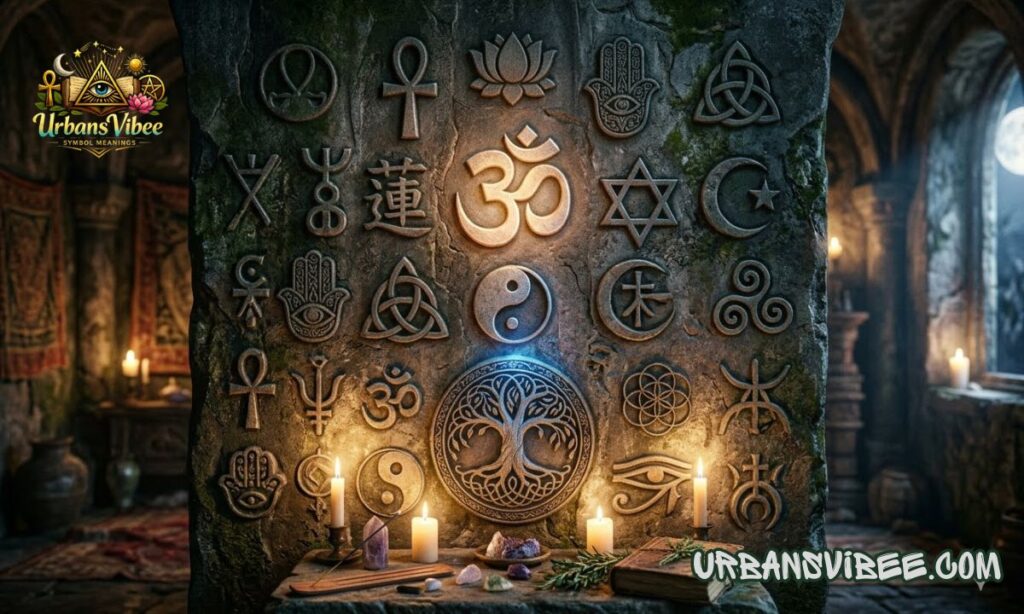
Some symbols carry meaning so deep that even a brief glance at them can trigger reflection. These include:
- The Yin-Yang — balance between opposites in all things
- The Mandala — wholeness and the cosmic order of the universe
- The Hamsa Hand — protection and the power of divine blessing
- The Eye of Horus — protection, royal power, and spiritual sight
- The Seed of Life — the origin of all creation from a single source
Things That Represent Life
Life is represented not only in symbols but also in objects, animals, and nature itself:
- Mountains — strength and the challenge of growth
- Rivers — constant change and forward movement
- Fire — passion, energy, and the life force within
- Eggs — new beginnings and the potential for life
- Sunrise — hope, fresh starts, and the return of light
Greek Life Symbols
Ancient Greek culture gave us some of the most enduring life symbols still used today.
The Ankh-Style Cross (Sometimes Confused)
While the Ankh is Egyptian in origin, it was adopted and celebrated in Greek-influenced Egypt during the Ptolemaic period. Greeks used the cross form in various spiritual and philosophical contexts.
The Greek Key (Meander)
This repeating wave pattern carved into Greek temples represents the eternal flow of life and the infinite nature of existence. It symbolizes the endless journey of the human spirit.
The Owl
The owl is the symbol of Athena — the goddess of wisdom. In Greek culture, the owl represents the deeper meaning beneath the surface of life, the wisdom to see through darkness.
The Olive Branch
One of the most peaceful Greek life symbols. It represents peace, new beginnings, and hope. Even today, the olive branch is used globally as a symbol of reconciliation and fresh starts.
Spiritual Life Symbols and Meanings
Lotus Flower
The lotus grows from muddy water but blooms into a beautiful flower. This makes it one of the most powerful spiritual symbols of purity, rebirth, and rising above difficult circumstances. In Hinduism and Buddhism, it represents enlightenment and the journey toward spiritual awakening.
Tree of Life
Spiritually, the Tree of Life connects heaven and earth. It represents the relationship between the physical world and the divine. Many spiritual traditions see it as a map of the soul’s journey.
Infinity Symbol
The infinity symbol carries spiritual meaning beyond mathematics. It represents eternal love, endless divine presence, and the idea that the soul is timeless. Many people wear it as a reminder that certain connections never truly end.
Spiral
In spiritual traditions, the spiral represents the journey inward toward the self. It also shows the continuous nature of growth — we always return to the same themes in life, but at a deeper level each time.
New Life Symbols
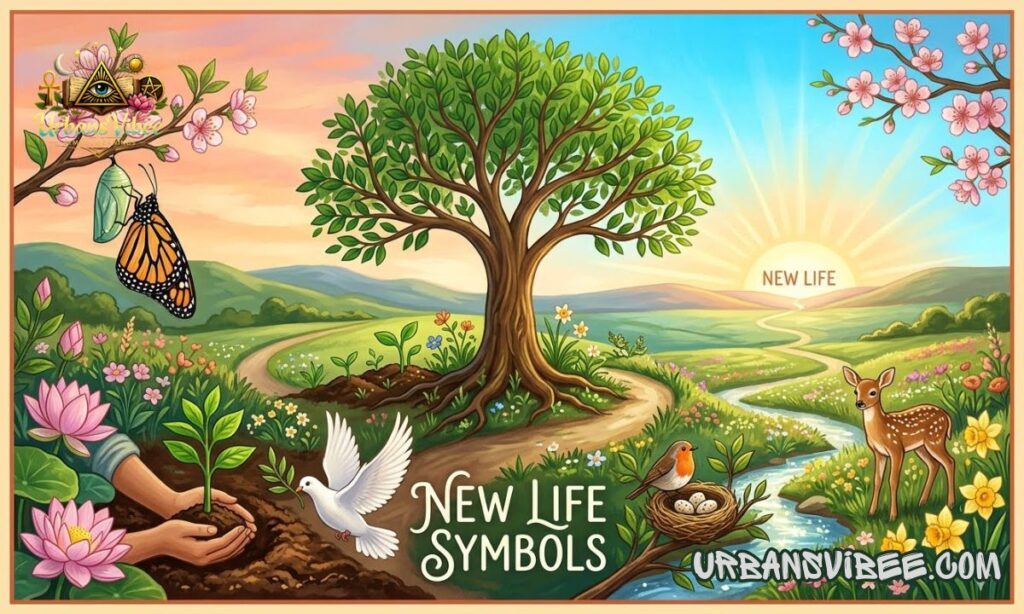
New beginnings deserve their own category of symbols. These are the signs of fresh starts and transformation:
Butterfly
The butterfly is a universal symbol of new life. A caterpillar that transforms into a butterfly mirrors the human journey — from limitation to freedom. Many people release butterflies at weddings and memorial ceremonies to mark new chapters.
Sunrise
Each sunrise is proof that darkness ends and light returns. It is one of nature’s simplest and most powerful symbols of new beginnings.
Egg
An egg holds life within it before it is ready to emerge. It symbolizes potential, creation, and the beginning of something new.
Phoenix
The Phoenix is a mythical bird that lives for hundreds of years before bursting into flames. From the ashes, it rises again as a completely new Phoenix. This makes it the ultimate symbol of radical new beginnings born from endings.
Base 12 Eternal Life Symbols
The number 12 appears repeatedly in systems connected to eternal life — 12 months in a year, 12 zodiac signs, 12 apostles. In sacred geometry and ancient wisdom traditions, base-12 systems represent completeness and the full cycle of existence.
Egyptian Life Symbols
Ancient Egyptians were deeply obsessed with life, death, and what comes after. Their symbols reflect a sophisticated understanding of the cycle of existence.
The Ankh
The Ankh is the most recognized Egyptian life symbol. It is a cross with a loop at the top, often called the “key of life.” It represents eternal life, immortality, and the life-giving power of the gods. It appeared on temple walls, tombs, jewelry, and in the hands of gods and pharaohs throughout Egyptian art.
The Scarab Beetle
The scarab beetle was a sacred symbol in ancient Egypt. Egyptians observed dung beetles rolling balls of dung across the sand and saw in this act a metaphor for the sun being rolled across the sky. This observation led them to associate the scarab with rebirth, resurrection, and transformation. Scarab amulets were placed on mummies to protect the heart during judgment in the afterlife.
The Djed Pillar
Known as the “backbone of Osiris,” the Djed Pillar represents stability, strength, and endurance. It is closely connected to Osiris — the god of the afterlife — and symbolizes resurrection and eternal life. The annual “Raising of the Djed” ceremony was a major Egyptian festival celebrating cosmic renewal.
The Eye of Horus
The Eye of Horus is one of the most powerful protective symbols in Egyptian culture. It represents protection, royal power, and good health. It was used as an amulet to ward off evil and bring safety to both the living and the dead.
Life Symbols Across Cultures
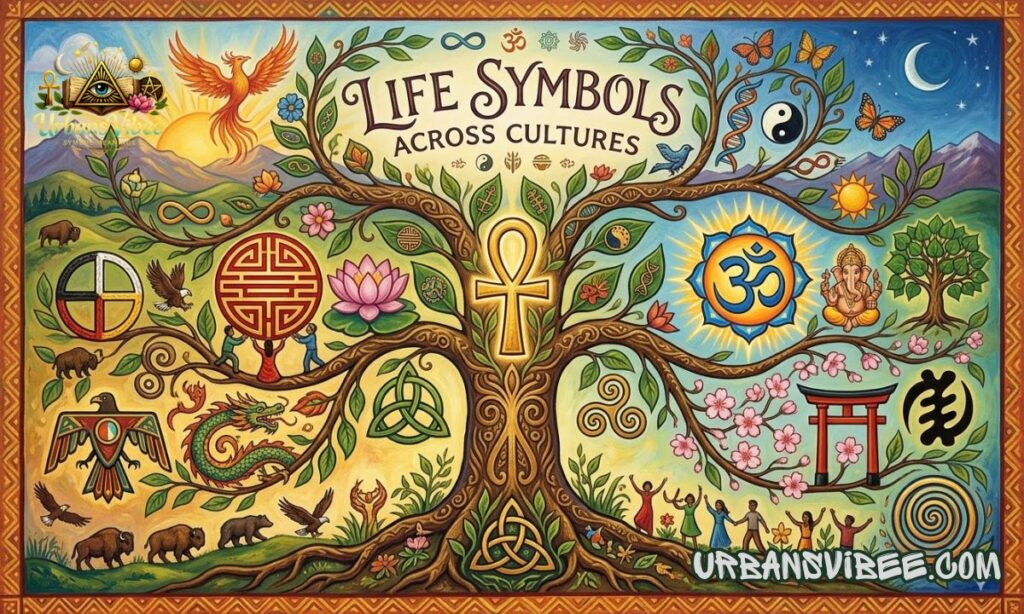
Life symbols are not confined to one place or one time. They appear everywhere humans have ever lived.
Ancient Egypt
Egypt gave us the Ankh, the Scarab, the Djed Pillar, and the Eye of Horus — symbols that still resonate globally thousands of years later.
Celtic Culture
The Celts celebrated the Tree of Life, the Spiral, and the Triquetra (three interlocking arcs representing life, death, and rebirth). Nature was sacred and alive with meaning in Celtic belief.
Eastern Cultures
In Hinduism and Buddhism, the Lotus Flower, the Mandala, and the Om symbol represent spiritual life, enlightenment, and the eternal nature of the soul.
Greek Mythology
Greek culture contributed the Olive Branch, the Owl, and mythological creatures like the Phoenix to the global language of life symbols.
Native American Culture
The Medicine Wheel and the Labyrinth (also called the “life maze”) represent life’s journey and the cycles of existence. The Hopi people use a labyrinth-like symbol called the “life-labyrinth” which shows how life sometimes feels like a maze — and that there is always a path through it.
Life Symbols in Art, Movies and Pop Culture
Movies
Life symbols appear constantly in film. The Lion King’s “Circle of Life” draws on the idea of continuous cycles. The Phoenix appears in Harry Potter. The Tree of Life features in Terrence Malick’s philosophical film of the same name.
Paintings
Artists from ancient cave painters to modern illustrators have used life symbols to communicate meaning beyond words. Gustav Klimt’s “The Tree of Life” is one of the most famous examples.
Tattoos
Tree of Life tattoos and Infinity symbol tattoos rank among the most requested tattoo designs globally. People choose these to carry life’s meaning on their skin permanently.
Fashion and Jewelry
Ankh pendants, infinity bracelets, and lotus earrings are popular worldwide. Wearing a life symbol is a way of carrying its meaning close — a personal talisman for daily life.
Spiritual and Dream Meaning of Life Symbols
When life symbols appear in dreams or meditation, they often carry messages from the subconscious or the spiritual realm. Psychologists like Carl Jung believed that symbols are the language of the unconscious mind.
- Dreaming of a Tree of Life — may reflect personal growth or a need for deeper roots
- Dreaming of a Phoenix — often signals that you are recovering from emotional difficulty
- Dreaming of a Lotus — suggests spiritual awakening or rising above a challenge
- Dreaming of a Spiral — points to a period of significant personal transformation
Positive and Negative Meaning of Life Symbols
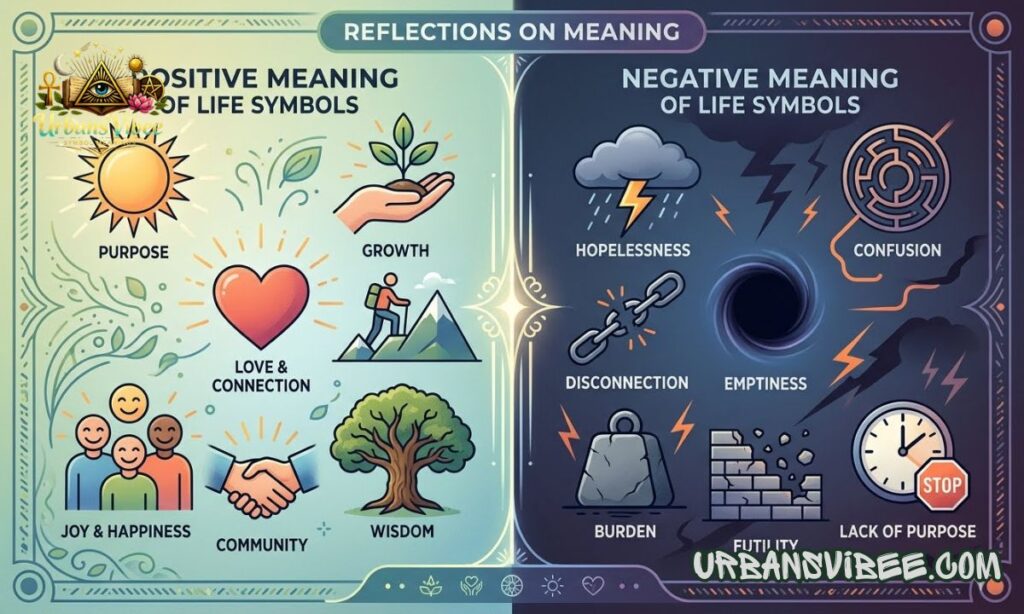
Life symbols carry both light and shadow because life itself contains both.
Positive Meaning
- Growth and personal development
- Hope, renewal, and new beginnings
- Connection to something greater than the self
- Eternal love and spiritual continuity
Negative Meaning
- The Phoenix represents destruction before rebirth — reminding us that endings are necessary
- The Ouroboros can also represent being trapped in cycles that repeat without growth
- The Skull, sometimes paired with life symbols, reminds us of mortality and impermanence
This duality is not a weakness of life symbols. It is their greatest strength — they hold the full truth of existence.
Why Humans Are Attracted to Life Symbols?
Human beings are meaning-making creatures. Viktor Frankl, a psychiatrist and Holocaust survivor, wrote that our primary drive is not pleasure but the search for meaning. Life symbols answer that search without requiring a single word.
Symbols help the brain process complex emotional experiences. They give us a way to talk about things that feel too big for language — love, death, transformation, hope. When someone survives something difficult and gets a Phoenix tattoo, they are not just decorating their body. They are telling the story of their survival in the oldest human language there is.
We are drawn to life symbols because they remind us of what matters most.
Conclusion
Life symbols are far more than decorative patterns. They are the shared visual language of humanity — created by cultures separated by oceans and centuries, yet remarkably similar in what they say. The Tree of Life, the Ankh, the Lotus Flower, the Phoenix — these are not just beautiful images. They are maps of the human experience.
Understanding life symbols does not require being religious or spiritual. It simply requires being curious about what it means to be alive. And that curiosity, in itself, is one of the most human things there is.
Whether you wear a symbol, place one in your home, or simply recognize one in art — you are participating in a tradition as old as human consciousness itself.
Frequently Asked Questions
What is the most powerful symbol of life?
The Ankh from ancient Egypt is widely considered the most powerful symbol of life. It represents eternal life, immortality, and the life-giving power of the divine.
What symbol represents new life and new beginnings?
The butterfly and the sunrise are the most widely recognized symbols of new life, followed closely by the Phoenix for radical transformation and rebirth.
What does the Tree of Life symbolize?
The Tree of Life symbolizes growth, strength, connection between heaven and earth, and the eternal cycle of birth, death, and rebirth. It appears in nearly every major world culture.
What is the Egyptian symbol for life?
The Ankh is the primary Egyptian symbol for life. The Scarab Beetle, Djed Pillar, and Eye of Horus are also key Egyptian life symbols.
What symbolizes eternal life?
The Ankh, the Infinity Symbol, the Circle, the Ouroboros (serpent eating its tail), and the Phoenix are the most recognized symbols of eternal life across different cultures.
What does the Lotus Flower symbolize?
The Lotus Flower symbolizes purity, rebirth, and spiritual awakening. It grows from muddy water and blooms beautifully, representing the ability to rise above difficult circumstances.
What is the symbol for change in life?
The Butterfly is the most universal symbol for change in life. The Phoenix represents radical transformation. The Spiral represents gradual, continuous growth.
Are life symbols religious?
Many life symbols originate in religious traditions, but they are widely used outside of religion as well. Symbols like the infinity sign, spiral, and tree of life carry meaning for people of all beliefs and none.
What do life symbols mean in tattoos?
In tattoos, life symbols carry personal meaning for the wearer — often representing a significant experience, value, or belief. Tree of Life and Infinity tattoos are among the most popular life symbol tattoo choices globally.
What is the Greek symbol for life?
The Greek Key (Meander) represents the eternal flow of life. The Olive Branch symbolizes peace and new beginnings. The Owl represents wisdom and deeper perception of life’s meaning.

Stephen Miller is a language enthusiast and symbol researcher at UrbansVibee. He specializes in uncovering the meanings, origins, and cultural significance of symbols, helping readers understand signs, icons, and symbolism from around the world.