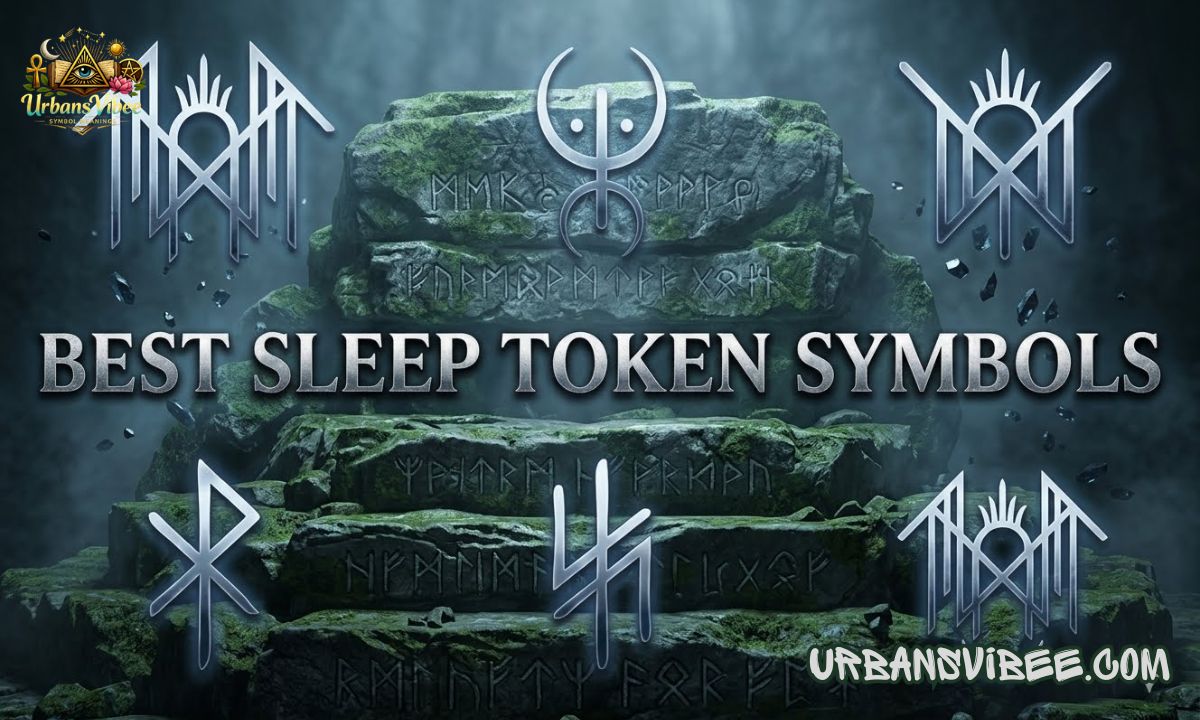
There is a band performing right now that has never shown its face. Their lead singer calls himself Vessel. The others have no names — just numbers. They wear masks, paint their arms black, and offer their music to a mysterious entity called Sleep.
And every single thing they do — every image, every sigil, every carved symbol on every album cover — means something.
Sleep Token’s symbol system is one of the most layered and obsessively studied in modern music. Fans spend hours decoding their runes. Researchers trace their origins to Elder Futhark alphabets, medieval alchemical texts, and occult grimoires. Artists recreate them in tattoos that will last a lifetime.
This is the complete guide to Sleep Token symbols — where they come from, what they mean, and why they have captivated millions of people around the world.
What Are Sleep Token Symbols?
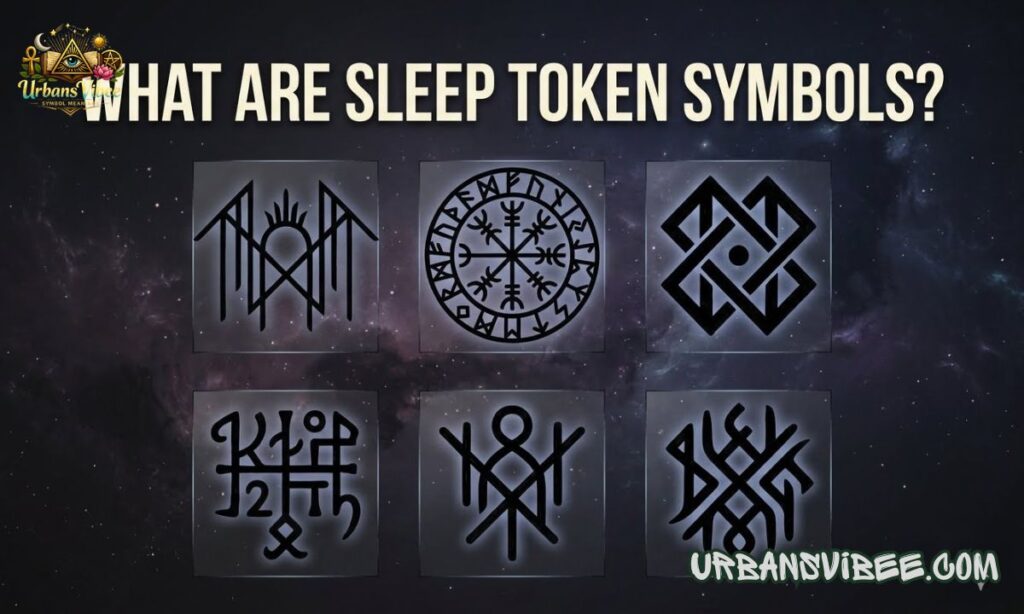
Sleep Token symbols are the collection of sigils, runic letters, bind runes, and visual emblems that form the band’s sacred visual language. They function almost like an ancient script built specifically for a modern mythology.
The band presents itself as followers of a mysterious deity called “Sleep,” and Vessel acts as the human conduit — the offering-bearer — between the mortal world and this entity. Every symbol reinforces this mythology. None of it is random decoration. Each mark is part of a deliberate, deeply considered symbolic system that spans their entire discography.
Understanding Sleep Token Symbols And Their Hidden Meaning
Sleep Token symbols operate on multiple levels at once. On the surface, they are striking visual designs that function as logos, song identifiers, and merchandise imagery. At a deeper level, they encode lore, emotion, and meaning in the same way ancient sacred scripts were designed to do.
The band deliberately keeps official explanations minimal, allowing fans to interpret and discover meaning themselves. This is not an accident — it is the entire point. As with everything Sleep Token, interpretation remains in the eye of the beholder.
Sleep Token Symbol
The primary Sleep Token symbol — the central logo — is a geometric, symmetrical emblem that has evolved across albums. At first glance it looks abstract: straight lines, an arch, a crown-like structure at its top. But look more carefully and runic letters begin to emerge from within the design.
The current iconic logo and many of the band’s visuals were created by Daniel Owen of Nemesis Design, a UK-based illustrator known for occult-inspired work. The logo’s core design has remained minimalist — primarily black, white, or grey — emphasizing duality and timelessness.
Sleep Token Symbols Meaning
The overarching meaning encoded in Sleep Token’s symbols circles around themes of:
- Devotion — surrendering the self to something greater
- Sacrifice — the cost of serving a god or higher purpose
- Transformation — death of the ego, emergence of something new
- Duality — the tension between light and dark, Vessel and Sleep, human and divine
- Eternal cycles — sleep, waking, death, renewal
What Do The Sleep Token Symbols Mean
No single definitive translation exists — and the band has deliberately maintained this ambiguity. What makes the symbols so compelling is that each one rewards a different reading. A symbol that means “sacrifice” to one fan means “devotion” to another. This layered quality is part of what makes Sleep Token’s symbolic system so enduring.
Sleep Token Runes, Sigils And Symbol System Explained
Sleep Token’s symbol system draws from several distinct historical and esoteric traditions, combined and remixed into something entirely their own.
Sleep Token Runes
The foundation of Sleep Token’s visual language is Elder Futhark — the oldest extant runic alphabet, used by ancient Scandinavian and Germanic tribes. The band’s logo, from the original to the iconic one seen today, can be deconstructed into individual Elder Futhark runes.
Key runes identified within the logo include:
| Rune | Elder Futhark Symbol | Core Meaning |
| Dagaz | ᛞ | Transformation, breakthrough, new dawn |
| Tiwaz | ᛏ | Justice, self-sacrifice, warrior’s purpose |
| Uruz | ᚢ | Raw energy, endurance, formation |
| Eihwaz | ᛇ | Death, rebirth, the axis between worlds |
| Sowilo | ᛋ | Victory, the sun, life force |
| Wunjo | ᚹ | Joy, harmony, kinship |
| Nauthiz | ᚾ | Need, constraint, the necessity of struggle |
In the bind rune interpretation, the logo is built from four runes: Tiwaz, Nauthiz, Wunjo, and Uruz, combined into one half of the mask design. When that half is mirrored, the full logo emerges. Within rune lore, mirroring often suggests an inversion — a symbolic play on the duality between Vessel and Sleep, a recurring motif throughout Sleep Token’s mythology.
Sleep Token Sigil
A sigil is a symbol created with specific intent — designed to carry a compressed meaning or magical charge. Sleep Token’s sigils are among the most discussed in fan communities worldwide.
The sigils for the Sundowning singles were created by Nemesis Designs. They integrate elements from Elder Futhark runes, alchemical symbols, and possibly characters inspired by the Ars Goetia — a 17th-century grimoire cataloguing demon sigils. Together they form composite symbols where each element adds a layer of meaning to the song it represents.
Sleep Token Sigil Meaning
Take the sigil for “The Offering” as an example. It contains the alchemical symbol for a chalice or crucible and the symbol for fumes or smoke — suggesting something being burned as a ritual sacrifice. This meaning is confirmed in the song itself, where Vessel sings about offering, sacrifice, and giving in the name of Sleep.
The sigil for “Dark Signs” is more complex. One of its individual components refers to “sublimation” — the phenomenon of witnessing something that challenges the limits of human comprehension. The symbol and the song both point toward a confrontation with the incomprehensible.
Sleep Token Symbols Alphabet
For Take Me Back to Eden (2023), Sleep Token revealed an entirely new layer of their symbolic system: a proprietary cipher alphabet — sometimes called the Eden Rune Alphabet by fans. Each rune in this system directly corresponds to one of the 26 letters of the modern English alphabet, allowing song titles and messages in artwork to be decoded.
The letters were slowly revealed through social media posts and single releases throughout the album campaign. However, even after the album’s release on May 19, 2023, some letters remained unknown — specifically J, X, and Z — keeping the sense of mystery deliberately intact.
Sleep Token Symbols Translation
Fans have largely decoded the Eden Rune Alphabet and created translation charts. Using these charts, hidden messages in Sleep Token’s artwork can be read in English. Many fans share these translations on Reddit, Discord, and dedicated wikis, creating a community of symbolic archaeologists constantly uncovering new layers.
Sleep Token Symbols In Songs, Albums And Media
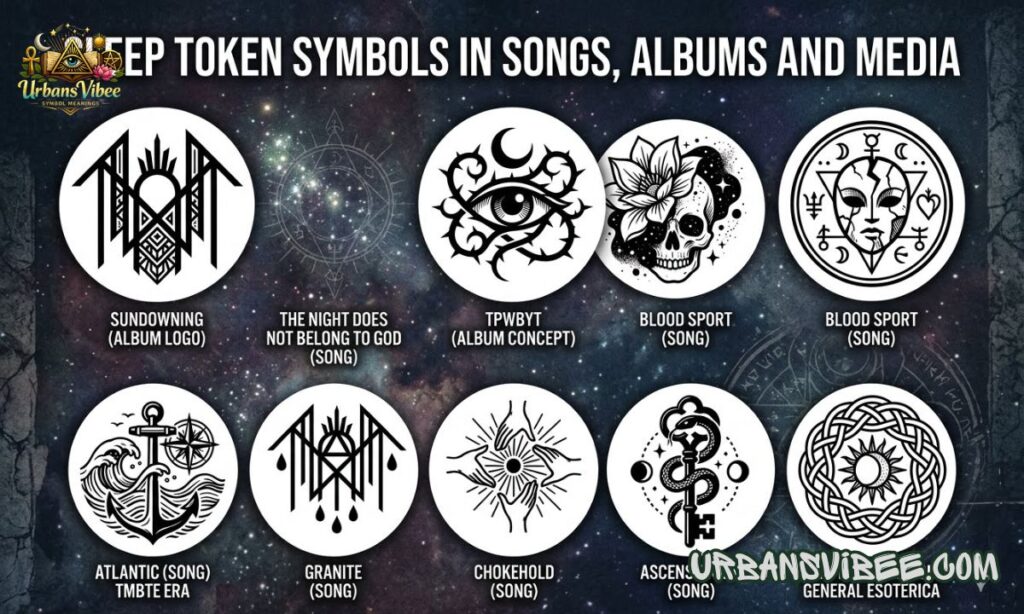
Each Sleep Token album has its own distinct visual symbol system, evolving from one era to the next.
Sleep Token Sundowning Symbols
Sundowning (2019) established the template. Every song is represented by a unique sigil — a series of interconnected shapes, often lines, triangles, and circles — arranged on the album artwork in a clock-face pattern, with each sigil at a different hour of the clock.
The Sundowning sigils draw from Elder Futhark runes, Enochian letters (an occult language), alchemical symbology, and Ars Goetia demon sigils. The clock arrangement is itself a symbol: time, cycles, the inevitability of endings. Sundowning — the disorientation that comes with fading light — is encoded in every element of the album’s visual identity.
Sleep Token Symbols Take Me Back To Eden
Take Me Back to Eden (2023) introduced the proprietary cipher alphabet and a new visual language: fantasy avatar characters created by Alex Tillbrook, styled after video games like Destiny and Elden Ring. Each song received its own character — a warrior, a spirit, a divine figure — reinforcing the album’s themes of conflict, loss, and spiritual yearning.
The album’s symbols are steeped in references to Eden — paradise lost, the desire to return to an original state of wholeness, and the pain of knowing that return is impossible.
Sleep Token Symbols Even In Arcadia
Even In Arcadia (2025) continued the pattern of per-song visual identities, this time using heraldic crests — coats of arms featuring weapons on shields decorated with specific flowers. Each weapon and each flower carries meaning connected to the song’s theme.
Roses appear on the crest for “Emergence,” nodding to the lyric “I am the rose you relinquished again.” Lilies on “Look To Windward” hint at rebirth and renewal. The pastoral, classical-art aesthetic of the album’s visuals marks a notable shift — from occult darkness toward something almost elegiac.
Visual Use | Tattoos, Logos, Wallpapers And Downloads
Sleep Token Symbols Tattoo
Sleep Token tattoos are among the most requested in the music tattoo community. Fans choose:
- The main logo sigil, often in fine-line black work
- Individual Sundowning song sigils, each tied to a personal meaning
- Specific Elder Futhark runes from the logo, worn as personal talismans
- The Eden Rune Alphabet, used to spell words or phrases meaningful to the wearer
- Vessel’s mask design, representing ego death and spiritual devotion
Logo Sleep Token Symbols Meaning
The logo has evolved through the band’s history. A pivotal update came in 2019 with Sundowning, introducing the central arch and five crown-like spikes. This version aligned with the album’s sigils and introduced a more complex, layered visual language. The five spikes at the crown are noted by fans — Vessel’s mask bears five prongs, while the other members’ masks bear seven, suggesting a deliberate hierarchy within the band’s mythology.
General Symbolism And Broader Meaning Of Sleep
Sleep Symbolism
Sleep itself is one of humanity’s oldest and most complex symbols. It represents:
- The temporary death that precedes renewal
- The subconscious mind and its truths
- Surrender and vulnerability
- The threshold between the known world and the unknown
- Sacred rest — in many traditions, the state in which divine contact is possible
Sleep Token uses “Sleep” as both a deity’s name and a state of being. The band’s entire mythology lives in the space between consciousness and unconsciousness — the liminal place where the self dissolves.
Symbols Of Sleep
Across history, sleep has been symbolized by:
- The crescent moon and stars (night, rest, cyclical time)
- Poppies (induced sleep, forgetting, the threshold of death in Greek mythology)
- The owl (the watcher in darkness, wisdom carried through the night)
- Still water (the unconscious mind, deep reflection)
- A closed eye (rest, turning inward, suspension of judgment)
Sleep Token incorporates crescent moons, roots, barren landscapes, and dark earthy tones throughout their visual identity — a direct echo of these universal sleep symbols.
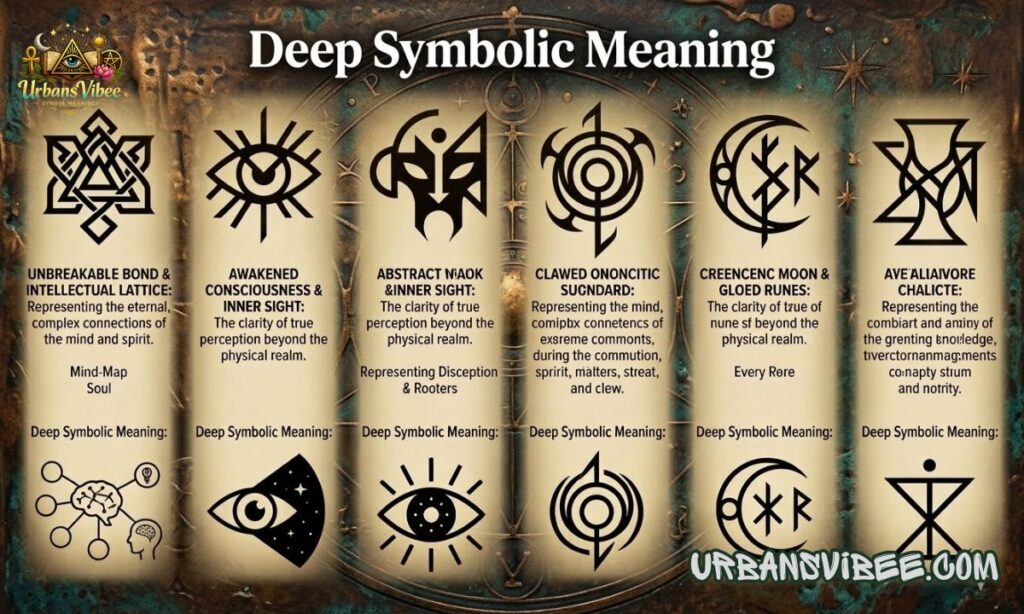
Deep Symbolic Meaning
Spiritual Level
At the spiritual level, Sleep Token’s symbols function as modern sacred geometry — visual anchors for a personal religion of devotion and surrender. Vessel is not a rock star performing for an audience. Within the band’s mythology, he is a priest making offerings. The symbols around him are the sacred script of that ritual.
Fans who engage deeply with the symbols describe a meditative quality to studying them — a sense of accessing something older and larger than the band itself.
Psychological Level
Psychologically, the symbols tap into the archetype of the hidden face — the persona, the mask that covers the true self. Carl Jung wrote extensively about the Shadow, the parts of ourselves we hide or deny. Vessel’s literal mask is a perfect embodiment of this psychological truth: the identity we show the world is never the whole person.
The act of decoding Sleep Token’s symbols also mirrors the psychological process of uncovering hidden motivations — the analytical mind searching for meaning in the unconscious.
Cultural Level
Culturally, Sleep Token’s symbols function as tribal markers. Wearing the logo, getting a sigil tattoo, decoding the alphabet — these are acts of community belonging. They say: I am one of the devoted. I have looked closely enough to see what others miss.
Types and Variations of Sleep Token Symbols
1. The Sleep Token Sigil
The primary logo — a bind rune combining Dagaz, Tiwaz, Uruz, Eihwaz, and possibly others — is the master symbol. It represents the entire mythology in a single glyph: transformation, sacrifice, endurance, the axis between worlds.
2. The Runic Alphabet
The Elder Futhark base and the custom Eden Rune Alphabet form Sleep Token’s written symbolic system. They allow the band to encode messages in plain sight — visible to all, readable only by those who have done the work of decoding.
3. Vessel’s Mask Symbolism
The mask represents ego death, anonymity, and spiritual channeling. It also represents the idea that the body is merely a vessel — a temporary container for something that transcends individual identity. This is perhaps the most personal and confronting symbol in Sleep Token’s entire visual language.
4. Elemental and Alchemical Motifs
The Sundowning sigils draw on alchemical symbols for fire, water, earth, air, and specific chemical processes like sublimation and calcination. These represent stages of transformation — the process by which something base becomes something pure, through the application of intensity and heat.
Sleep Token Symbols Across Cultures
Ancient Norse Influence
The Elder Futhark foundation connects Sleep Token directly to ancient Norse and Germanic sacred tradition. In that tradition, runes were not merely letters — they were the fabric of reality, discovered by Odin through self-sacrifice. The runes that Vessel carries in his logo are, in this reading, the same knowledge Odin found hanging on the world tree.
Medieval Occult Traditions
The Ars Goetia connections and alchemical references place Sleep Token within the stream of medieval European esoteric tradition — a tradition that sought hidden knowledge through symbolic language, ritual, and the deliberate blurring of the boundary between the material and spiritual worlds.
Japanese Minimalism
Vessel’s mask and the band’s overall aesthetic owe something to Japanese theatrical traditions — particularly Noh theater, where masked performers embody archetypes rather than characters, and the mask literally transforms the wearer into something other than human.
Modern Western Subculture
Sleep Token’s symbols have become central to a new kind of fandom — one that treats engagement with the band’s mythology as a serious interpretive practice. This is the tradition of communities that form around shared symbolic languages, from Tolkien’s constructed languages to online ARG communities.
Sleep Token Symbols in Art, Movies and Pop Culture
Sleep Token’s visual identity has crossed from music into broader cultural recognition. Their aesthetic — dark, geometric, masked, runic — has influenced album art, tattoo design, and digital art communities worldwide.
The band’s symbols appear in fan art on Pinterest, DeviantArt, and Instagram in quantities that rival major franchise fandoms. Online communities on Reddit and Discord are dedicated entirely to translating, interpreting, and extending the symbolic system.
Comparisons are frequently drawn to other masked, mythologically-driven acts — Ghost, Slipknot, Daft Punk — but Sleep Token’s deliberate engagement with sacred geometry and ancient symbol systems places them in a category of their own.
Spiritual and Dream Meaning of Sleep Token Symbols
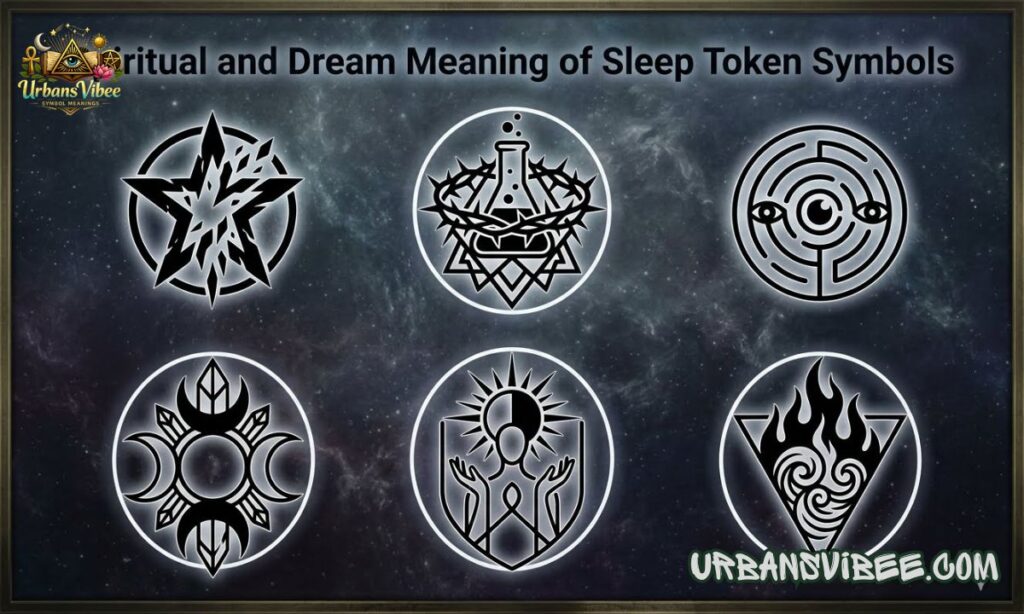
When Sleep Token symbols appear in dreams or personal meditation, fans and interpreters have identified the following meanings:
- The logo sigil in a dream — a call to surrender, to release control and trust something larger
- Vessel’s mask — a prompt to examine what you are hiding, or what mask you wear in daily life
- A Sundowning sigil — a specific emotional or transformative process is underway, connected to the song that sigil represents
- The Eden Rune Alphabet — a hidden truth is waiting to be decoded in your current situation
- The clock-face arrangement — a sense of running out of time, or a reminder that cycles are natural and inevitable
Positive vs Negative Meaning
| Symbol/Aspect | Positive Reading | Shadow Reading |
| The logo sigil | Devotion, sacred purpose, identity | Obsession, loss of self |
| Vessel’s mask | Ego death, spiritual purity | Erasure, hiding from truth |
| Sundowning sigils | Transformation, alchemical growth | Darkness, endings, grief |
| The runic alphabet | Hidden wisdom, sacred language | Inaccessibility, exclusion |
| The entity “Sleep” | Divine love, surrender | Control, dependency, dissolution |
| The offering | Generosity, spiritual act | Self-destruction, martyrdom |
Why Humans Are Attracted to Sleep Token Symbols
The answer is simple and profound at once: humans have always been attracted to sacred symbols. They compress meaning into form. They make invisible things visible. They create community among those who understand them and mystery for those who do not.
Sleep Token’s symbols do all of this and add a uniquely modern element: they reward sustained engagement. The more you study them, the more you find. A casual listener sees a logo. A dedicated fan sees a complete mythology encoded in layers of runes, alchemy, and personal lore.
In a world saturated with disposable content, something that genuinely rewards deep attention is extraordinarily rare. That rarity is magnetic.
Conclusion
Sleep Token’s symbols are not decoration. They are the entire point. They are the band’s real language — more honest, perhaps, than any lyric — because they do not explain themselves. They simply exist, waiting for those willing to look closely enough to find what is hidden inside.
From Elder Futhark runes encoded in the logo to alchemical sigils on the Sundowning clock face to the proprietary cipher alphabet of Take Me Back to Eden to the heraldic crests of Even In Arcadia — every era of Sleep Token is a new chapter in an ongoing sacred text.
The mask never comes off. The symbols never fully reveal themselves. And that is precisely what makes them impossible to stop thinking about.
Frequently Asked Questions
What is the Sleep Token logo made of?
The logo is a bind rune built from Elder Futhark characters including Dagaz, Tiwaz, Uruz, and Eihwaz, designed by Daniel Owen of Nemesis Design and encoding themes of transformation, sacrifice, and duality.
What do the Sundowning sigils mean?
Each Sundowning sigil represents one song, combining Elder Futhark runes, alchemical symbols, and Ars Goetia references into a composite emblem — arranged in a clock-face pattern symbolizing time, cycles, and endings.
What is the Eden Rune Alphabet?
The Eden Rune Alphabet is a proprietary cipher system introduced with Take Me Back to Eden (2023), where each custom rune corresponds to a letter of the English alphabet, allowing hidden messages in artwork to be decoded.
What does Vessel’s mask symbolize?
Vessel’s mask symbolizes ego death, spiritual anonymity, and the idea that the body is a temporary vessel for something beyond individual identity.
Can I translate Sleep Token symbols?
Yes — fans have decoded the Eden Rune Alphabet and many sigil components. Translation guides are widely available in fan wikis, Reddit communities, and Discord servers dedicated to Sleep Token lore.
What runes are in the Sleep Token logo?
Key runes identified in the logo include Dagaz (transformation), Tiwaz (sacrifice), Uruz (energy), Eihwaz (death/rebirth), Sowilo (victory), Wunjo (joy), and Nauthiz (struggle) — though the bind rune nature of the design allows for many interpretations.
Why does Sleep Token use symbols instead of words?
Symbols compress meaning that words cannot fully hold — they speak directly to the subconscious, reward deep engagement, and reinforce the band’s mythology of sacred offering and hidden knowledge.
What is a bind rune?
A bind rune is a symbol created by combining two or more individual runes into a single composite glyph — layering their meanings together into something more complex than any single rune alone.

Stephen Miller is a language enthusiast and symbol researcher at UrbansVibee. He specializes in uncovering the meanings, origins, and cultural significance of symbols, helping readers understand signs, icons, and symbolism from around the world.