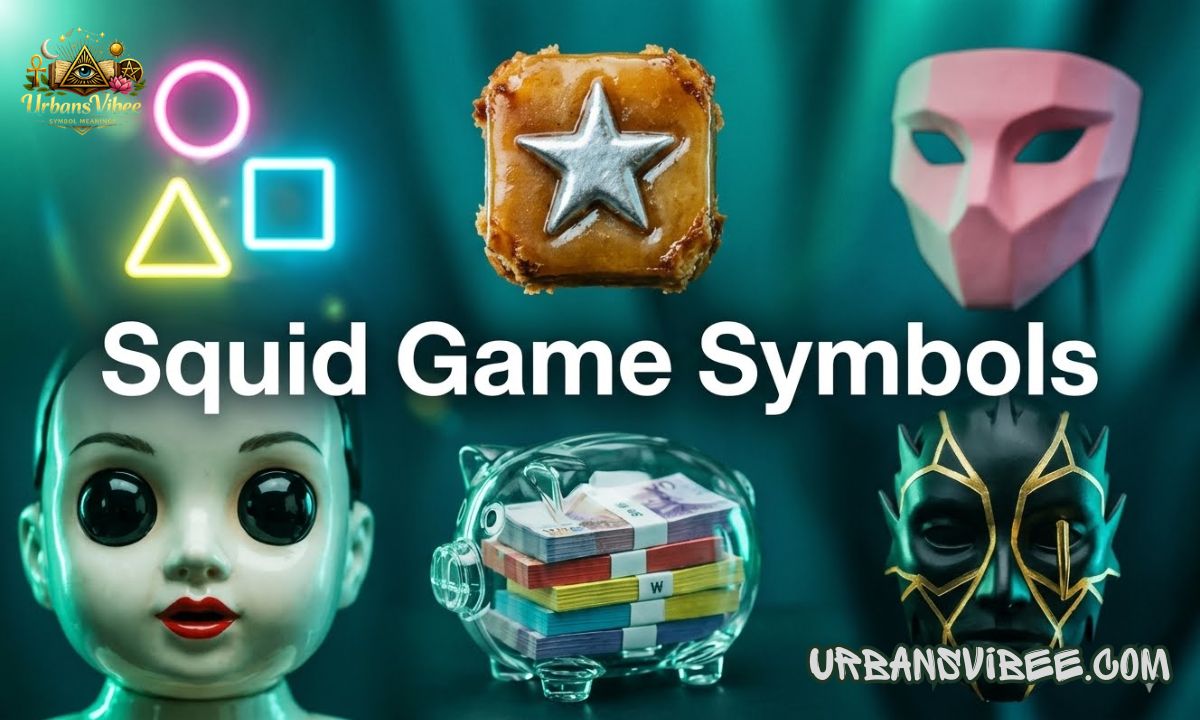
You watched Squid Game and thought you understood it. Red jumpsuits. Green tracksuits. Children’s games turned deadly. But here is the truth — the visual language of this show is operating on five different levels at once, and most viewers only catch one of them.
The circle, the triangle, and the square are not just cool mask designs. They are a complete symbolic system that encodes hierarchy, language, philosophy, psychology, and cultural critique into three simple shapes.
This article breaks down every Squid Game symbol, what each one means, and why this layered visual language is the real reason the show hit so many people so deeply.
What Are Squid Game Symbols?
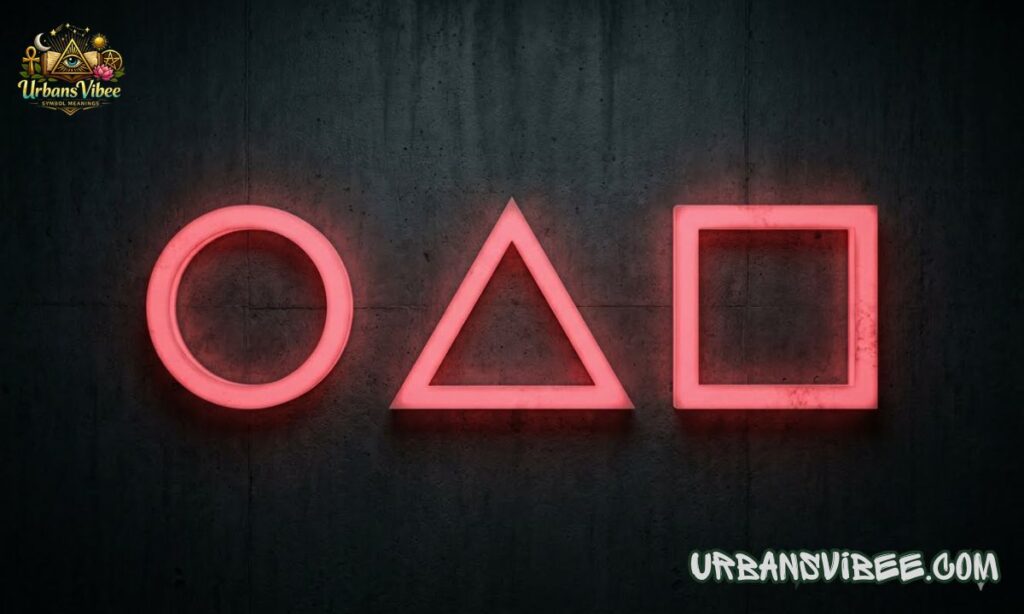
Squid Game symbols are the geometric shapes — circle (○), triangle (△), and square (□) — that appear on the black masks worn by the red-uniformed guards throughout the Netflix series. They are the most immediately recognizable visual element of the show outside of the color contrast between players and staff.
But they are much more than mask decorations. These three shapes function simultaneously as a rank system, a Korean language cipher, a philosophical framework, a psychological tool, and a social commentary device. Creator Hwang Dong-hyuk did not pick them randomly. Each shape was chosen because it carries meaning at every level of interpretation.
The title of the show itself is directly embedded in the symbols. In Korean, the show is called Ojingeo Geim (오징어 게임). The circle, triangle, and square correspond to the Hangul alphabet letters O (ㅇ), J (ㅈ), and M (ㅁ), forming OJM — the initials of Ojingeo Geim. Three shapes on three masks spelling out the name of the game in the native language of the people running it.
At the same time, the shapes appear throughout the show’s physical environment. The squid game playing field itself — from the actual Korean children’s game the show is named after — is drawn on the ground as a combination of a circle, a triangle, and a rectangle, visually unifying the symbol system with the game’s literal origin.
| Symbol | Shape | Guard Rank | Hangul Letter | Meaning |
| ○ | Circle | Worker (Lowest) | ㅇ (O) | Infinity, unity, zero hierarchy |
| △ | Triangle | Soldier (Mid) | ㅈ (J) | Force, direction, enforcement |
| □ | Square | Manager (Highest) | ㅁ (M) | Structure, authority, control |
Deep Symbolic Meaning
Spiritual Level
The three shapes carry deep spiritual meaning that transcends any single culture.
The circle is one of the oldest spiritual symbols in human history. It represents infinity, wholeness, the cycle of life and death, and the divine — because it has no beginning and no end. In many spiritual traditions, the circle symbolizes God, the cosmos, and the soul. In Squid Game, placing the circle on the lowest-ranking guards — the workers — creates a dark inversion of that spiritual meaning. The shape associated with divine completeness marks the people with the least power.
The triangle points upward. In spiritual symbolism, the upward-pointing triangle represents fire, ambition, and ascension. It is the shape of a mountain — something to be climbed, something you strive toward. The Squid Game soldier wears this shape as an enforcer. They are the force that maintains the order the managers create.
The square is the shape of earth, stability, and structure in spiritual geometry. Four equal sides. No direction of travel. Pure foundation. The manager wears the square because managers are the structural foundation of the operation — the ones who give the system its form and permanence.
In Korean philosophy, these three shapes connect directly to the concept of cheon-ji-in (천지인) — the triad of heaven, humanity, and earth. The circle represents heaven. The triangle represents humanity. The square represents earth. This ancient Korean philosophical framework is embedded directly into the show’s visual system by its Korean creator for a Korean audience, and it adds a layer of meaning that most international viewers never catch.
Psychological Level
The symbols perform a precise psychological function in the show. They dehumanize the guards. When a person wears a mask that reduces their identity to a geometric shape, they become a symbol rather than a human being. That anonymity is not accidental — it is engineered.
For the players, the masked guards are not people. They are shapes. Categories. Functions. This psychological distancing makes it easier for the guards to carry out violence and easier for the players to be terrorized without being able to humanize their oppressors. It is the same psychological mechanism used in military uniforms, executioner’s hoods, and riot gear throughout history.
For viewers, the masks create the same effect. We fear the guards collectively — as a system — rather than individually. We respond to the shape on the mask, not the person behind it.
Cultural Level
At the cultural level, the symbols carry Squid Game’s sharpest critique. The show is fundamentally about class inequality, predatory capitalism, and how economic desperation traps people in systems they cannot escape. The shape hierarchy maps perfectly onto that critique.
The circles — the lowest rank — do the dirty work. Literal dirty work. They clean the bodies of eliminated contestants. They handle waste. They are forbidden from speaking unless spoken to by a superior. They have the most morally repugnant job and the least power.
The triangles — the soldiers — enforce order through violence. They follow the rules without question. They are the threat that keeps the system running.
The squares — the managers — design the order. They make the decisions. They give instructions to circles and triangles and report directly to the Front Man.
This three-tier structure mirrors the real-world economy the show is critiquing. There are workers, enforcers, and managers. There are people who clean up the mess, people who maintain the system through force, and people who issue the directives. And critically — all three groups are equally trapped within the game’s logic, just at different levels of the hierarchy.
Types / Variations of Squid Game Symbols
Circle
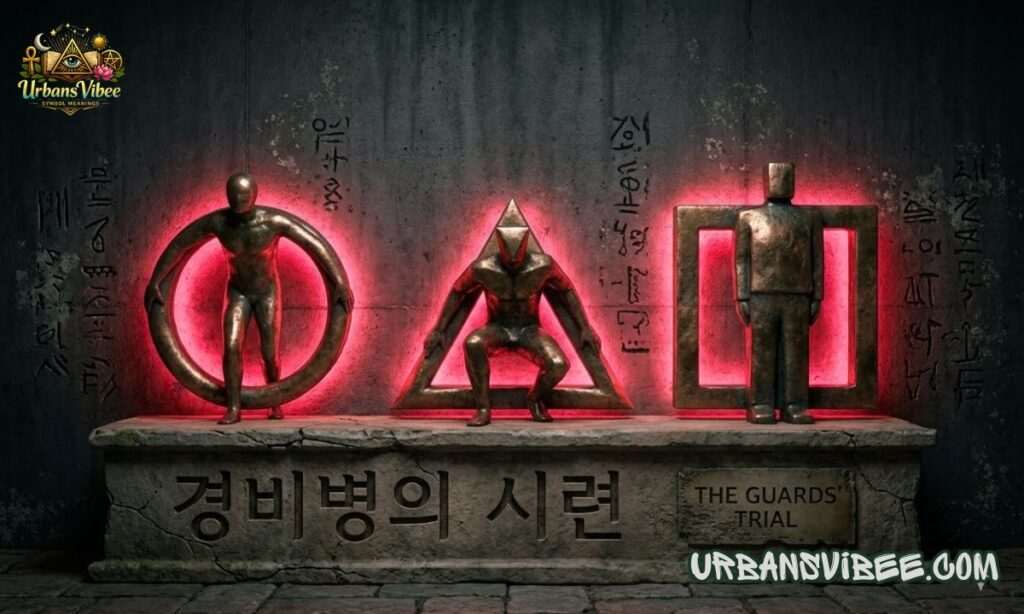
The circle (○) is worn by the lowest-ranking workers in the operation. They handle logistics, body disposal, cleaning, and setup. They are forbidden from speaking to superiors unless spoken to. In the show’s hierarchy, they have no authority.
Universally, the circle symbolizes:
- Infinity and endlessness — no start, no finish
- Unity and wholeness
- Cycles — birth, death, rebirth
- Zero, emptiness, void
The bitter irony of placing this symbol of cosmic wholeness on the people with the least status is one of the show’s most sophisticated visual choices.
Triangle
The triangle (△) is worn by the soldiers — the armed enforcers of the game. They carry weapons. They eliminate rule-breakers. They maintain order through force.
The triangle symbolizes:
- Direction and motion — it points toward a goal
- Power and ascension
- Stability — three points form the most structurally stable shape
- Change and conflict
Square
The square (□) is worn by the managers — the highest-ranking staff. They oversee the soldiers and workers, make operational decisions, and report to the Front Man.
The square symbolizes:
- Structure and order
- Equality of all sides — all four sides equal, suggesting balanced authority
- Earth and foundation
- Completeness within boundaries — a closed system
Combined Symbol System
Together, the three shapes create a self-contained visual language. You can identify any guard’s rank, function, and authority level from a distance without a word being spoken. The system communicates hierarchy instantly and silently — exactly as power structures in the real world operate. You know who is above you. You know who is below you. The shapes tell you everything.
Squid Game Symbols Across Cultures
Korean Culture
The shapes connect directly to Korean Hangul. The circle (ㅇ), as a consonant in Hangul, is actually silent at the beginning of a syllable — it is a placeholder. Placing a silent consonant on the silent, voiceless workers is a layer of meaning specifically designed for Korean-language viewers.
The cheon-ji-in (천지인) philosophical framework — heaven, humanity, earth — maps directly to circle, triangle, and square and is a foundational concept in Korean thought.
Ancient Greek Influence
Plato described five perfect solids — the Platonic solids — as the building blocks of the universe. The three shapes in Squid Game echo this philosophical tradition of geometry as cosmological language. The idea that simple shapes can encode profound truths about how the universe is organized is Greek in origin and universal in application.
Eastern Philosophy
In Japanese Zen Buddhism, the circle, triangle, and square appear in the teachings of Zen monk Sengai Gibon (1750–1837), who created a famous ink painting of all three shapes to represent the universe. The circle represents the infinite. The triangle is the first form — the origin of all shapes. The square is all the complexity that arises from those foundations.
Hwang Dong-hyuk has referenced awareness of this tradition. The Zen connection gives the shapes a meditative, philosophical weight that elevates them beyond simple rank insignia.
Modern Global Culture
The shapes are also synonymous with PlayStation’s controller buttons — circle, triangle, square, and cross. This connection is widely discussed by fans and critics, and it adds a deliberately playful dimension to the show’s use of them. The message is uncomfortable: the deadly games of Squid Game are presented with the same visual language as entertainment. The symbols of the game are the symbols of play.
This is exactly the show’s critique in visual form. Entertainment, competition, and death are all running on the same interface.
Digital Age Symbolism
In the digital age, shapes carry UI/UX design meaning. Circles suggest buttons and interaction. Squares suggest structure and containment. Triangles suggest navigation — the play button, the fast-forward arrow, the directional cue. The show uses these inherited digital meanings deliberately, embedding its symbols into the visual grammar that modern audiences already speak fluently through screens and devices.
Squid Game Symbols in Art, Movies & Pop Culture
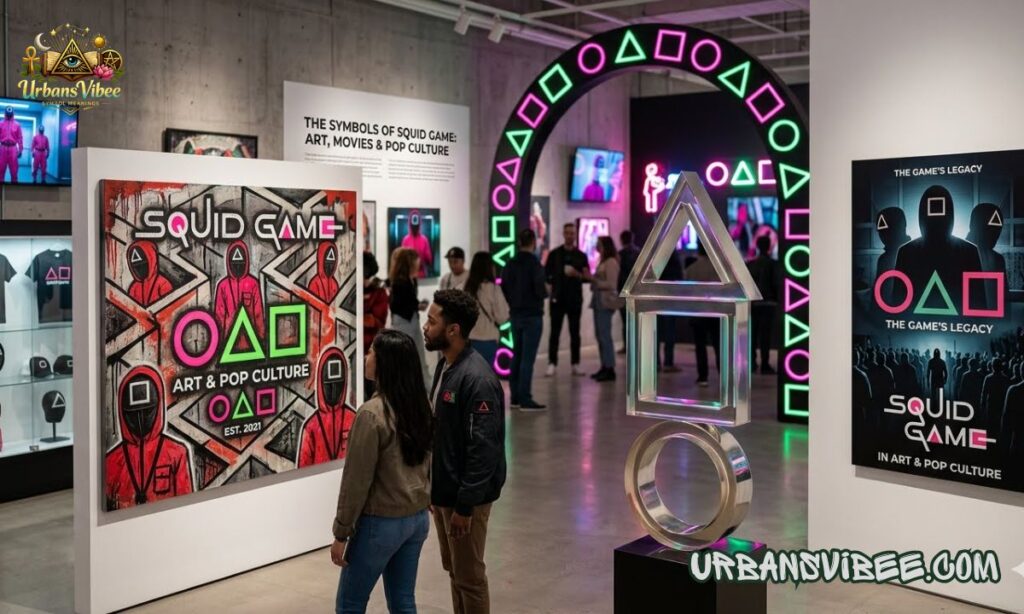
The symbols became cultural objects almost immediately after the show premiered. They have appeared on:
- Halloween costumes — The guard mask became one of the most popular costume items globally after Season 1
- Street art and murals — The shapes appear in urban art across Asia, Europe, and the Americas
- Fashion — The geometric shapes have appeared in high fashion editorial work and streetwear designs
- Tattoos — The symbols have become popular tattoo choices, representing survival, hierarchy awareness, and fandom
- Video game skins and mods — Player skins in popular games like Minecraft, Roblox, and Fortnite have incorporated Squid Game guard masks
- Advertising — Brands have used the visual language of circle-triangle-square to signal cultural awareness to young audiences
- Fan art — Thousands of pieces of fan artwork across DeviantArt, ArtStation, and Instagram explore the symbols in different artistic styles
Spiritual & Dream Meaning of Squid Game Symbols
When Squid Game symbols appear in dreams, the interpretation typically connects to the dreamer’s relationship with authority, hierarchy, and survival instinct.
Dreaming of wearing a circle mask suggests feelings of powerlessness — being at the bottom of a system, doing thankless work without recognition or voice.
Dreaming of a triangle mask suggests being in a position of enforcement — either enforcing rules on others or feeling enforced upon yourself. It can represent conflict, directed energy, or the pressure of maintaining an order you did not design.
Dreaming of a square mask suggests authority anxiety — either the desire for control or the fear of those who hold it.
Dreaming of the combined system — all three shapes together — suggests awareness of being inside a structure larger than yourself, with clearly defined roles that feel impossible to escape.
Positive vs Negative Meaning
Positive Meaning
Viewed through an optimistic lens, the symbols represent:
- The circle — Completeness, potential for change, the inherent worth of every person regardless of rank
- The triangle — Focus, direction, the ability to channel energy toward a goal
- The square — Structure, reliability, the stability that makes systems function
- The combined system — Unity of different roles working toward a shared purpose
Negative Meaning
Viewed through the show’s critical lens, the same symbols represent:
- The circle — Voicelessness, disposability, the cycle of exploitation that never ends
- The triangle — Violence, enforcement, the use of force to maintain unjust order
- The square — Hierarchical control, bureaucratic authority, the face of systemic inequality
- The combined system — The dehumanizing machinery of capitalism, where people become functions rather than individuals
Why Humans Are Attracted to These Symbols
The psychological pull of Squid Game symbols is real and measurable. The show generated one of the largest Halloween costume trends in modern history. The symbols have been tattooed millions of times worldwide. They appear in completely different cultural contexts across six continents. Why?
Three interconnected reasons explain it:
The symbols are visually simple but conceptually deep. Three basic geometric shapes. No elaborate design. No difficult iconography. Anyone can draw them. But understanding them fully takes hours of analysis. That combination — accessible form, complex content — is exactly what makes symbols powerful and lasting.
The symbols tap into universal psychological experiences. Everyone has felt like a circle — at the bottom, voiceless, doing work that goes unrecognized. Everyone has felt like a triangle — enforcing rules they did not make, caught between authority and conscience. Some people have felt like a square — in a position of control that also comes with loneliness and moral responsibility. The shapes give form to experiences that most people have never found language for.
The symbols represent the show’s central insight about modern life. Most people are inside a hierarchy they did not choose, doing a job they need for survival, in a system that benefits people above them. The masked guards of Squid Game are not monsters. They are workers. Soldiers. Managers. Sound familiar? The symbols stay with people because they describe something true about the world we all already live in.
Conclusion
The circle, triangle, and square of Squid Game are three of the most efficiently designed symbols in the history of popular culture. They encode Korean language, ancient philosophy, social hierarchy, psychological dehumanization, gaming culture, and class critique all at once — in three shapes a child could draw in three seconds. That is an extraordinary symbolic economy.
Hwang Dong-hyuk built a visual language so layered that it rewards multiple viewings and hours of analysis without ever feeling overdesigned or pretentious. In 2026, as Squid Game continues to generate cultural conversation across seasons and global markets, its symbols remain the most enduring part of the show’s identity. Once you understand what the shapes really mean, you cannot unsee it — in the show, or in the world around you.
Frequently Asked Questions
What do the Squid Game symbols mean?
The circle, triangle, and square represent a strict guard hierarchy — circle for workers, triangle for soldiers, and square for managers — and also spell the initials of “Ojingeo Geim” in Korean.
Why did Squid Game use circle, triangle and square?
Creator Hwang Dong-hyuk chose these shapes because they encode Korean Hangul initials, represent the cheon-ji-in philosophical framework, and mirror PlayStation controller buttons to connect the show’s violence to the language of entertainment.
What does the circle mean in Squid Game?
The circle marks the lowest-ranking workers who perform manual labor, are forbidden to speak unless addressed, and symbolize voicelessness, infinity, and the cycle of exploitation.
What does the triangle mean in Squid Game?
The triangle marks the soldiers — armed enforcers who maintain order through force. The shape represents directed power, conflict, and ascension.
What does the square mean in Squid Game?
The square marks the highest-ranking managers who give instructions to soldiers and workers. It symbolizes structure, authority, control, and earth in multiple philosophical traditions.
What is cheon-ji-in in Squid Game?
Cheon-ji-in is a Korean philosophical concept representing the triad of heaven (circle), humanity (triangle), and earth (square) — a framework that maps directly onto the show’s three mask symbols.
Are Squid Game symbols related to the PlayStation controller?
Yes. Circle, triangle, and square are three of the four PlayStation controller face buttons. This connection is intentional — it links the show’s deadly games to the visual language of entertainment and play.
What does the Squid Game mask represent?
The masks dehumanize the guards by reducing their identity to a geometric shape, removing individual accountability and enabling violence through anonymity.
Why do Squid Game symbols appear in the playing field?
The original Korean children’s game called Ojingeo (squid game) uses a playing field drawn as a combination of circle, triangle, and rectangle on the ground, directly connecting the show’s symbols to its game-of-origin.
What is the spiritual meaning of Squid Game symbols?
Spiritually, the circle represents cosmic wholeness and infinity, the triangle represents fire and ascension, and the square represents earth and structure — meanings drawn from Zen Buddhism, Korean philosophy, and ancient Greek geometric cosmology.

Stephen Miller is a language enthusiast and symbol researcher at UrbansVibee. He specializes in uncovering the meanings, origins, and cultural significance of symbols, helping readers understand signs, icons, and symbolism from around the world.