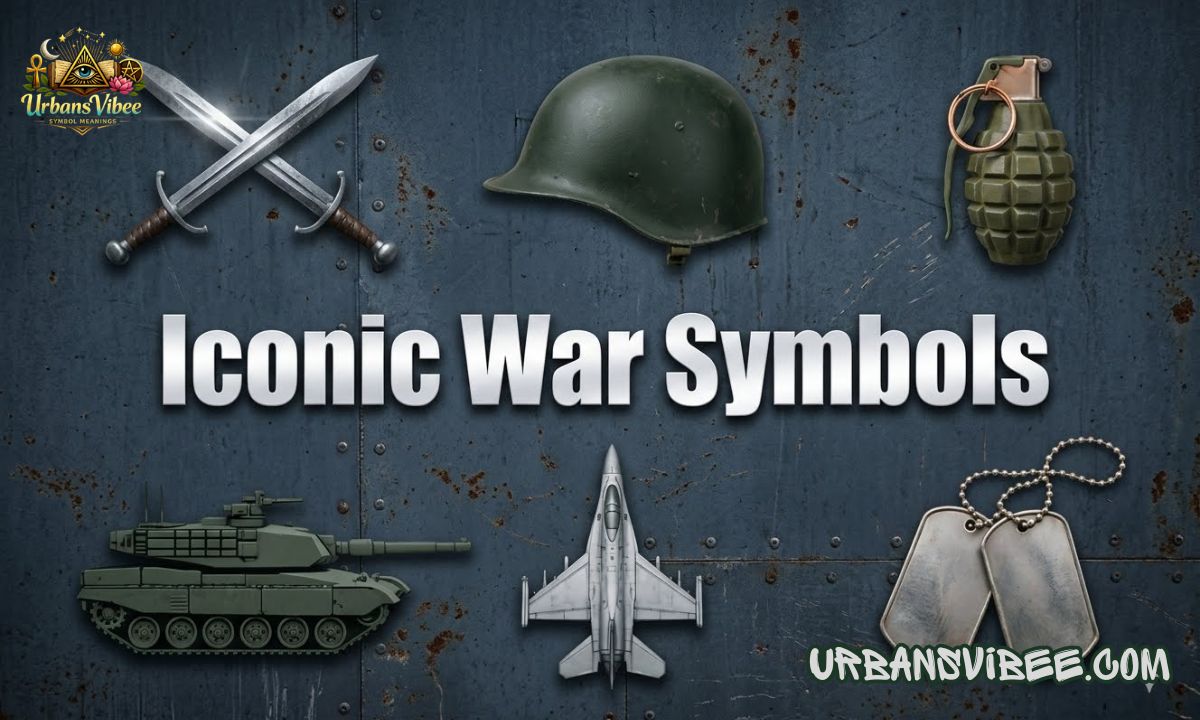
Throughout human history, warriors and empires have used symbols to inspire armies, intimidate enemies, and honor the fallen. A sword carved into stone. An eagle painted on a battle standard.
A skull displayed on a helmet. These images carried enormous weight — and many still do. War symbols are more than decorative marks. They are compressed expressions of courage, sacrifice, honor, power, and the terrible cost of conflict.
This guide covers 85+ iconic war symbols used by legendary warriors and empires across history, mythology, and modern culture.
What Are War Symbols?
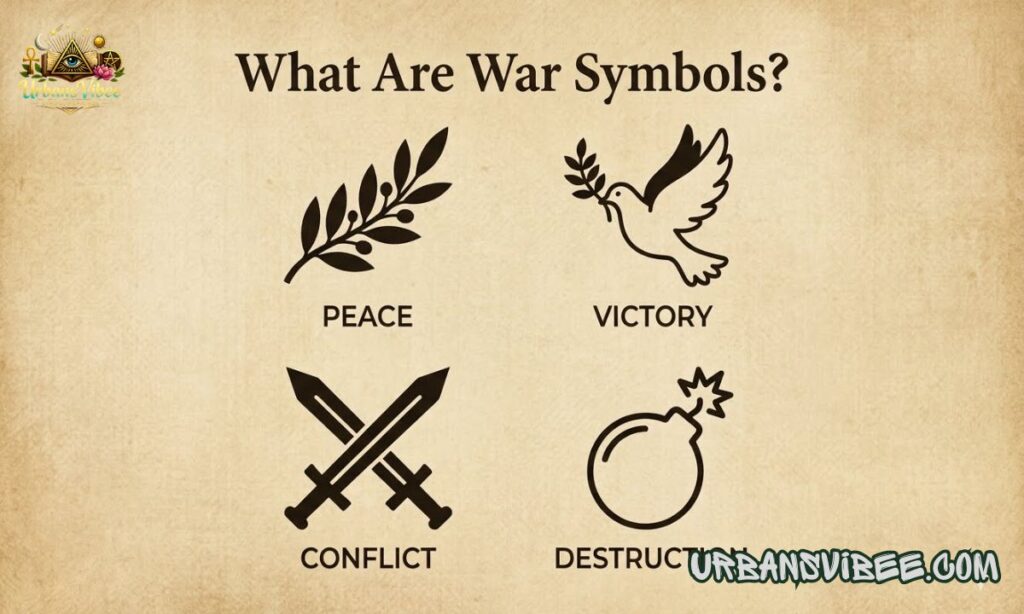
War symbols are images, signs, marks, or objects that represent conflict, military power, warrior identity, or the values associated with battle. A symbol becomes a war symbol when it is used to communicate something about fighting — whether that is courage before battle, honor during it, or remembrance after it.
War symbols appear on weapons, flags, armor, shields, monuments, tattoos, and national emblems. Some are ancient. Some are modern. All carry meaning that goes far beyond the image itself.
Symbols Of War And Their Deep Meanings
Symbols Of War
The most powerful war symbols have survived for thousands of years because they tap into emotions that do not change across generations. Fear. Courage. Loyalty. Loss. Victory. These emotions are universal — and so are the symbols that represent them.
War Symbolism
War symbolism is the practice of using images to communicate something about conflict, military identity, or the experience of battle. It works because humans are visual creatures.
A single image can communicate bravery, identity, grief, or defiance more immediately than a paragraph of words. That is why war symbolism appears in every culture that ever had to organize men to fight.
Symbols That Mean War
| Symbol | Core Meaning | Origin |
| Crossed Swords ⚔ | Combat, military conflict, opposing forces | Global, ancient |
| Eagle | Power, authority, military strength | Rome, USA, Germany |
| Skull ☠ | Death, danger, warrior identity | Global |
| Red Poppy | Remembrance, sacrifice, fallen soldiers | WWI Europe |
| Shield 🛡 | Defense, protection, endurance | Ancient global |
| Raven | Battle, death, Norse war god Odin | Norse mythology |
| Lightning Bolt ⚡ | Divine power, military authority | Greece (Zeus), Norse (Thor) |
| Dragon | Power, destruction, empire | Asia, Medieval Europe |
| Battle Axe | Ferocity, Viking warrior identity | Norse culture |
| Sword | Justice, authority, warrior spirit | Global, ancient |
| Spartan Lambda (Λ) | Military discipline, Spartan identity | Ancient Greece |
| Iron Cross | Military service, German military tradition | Germany, WWI/WWII |
| Red Color | Aggression, courage, sacrifice | Global military traditions |
War Symbols Copy And Paste
Here are common war symbols you can copy and use directly:
⚔ ☠ 🛡 ✠ ♞ 🏹 ⚡ 🦅 🔱 ⚒ 🐉 🗡 🪖 💀 🏴☠️
These work for usernames, social media bios, gaming profiles, and creative projects. They carry instant visual impact and communicate warrior energy immediately.
War Symbols Tattoos
War symbol tattoos remain among the most requested designs in American and European tattoo studios. People choose them to honor military service, personal battles they have survived, or the values of courage and strength they want to carry permanently on their skin. Popular war tattoo symbols include:
- Spartan helmet — discipline, mental toughness, warrior identity
- Crossed swords — military service or personal conflict survived
- Dog tags — especially meaningful for veterans; represent identity and remembrance of loss
- Eagle — national pride, strength, authority
- Viking runes — spiritual protection and warrior heritage
- Skull — mortality, fearlessness, the warrior’s acceptance of death
- Helm of Awe (Ægishjálmur) — Norse protective symbol worn before battle
- Maori warrior designs (Tā moko) — ancestry, warrior lineage, strength
Famous Ancient And Historical War Symbols
War Symbols Emoji
The most commonly used war-related emoji symbols are ⚔ (crossed swords), ☠ (skull and crossbones), 🛡 (shield), 🏹 (bow and arrow), 🪖 (military helmet), and 🐉 (dragon). Each carries an immediately recognizable visual shorthand for conflict, danger, or warrior identity in digital communication.
War Symbols WW2
World War II produced some of the most recognizable war symbols in modern history:
- Iron Cross — awarded to German military personnel for valor
- V for Victory — used by Allied nations to represent resistance and ultimate victory
- Red Star — Soviet military identity and communist solidarity
- Rising Sun — Japanese Imperial military flag
- Red Poppy — British and Commonwealth remembrance symbol
- Star of David — marked on Holocaust victims; later became Israel’s national symbol
War Symbols And Meanings
War symbols carry layered meaning. At the surface level, they identify a warrior, an army, or a nation. At a deeper level, they communicate values — what a culture believes combat requires of a person, what it costs, and what it means to survive it or fall in it.
Ancient War Symbols
Ancient civilizations produced war symbols that still appear in military insignia, heraldry, and tattoos today:
- Roman Aquila — the eagle standard carried into battle; losing it was considered a catastrophic disgrace
- Egyptian Khopesh — a curved sword representing pharaonic military power
- Greek Gorgon (Medusa) — placed on shields to terrify enemies
- Viking Valknut — Odin’s knot, associated with warriors who died in battle
- Celtic Triskelion — warrior movement, progress, and forward momentum
- Aztec Jaguar — the elite jaguar warrior class’s sacred identity symbol
- Samurai Mon — Japanese clan crests displayed on banners, armor, and swords
War Symbols Greek
Ancient Greek warfare produced symbols that have endured for 2,500 years:
- Ares’ Spear and Shield — primary symbols of the Greek god of war
- Athena’s Aegis Shield — the shield bearing the Gorgon’s head
- Spartan Lambda (Λ) — worn on Spartan shields at the Battle of Thermopylae
- Nike (Winged Victory) — the goddess of victory, now one of the world’s most recognized brand names
- Trident of Poseidon — naval and maritime military power
- Thunderbolt of Zeus — supreme divine authority over war
Symbols Of War In Mythology
Every major mythology assigned specific symbols to war:
- Norse: Odin’s ravens Huginn and Muninn, Thor’s hammer Mjolnir, the Valknut
- Greek: Ares’ spear, Athena’s owl and aegis, the Gorgon
- Roman: Mars’ wolf and woodpecker, the Aquila eagle standard
- Japanese: The dragon, the rising sun, the katana as spiritual object
- Celtic: Ravens, the boar, the triskelion
- Hindu: Indra’s thunderbolt (Vajra), the war god Kartikeya’s peacock
What Symbolizes War?
War is symbolized most consistently by weapons, predatory animals, fire, and the color red. These images appear in war symbolism across virtually every culture because they reflect the fundamental elements of combat — a weapon, an aggressive creature, consuming destruction, and spilled blood.
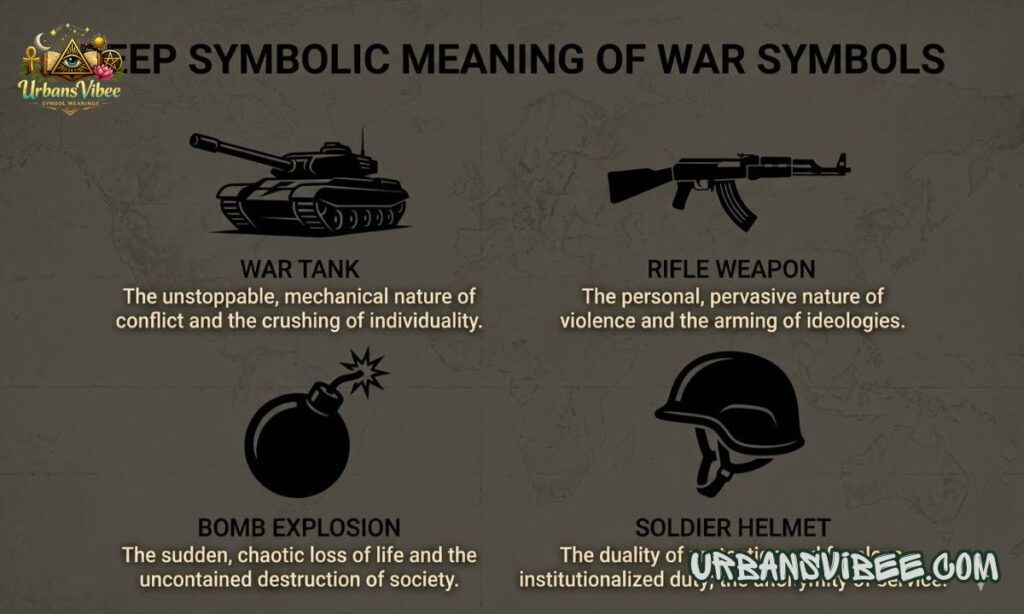
Deep Symbolic Meaning of War Symbols
Spiritual Meaning
Spiritually, war symbols connect warriors to divine protection and cosmic purpose. Roman soldiers carried eagle standards not just as unit identifiers but as sacred objects tied to divine favor. Norse warriors wore Mjolnir pendants believing Thor’s protection would be with them in battle.
Samurai treated the sword as a spiritual object — an extension of the warrior’s soul, not just a tool for killing. When a culture’s war symbols are tied to the divine, warfare itself becomes a sacred act — and the symbols that mark it carry that sacred weight.
Psychological Meaning
Psychologically, war symbols work because humans naturally respond to visual signs tied to strong emotion and memory. A skull communicates danger immediately — no explanation needed. An eagle communicates power and authority with a single glance.
Psychologists who study military psychology consistently note that symbols serve critical functions in combat environments: they create group identity, reduce individual fear by embedding the soldier in something larger, and honor sacrifice in ways that give meaning to death. That psychological machinery is why war symbols have never disappeared — they are doing real cognitive and emotional work.
Cultural Meaning
Culturally, war symbols define who belongs to a group and what that group values in conflict. The Roman eagle said: we are disciplined, powerful, and divinely protected. The Spartan lambda said: we are trained harder than everyone else and we do not run.
The red poppy says: we remember what was paid so that we could be here. Cultural war symbols are community agreements about what combat means and how those who fought and died should be honored.
Powerful Types of War Symbols and Their Meanings
Eagle Symbol
- Visual Description: A large bird of prey shown with wings spread, talons extended, and head turned forward. Often depicted in gold, silver, or black.
- Meaning: Power, authority, military strength, divine protection, and victory. The eagle sees everything from above — a quality empire associated with command.
- Where It Appears: Roman Aquila standards, American military insignia, German federal eagle, coat of arms of dozens of nations, military unit patches worldwide.
Sword Symbol
- Visual Description: A long blade with a cross-guard handle, shown upright or crossed with another sword. One of the most universal weapon symbols in human history.
- Meaning: Authority, justice, warrior spirit, honor, and the willingness to fight for what you believe. Medieval knights swore oaths on their swords. Japanese samurai considered the sword a spiritual extension of the self.
- Where It Appears: National coats of arms, military order insignia, medieval heraldry, grave markers of warriors, tattoos, mythology, and fantasy literature worldwide.
Skull and Crossbones
- Visual Description: A human skull above two crossed bones, shown in white against dark backgrounds.
- Meaning: Death, danger, fearlessness, and the warrior’s acceptance of mortality. For pirates, it announced intent. For military units, it projects ferocity and absolute commitment.
- Where It Appears: Pirate flags, military unit patches (including the famous Totenkopf of World War I), poison labels, biker culture, heavy metal imagery, and war tattoos globally.
Red Poppy Symbol
- Visual Description: A bright red flower with four petals and a dark center, growing from a thin green stem.
- Meaning: Remembrance of fallen soldiers, sacrifice, the cost of war, and the fragility of life lost in conflict. The red poppy grew naturally in the blood-soaked fields of Flanders during World War I.
- Where It Appears: Commonwealth Remembrance Day commemorations every November 11th, military memorials, government buildings, lapels of public figures, war cemeteries across Europe and beyond.
Shield Symbol
- Visual Description: A shaped protective barrier — round, rectangular, or kite-shaped — often decorated with a crest, animal, or symbol of identity.
- Meaning: Defense, protection, endurance, and the defense of something worth protecting. Shields identify who you are while you survive what is thrown at you.
- Where It Appears: Heraldry and coats of arms, police badges, military unit insignia, superhero imagery (Captain America’s shield), fantasy literature, and tattoos representing personal resilience.
Dragon Symbol
- Visual Description: A large reptilian creature with wings, claws, and fire breath. In Asian tradition, it is shown as serpentine and powerful. In European tradition, it is shown as monstrous and destructive.
- Meaning: In Asian military culture — power, imperial authority, divine protection, and supreme strength. In European tradition — a formidable enemy to be defeated, chaos, and destruction. The difference in meaning reflects fundamentally different cultural relationships to power and nature.
- Where It Appears: Chinese imperial military banners, Welsh national flag, Viking ship prows, medieval heraldry, Japanese and Chinese tattoo culture, fantasy military fiction.
War Symbols Across Cultures
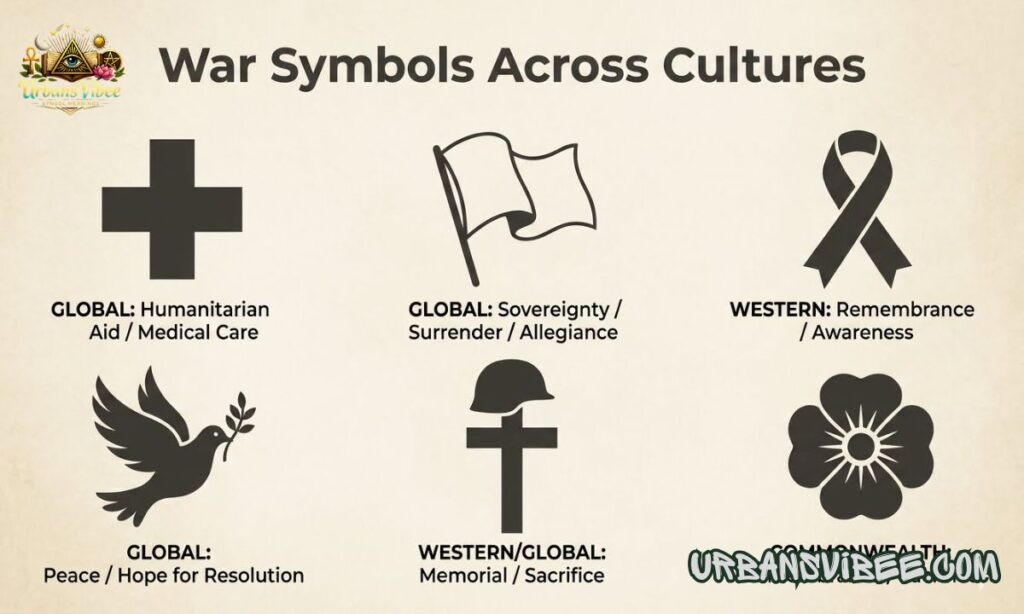
Ancient Roman Culture
Rome built its military identity around symbols with extraordinary precision. The Aquila eagle standard was so sacred that Roman legions would fight to the death rather than allow it to be captured. Roman soldiers swore oaths to the standard itself — it represented the honor, identity, and divine favor of the entire legion.
The wolf was sacred to Mars, the god of war. Roman military symbolism projected invincibility and permanence — qualities the empire believed it actually possessed.
Viking Culture
Viking warriors surrounded themselves with protective and aggressive symbols. The Valknut (three interlocked triangles) was tied to Odin and the honored dead who fell in battle. Mjolnir pendants provided Thor’s protection. The Helm of Awe (Ægishjálmur) was inscribed on foreheads to create invincibility and paralyze enemies with fear.
Ravens represented Odin’s presence on the battlefield — seeing ravens before battle was considered a divine sign that the god of war was watching. Viking war symbolism connected individual warriors to cosmic forces in ways that made death in battle feel not like an ending but a beginning.
Japanese Samurai Culture
The katana was more than a weapon in samurai culture. It was a spiritual object that contained the warrior’s soul. Samurai clan crests (Mon) were displayed on armor, banners, and swords as sacred identity marks. The chrysanthemum — symbol of the emperor — represented the ultimate authority in whose name samurai fought and died.
Japanese war symbolism was inseparable from spiritual practice, loyalty, and the concept of Bushido — the warrior’s code that made death in service preferable to survival in dishonor.
Native American Cultures
Indigenous war symbols varied across nations but shared common themes. The Two Arrows symbol in many Plains nations represented preparedness and conflict — arrows pointing in opposite directions signified opposing forces.
Eagle feathers were awarded for acts of battlefield courage, making them among the most valued personal symbols a warrior could carry. War paint applied before battle was not decoration. It was a visual prayer — a communication to spiritual forces that the warrior was ready to fight.
Medieval European Culture
Medieval European warfare produced the richest heraldic tradition in history. Every knight, lord, and kingdom carried a unique combination of symbols on their shield, banner, and coat of arms. Lions represented courage and noble leadership.
Crossed swords represented military power. Eagles represented imperial authority. The Crusader cross carried both religious conviction and military identity simultaneously.
Medieval war symbolism was a visual language that anyone on a battlefield could read instantly — it told you who was friend, who was enemy, and what each force stood for.
War Symbols in Art, Movies and Pop Culture
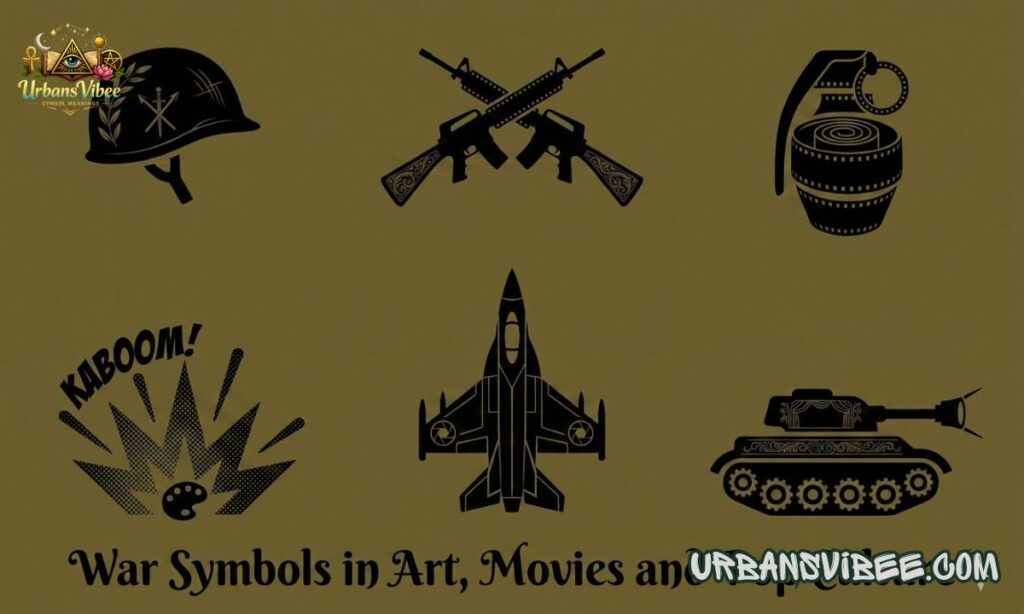
In Movies
War symbols anchor the visual identity of great war films. The Spartan lambda on the shields of 300 became one of cinema’s most recognized war images. The American flag carried through Saving Private Ryan carries the weight of an entire nation’s sacrifice.
Darth Vader’s helmet in Star Wars draws directly from Nazi military helmet design — a deliberate choice by George Lucas to signal authoritarian military power instantly to audiences.
In Paintings
Francisco Goya’s war paintings placed ordinary human suffering at the center of war imagery rather than heroic symbols. Eugène Delacroix’s Liberty Leading the People uses a flag as a war symbol in its most emotionally powerful form.
Ancient Roman triumphal art covered conquered cities in eagles, standards, and victory symbols to communicate military dominance to every person who passed.
In Books
Homer’s Iliad is built on war symbols — Achilles’ armor, Agamemnon’s scepter, Hector’s plume helmet that frightens his own son. Tolkien’s The Lord of the Rings gives every army its own battle standard, every warrior their identity symbol.
War symbols in literature do the work that paragraphs of exposition cannot — they communicate identity, allegiance, and values in a single image.
In Tattoos
War symbol tattoos are among the most deeply personal body art choices people make. Veterans tattoo dog tags to carry fallen comrades permanently. Civilians tattoo swords and shields to mark surviving personal battles.
Spartan helmets communicate the discipline someone aspires to maintain. Military family members tattoo unit insignia to stay connected to a loved one’s service. The permanence of tattoos makes them especially appropriate for war symbols — things meant to be carried always.
In Fashion
Military fashion has influenced global clothing for over a century. Camouflage patterns began as battlefield technology and became street fashion statements. Bomber jackets started on WWII aircraft and became one of the most enduring style icons of the 20th century. Combat boots crossed from military necessity to fashion staple across every subculture.
Luxury fashion houses including Versace, Burberry, and Balenciaga regularly incorporate military insignia, medals, and war-referencing design elements for their visual power and historical weight.
Spiritual and Dream Meaning of War Symbols
Seeing Swords in Dreams
A sword appearing in a dream typically represents a decision that requires courage, a conflict requiring resolution, or the need to cut away something that no longer serves you. In classical dream interpretation across multiple traditions, the sword means clarity — the ability to separate true from false, important from unimportant.
Seeing Flags or Banners
Dreaming of a flag or battle banner represents identity, loyalty, and belonging. It asks: what are you willing to fight for? Whose banner do you march under? These dreams often arise during periods of personal transition where loyalty and identity are being tested or redefined.
Seeing Battles or Armor
Dreams of battle or wearing armor typically reflect active emotional conflict in waking life — an ongoing struggle that requires protection, resolve, and strategic thinking. Armor in dreams often signals that the dreamer is in a defensive posture, protecting something valuable from external pressure.
Positive vs Negative Meaning of War Symbols
Positive Meanings
- Eagle — leadership, vision, divine protection, strength in service of something larger
- Shield — protection of the innocent, endurance, the defense of values worth defending
- Red Poppy — gratitude, remembrance, the honoring of sacrifice
- Sword — justice, clarity, the courage to act when action is required
- Dragon (Asian) — imperial authority, wisdom, divine power used for good
Negative Meanings
- Skull and Crossbones — death, danger, the terror of mortality weaponized
- Red Banners — aggression, conquest, blood cost
- Dragon (European) — chaos, destruction, the monstrous enemy
- Battle Axe — brute force, savagery, conflict without mercy
- Fire — consuming destruction, the scorched earth of total war
Most powerful war symbols carry both dimensions. That duality is part of what makes them so enduring — they are honest about the full reality of what they represent.
Why Humans Are Attracted to War Symbols
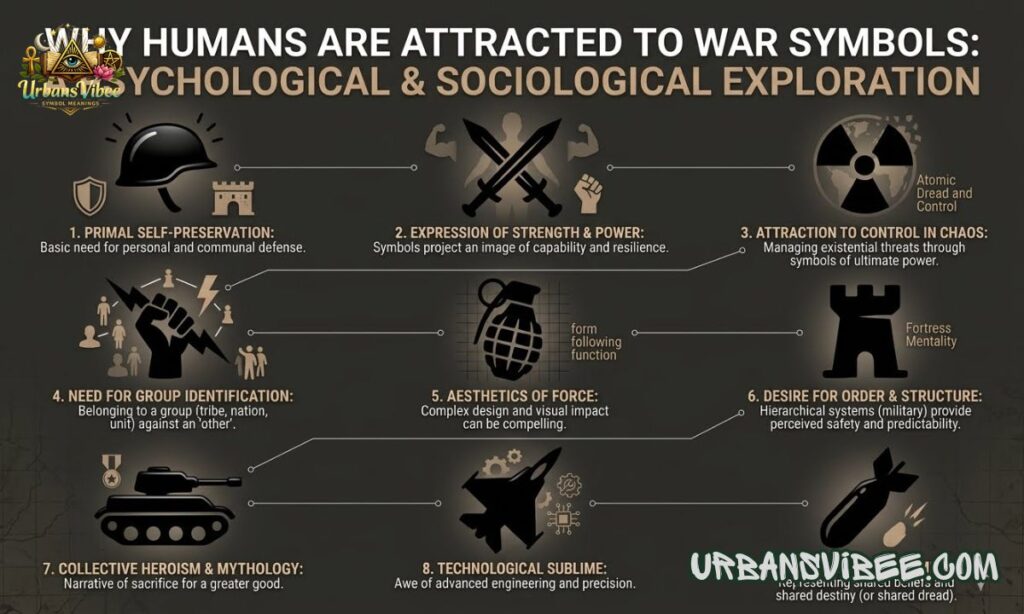
War symbols work on every level humans operate on simultaneously. They appeal to the body — a skull triggers fear physically. They appeal to the mind — an eagle communicates authority through a single visual. They appeal to the emotions — a red poppy pulls grief to the surface immediately. And they appeal to the spirit — a soldier’s oath to a battle standard connects individuals to something sacred and collective.
People who have never served in any military still feel drawn to war symbols. That attraction is not bloodlust. It is the recognition that these symbols represent something real about the human capacity for courage, sacrifice, loyalty, and the willingness to put yourself between something you love and something that threatens it. Those are among the deepest human values. War symbols carry them — which is why they have never disappeared, and why they never will.
Conclusion
War symbols are among the oldest, most powerful, and most persistent images in human history. From the Roman eagle to the red poppy. From the Spartan lambda to the Viking Valknut. From the samurai’s clan crest to the American unit patch.
These images have been carried into battle, inked on skin, carved on stone, painted on flags, and written into mythology for thousands of years — because they do something no other kind of image can.
They compress the full weight of courage, sacrifice, identity, and the cost of conflict into a single shape. Understanding them means understanding something deep about how humans have always made meaning out of the most terrible and defining experience of collective life.
Frequently Asked Questions
What are war symbols?
War symbols are images, marks, or objects that represent conflict, military power, warrior identity, or values like courage, sacrifice, and honor associated with battle.
What are the most famous war symbols?
The most recognized include crossed swords, the eagle, skull and crossbones, the red poppy, the shield, and the Spartan lambda — each carrying centuries of military meaning.
What symbolizes war the most?
The sword is the most universally recognized symbol of war across cultures and time periods. The eagle and skull also rank among the most globally recognized war images.
What are WW2 war symbols?
Major WWII symbols include the Iron Cross, V for Victory, the red poppy, the Rising Sun, the Red Star, and the Star of David — each tied to specific nations, armies, or experiences of the war.
What do war symbols mean in tattoos?
War tattoos represent courage, personal battles survived, military service, remembrance of the fallen, or warrior values like discipline and fearlessness that the wearer carries permanently.
What are Greek war symbols?
Key Greek war symbols include Ares’ spear and shield, the Spartan lambda, Athena’s aegis, Nike the winged victory goddess, and Zeus’s thunderbolt.
What is the red poppy a symbol of?
The red poppy symbolizes remembrance of fallen soldiers, particularly from World War I, where it grew naturally in the battlefields of Flanders after the fighting ended.
Are war symbols used in modern culture?
Yes. War symbols appear in military insignia, tattoos, fashion, movies, video games, heraldry, national flags, and sports team logos — carrying their ancient meanings into contemporary life.
What animals symbolize war?
The eagle, wolf, raven, lion, dragon, boar, and horse are the most commonly used animals as war symbols across world cultures and historical periods.
Why do war symbols remain powerful today?
They endure because they carry real human emotions — courage, sacrifice, grief, loyalty — that do not change across generations. The image compresses those feelings into a single visual that communicates instantly.

Stephen Miller is a language enthusiast and symbol researcher at UrbansVibee. He specializes in uncovering the meanings, origins, and cultural significance of symbols, helping readers understand signs, icons, and symbolism from around the world.