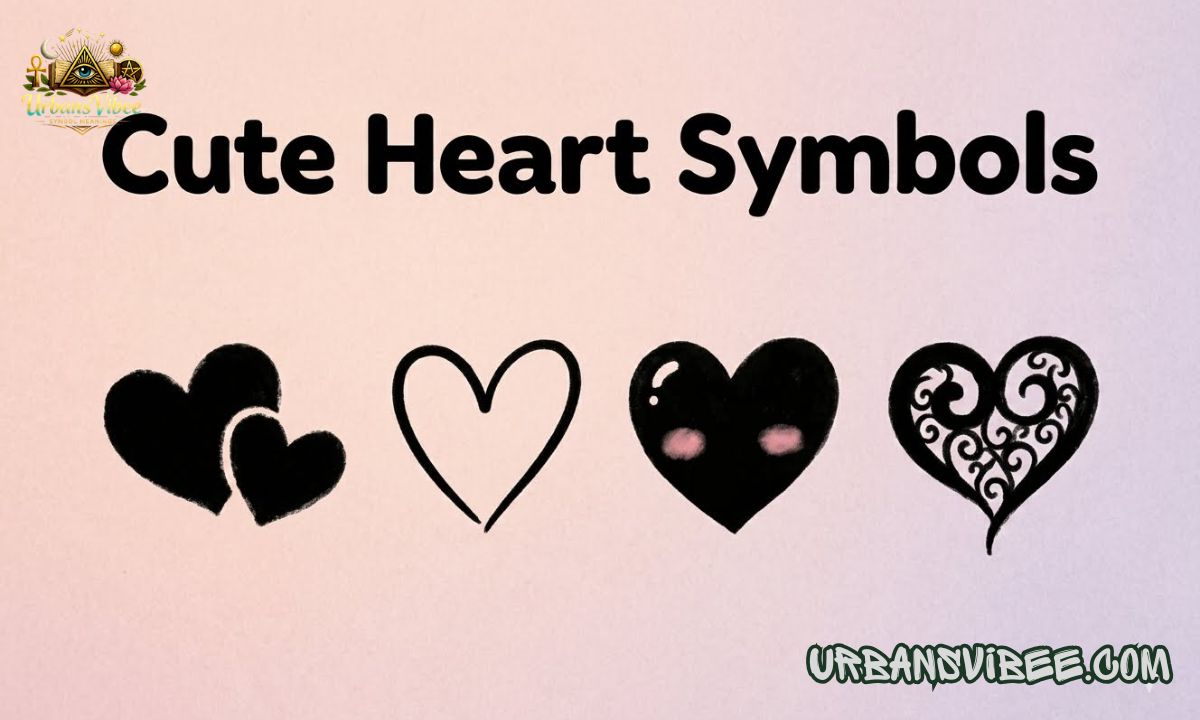
Some things do not need a sentence. A single heart says everything. Whether it floats at the end of a text message, appears in a painting, gets tattooed on skin, or decorates a piece of jewelry, the heart symbol communicates something deep and immediate — love, warmth, connection, and care.
It is one of the oldest and most universally understood symbols in human history. This guide explores 85+ cute heart symbols, their types, meanings, cultural roots, spiritual significance, and why this simple shape continues to speak louder than words across every language and era.
What Are Cute Heart Symbols?
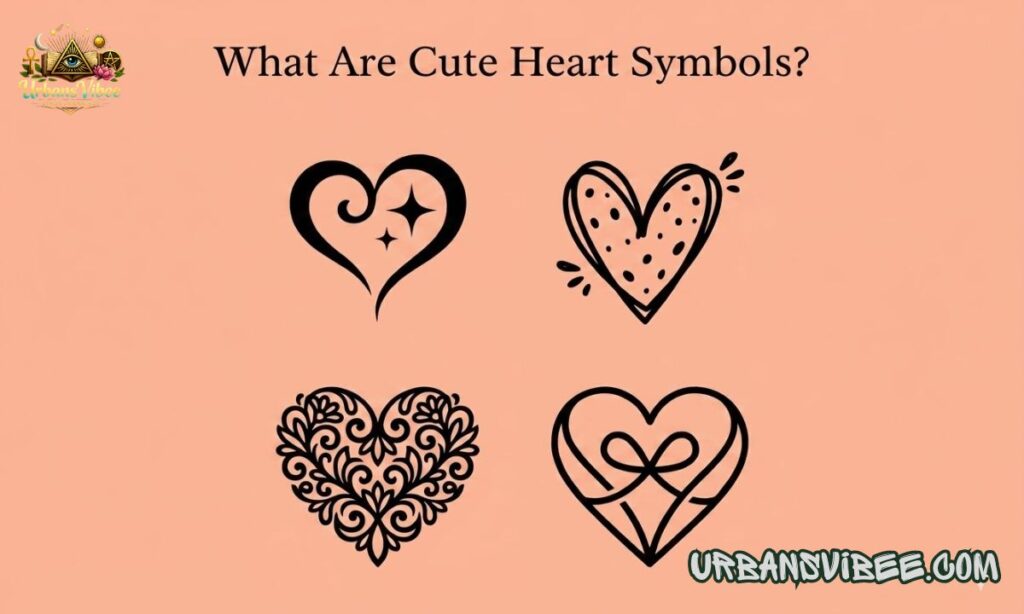
Cute heart symbols are visual representations of the heart shape used to express love, affection, care, and emotional connection. They are not anatomically accurate. The classic heart symbol — two rounded curves meeting at a point — does not resemble a real human heart.
Yet it has become the single most recognized symbol of emotion in the world. Cute heart symbols range from the classic red heart to sparkling hearts, broken hearts, black hearts, pink hearts, and dozens of emoji variations.
Each carries a slightly different emotional tone. Together, they form a complete language of feeling — one that works across texts, social media posts, tattoos, art, and daily life without requiring a single word.
Deep Symbolic Meaning
Spiritual Level
On a spiritual level, heart symbols represent the center of the soul. Across major belief systems — from Christianity to Hinduism to Buddhism — the heart is the seat of divine love, compassion, and inner truth. In Hindu tradition, the heart chakra (Anahata) governs love, forgiveness, and emotional openness.
When balanced, it allows deep compassion and peace to flow freely. In Christian tradition, the Sacred Heart represents Jesus’s divine love for humanity — a heart surrounded by flames of devotion, thorns of suffering, and rays of grace.
In biblical teachings more broadly, the heart symbolizes faith, inner intention, and a person’s moral character. Spiritual heart symbols remind us that the deepest kind of love is not just emotional but divine — something that connects individual human beings to something larger than themselves.
Psychological Level
Psychologically, heart symbols trigger feelings of safety, warmth, and belonging. The human brain processes the heart shape as a visual shortcut to emotional reassurance. Even a tiny heart emoji at the end of a message can shift how a person feels receiving it — from uncertain to valued, from anxious to comforted.
Research in social psychology consistently shows that people respond to heart imagery with measurable positive emotional reactions. This is why brands use hearts in their logos, why social media platforms use hearts as the universal like button, and why the heart symbol appears wherever human beings want to communicate care without explanation.
The psychology of cute heart symbols is simple: they work because they tap directly into the brain’s emotional centers, bypassing rational processing entirely.
Cultural Level
Culturally, the heart symbol has become a universal language that transcends borders, languages, and religions. It started as a local European romantic symbol and became the most globally recognized expression of affection in history.
Today, it appears in digital communication, fashion branding, product packaging, public art, and daily interaction across every continent.
Its cultural meaning adapts depending on context — a red heart means romantic love, a black heart means dark humor or grief, a sparkling heart means excitement and joy — but the emotional core of connection and care remains constant across all its variations.
Types and Variations of Cute Heart Symbols
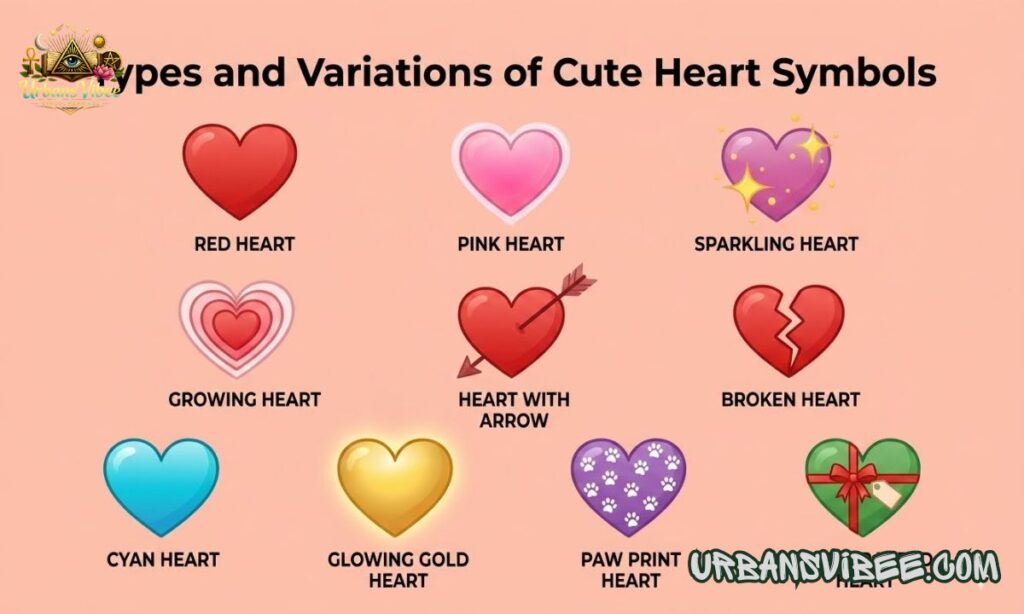
| Heart Symbol | Emoji | Core Meaning | Common Use |
| Red Heart | ❤️ | Classic love and deep affection | Romance, gratitude, sincerity |
| Pink Heart | 🩷 | Gentle affection, cuteness | Friendship, kindness, soft love |
| Sparkling Heart | 💖 | Excitement, joy, admiration | Celebrations, compliments, fandom |
| Broken Heart | 💔 | Heartbreak, grief, loss | Expressing sadness, sympathy |
| Black Heart | 🖤 | Dark humor, grief, mystery | Edgy affection, mourning |
| Growing Heart | 💗 | Growing feelings, warmth | New relationships, sweet emotion |
| Heart With Arrow | 💘 | Being struck by love, Cupid | Valentine’s Day, new romance |
| Purple Heart | 💜 | Compassion, spirituality | Military service, deep care |
| Blue Heart | 💙 | Trust, loyalty, calm affection | Friendship, professional warmth |
| Yellow Heart | 💛 | Happiness, friendship, sunshine | Cheerful bonds, positivity |
| Green Heart | 💚 | Nature, health, growth | Environmental love, wellness |
| Orange Heart | 🧡 | Warmth, enthusiasm, creativity | Encouragement, energy |
| White Heart | 🤍 | Purity, peace, clean love | Sympathy, spiritual love |
| Heart Decoration | 💟 | Love decoration, general affection | Design and art |
| Revolving Hearts | 💞 | Mutual love, connection in motion | Cute exchanges, romance |
| Heart Exclamation | ❣️ | Strong agreement with emotion | Emphasis and passion |
| Two Hearts | 💕 | Shared love, couple bond | Relationship posts |
Red Heart
- Visual Description: A classic bright red heart shape. Bold, symmetrical, and immediately recognizable in any size.
- Meaning: Classic romantic love, deep affection, gratitude, and sincere emotional connection. The red heart is the original and most universally understood heart symbol.
- Where It Appears: Valentine’s Day cards and gifts, wedding decorations, tattoos for loved ones, text messages, social media posts, and international branding worldwide.
Pink Heart
- Visual Description: A softer, lighter version of the red heart. Gentle and warm rather than bold and intense.
- Meaning: Gentle affection, nurturing love, cuteness, and kindness. The pink heart feels less intense than red but equally sincere. It carries a sweetness that the red heart does not always convey.
- Where It Appears: Messages between close friends, children’s products, beauty and wellness branding, social media captions expressing soft appreciation.
Sparkling Heart
- Visual Description: A pink or red heart surrounded by small sparkles or stars, suggesting radiance and excitement.
- Meaning: Excitement, admiration, deep joy, and the feeling of being dazzled by someone or something. The sparkling heart adds energy and enthusiasm to basic affection.
- Where It Appears: Fan messages to celebrities, compliments on social media, celebratory texts, and any moment where ordinary love feels too calm for the emotion being expressed.
Broken Heart
- Visual Description: A classic heart shape split down the middle with a jagged crack running through it.
- Meaning: Heartbreak, grief, emotional pain, the loss of a relationship, or the acute sadness of separation. The broken heart is the heart symbol’s most emotionally honest variation — it acknowledges that love sometimes ends in pain.
- Where It Appears: Breakup messages, expressions of sympathy, music lyrics about loss, tattoos marking emotional turning points, and literary imagery around grief.
Black Heart
- Visual Description: A solid black heart, identical in shape to the red heart but with no color warmth.
- Meaning: Carries multiple meanings depending on context. In some uses, it represents dark humor and edgy affection — affection expressed sarcastically or ironically. In others, it represents grief, mourning, or the darker side of love and desire. In creative contexts, it signals mystery and unconventional emotion.
- Where It Appears: Gothic fashion and aesthetic content, dark humor exchanges, posts marking loss or tragedy, and alternative cultural expressions of affection.
Growing Heart
- Visual Description: A pink heart shown with a surrounding glow or expansion effect, as if the emotion is building in real time.
- Meaning: Growing feelings, warmth building between two people, and the early stages of deepening emotional connection. The growing heart captures the feeling of falling in love before it has fully arrived.
- Where It Appears: Early romantic texts, expressions of appreciation that are growing stronger, sweet social media posts about developing relationships.
Heart With Arrow
- Visual Description: A classic red heart pierced by an arrow through its center, referencing the mythological image of Cupid’s arrow striking a person in love.
- Meaning: Being struck by love, romantic attraction that feels sudden and powerful, and the traditional Valentine’s Day imagery of love’s arrival.
- Where It Appears: Valentine’s Day cards and decorations, romantic tattoo designs, vintage love-letter imagery, and any context referencing the feeling of love hitting unexpectedly.
Cute Heart Symbols Across Cultures
Ancient Egypt
In ancient Egypt, the heart held enormous spiritual weight. The heart (ib) was considered the seat of the soul and the center of a person’s entire moral and spiritual identity. After death, the heart was weighed against the feather of Ma’at — the goddess of truth and justice — to determine whether the person had lived a good life.
A heart lighter than the feather meant the soul could pass into eternal life. A heavy heart, burdened by wrongdoing, meant the soul was consumed. Egyptian heart symbolism was not just about love — it was about the entire interior life of a human being, measured at the moment of ultimate truth.
Ancient Greece
Ancient Greek culture connected the heart to passion, desire, and the irrational force of emotion. Aristotle believed the heart was the body’s primary organ of intelligence and feeling — the center from which sensation, emotion, and thought all originated.
The gods of love — Eros (Cupid’s Greek counterpart) and Aphrodite — were closely associated with the heart as the site where their influence was felt most powerfully. Greek romantic poetry and drama placed the heart at the center of every story about desire, loss, and longing.
Medieval Europe
Medieval Europe transformed the heart symbol into the romantic icon we recognize today. Between the 13th and 15th centuries, the heart shape began appearing in European art and manuscript illustrations as a symbol of romantic love and courtly devotion. Knights offered their hearts to ladies.
Poets wrote about hearts given, broken, and cherished. The Catholic tradition added the Sacred Heart — the burning, thorned heart of Christ — as a powerful religious symbol of divine love and sacrifice. By the Renaissance, the heart had become the dominant visual symbol of human emotional life across Western culture.
Eastern Traditions
In Chinese culture, the heart (心 — xīn) represents both the physical heart and the mind — the combined seat of thought and feeling. In Japanese culture, kokoro (心) similarly encompasses heart, mind, and spirit together. In Indian tradition, the Anahata chakra — the heart energy center — governs love, compassion, forgiveness, and the capacity for deep human connection. These Eastern traditions embed the heart in a broader framework of spiritual and mental life, making it richer and more complex than purely romantic symbolism.
Modern Global Culture
Today, cute heart symbols belong to everyone. They appear in text messages between strangers, posts from corporations, tattoos on bodies across every continent, and product packaging in every language.
The emoji heart family has become the most universal emotional vocabulary humans have ever created — a set of symbols that work regardless of what language you speak. Social media platforms use hearts as the foundational engagement signal. The heart has become the digital era’s most essential communication tool.
Cute Heart Symbols in Art, Movies and Pop Culture
Heart symbols show up everywhere that human beings try to express what they feel most deeply. In movies, heart imagery reinforces emotional connection between characters — through lighting, props, scenic design, and direct symbolism in romantic scenes. Film posters for love stories frequently center on the heart shape as their primary visual.
In paintings, artists across every era have used hearts to express love, suffering, devotion, and divine grace. The Sacred Heart in Renaissance religious painting carries centuries of theological meaning. In books and poetry, heart imagery appears wherever language reaches for emotion — in love letters, elegies, and declarations of feeling that resist more clinical expression.
In tattoos, heart symbols are among the most personally meaningful designs people choose permanently. A red heart for a mother. A broken heart to mark a loss. A sacred heart for faith. A black heart for ironic love. Each one carries a story. In fashion, hearts appear on clothing, jewelry, handbags, and accessories as expressions of personality — from luxury brands like Tiffany & Co. to streetwear labels. Wearing a heart communicates warmth, playfulness, and emotional openness without saying a word.
Spiritual and Dream Meaning of Cute Heart Symbols
When heart symbols appear in dreams, spiritual traditions interpret them as messages about the dreamer’s emotional and spiritual state. A glowing or radiant heart in a dream often represents hope, compassion, or spiritual awakening — the heart opening to something larger than daily life.
A broken heart in a dream may signal unresolved grief, a relationship that needs attention, or the processing of past emotional pain. Receiving a heart from someone in a dream is often interpreted as a message of validation — a signal that you are loved, valued, or that a relationship carries more meaning than you have consciously acknowledged. Offering a heart to someone signals generosity, vulnerability, and the readiness to give deeply of yourself.
Positive vs Negative Meaning
Positive Meaning
- Red heart — deep, genuine love and gratitude
- Pink heart — gentle nurturing and soft affection
- Sparkling heart — joy, admiration, and emotional radiance
- Growing heart — deepening connection and building warmth
- Purple heart — compassion, spiritual love, and deep care
- Sacred heart — divine grace, devotion, and spiritual love
- White heart — purity, peace, and clean emotional intention
Negative Meaning
- Broken heart — grief, loss, emotional pain, and heartbreak
- Black heart — mourning, dark emotion, or sarcastic detachment
- Heavy heart — emotional burden, grief that weighs on the spirit
- Heart with crack — trust broken, vulnerability exploited
- Cold heart — emotional shutdown, the refusal to feel
Most heart symbols carry predominantly positive associations. The negative heart symbols exist to acknowledge that love — being so central to human experience — also produces the most profound pain when it is lost, broken, or betrayed.
Why Humans Are Attracted to This Symbol
The heart symbol’s attraction is not accidental. It persists because it reflects something real about how humans experience emotional life. Love — in its many forms — is the most powerful force most people will ever encounter. It drives decisions, shapes identity, motivates sacrifice, and creates the deepest bonds human beings form with one another.
The heart symbol captures all of that in a shape simple enough for a child to draw. That combination — maximum emotional weight in minimum visual complexity — is the formula for the most enduring symbols in human history. The heart also works because it is generous. It does not belong to one culture, one religion, one language, or one era.
It belongs to everyone who has ever felt something for someone else. That universality is not a coincidence. It is the reason the heart has been humanity’s most persistent symbol of emotional truth for thousands of years — and will continue to be for thousands more.
Conclusion
Cute heart symbols are far more than decorative images. They are a complete emotional language — one that carries spiritual depth, psychological power, cultural history, and personal meaning simultaneously. From the ancient Egyptian heart weighed for truth to the sparkling pink emoji sent between friends today.
The heart symbol has traveled the full length of human civilization without losing its essential meaning. It says love. It says care. It says you matter to me. And it does all of that without a single word. That is what makes it — and will always keep it — the most universally understood symbol of what it means to be human.
Frequently Asked Questions
What are cute heart symbols?
They are visual heart-shaped symbols used to express love, affection, care, and emotional connection — from classic red hearts to pink, broken, black, and sparkling variations.
What does the red heart emoji mean?
The red heart ❤️ represents classic romantic love, deep affection, and sincere gratitude — the most universal and widely used heart symbol in digital communication.
What does a black heart mean?
The black heart 🖤 represents dark humor and edgy affection, grief, mourning, or the mysterious and unconventional side of emotional expression depending on context.
What does a broken heart symbol mean?
The broken heart 💔 represents heartbreak, emotional pain, grief, and the loss of a relationship or something deeply valued.
What is the spiritual meaning of the heart symbol?
Spiritually, the heart represents the soul’s center, divine love, compassion, and the connection between physical and spiritual life found across traditions including Christianity, Hinduism, and Buddhism.
When did the heart shape become a symbol of love?
The heart shape became associated with romantic love primarily during the 13th to 15th centuries in Medieval Europe, when it appeared in courtly love poetry, art, and religious imagery.
What does the sparkling heart mean?
The sparkling heart 💖 expresses excitement, joy, admiration, and the feeling of being genuinely dazzled — a more energetic and enthusiastic version of basic affection.
Are heart symbols used in all cultures?
Yes. While specific meanings vary, heart symbolism appears across Egyptian, Greek, European, Indian, Chinese, and Japanese cultures with consistent themes of love, soul, and emotional truth.
What does the pink heart mean?
The pink heart 🩷 represents gentle, nurturing affection and cuteness — softer and warmer than the red heart but equally sincere.
What is the heart chakra?
The heart chakra (Anahata) is a concept from Hindu and yogic traditions representing the energy center that governs love, compassion, forgiveness, and deep emotional connection in the human body.

Stephen Miller is a language enthusiast and symbol researcher at UrbansVibee. He specializes in uncovering the meanings, origins, and cultural significance of symbols, helping readers understand signs, icons, and symbolism from around the world.