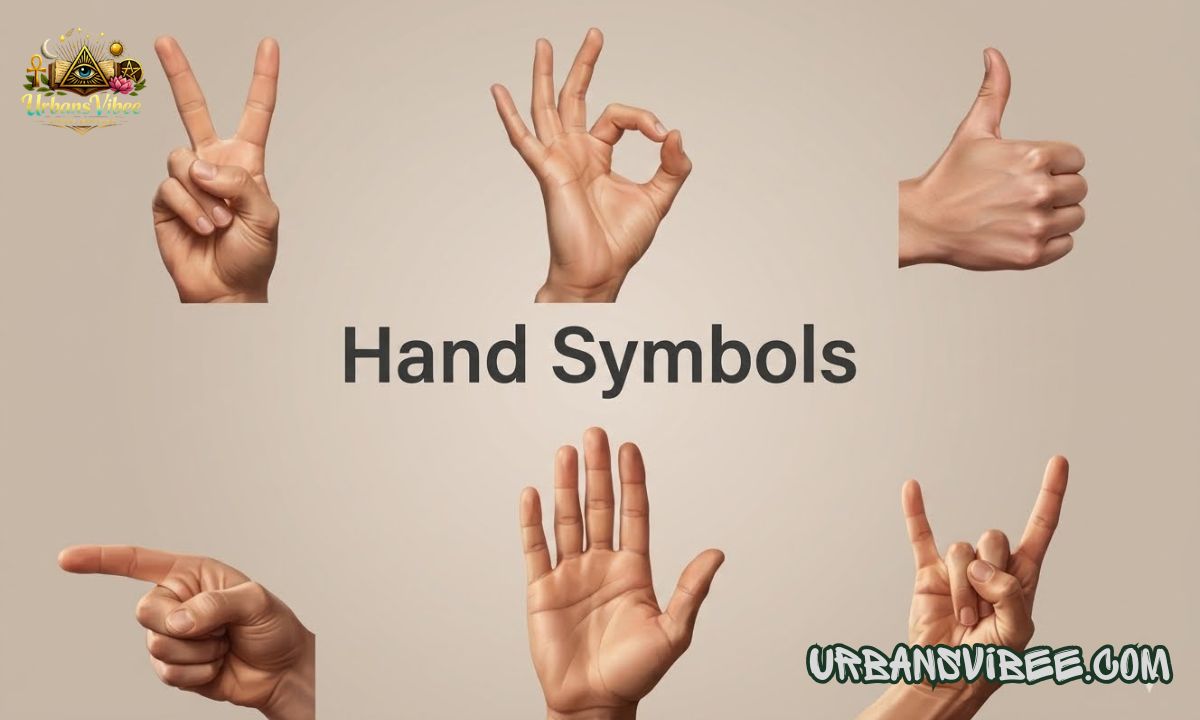
Have you ever paused to wonder why a simple raised palm can stop traffic, start a prayer, or signal peace across a crowded room? Hand symbols are among the oldest and most powerful forms of human communication — and in 2026, they remain just as relevant as ever. From ancient cave walls to Instagram reels, hands speak a language that words often can’t.
This guide covers 89+ hand symbols and meanings, explores their spiritual roots, cultural significance, and modern interpretations — all in one place.
What Are Hand Symbols?
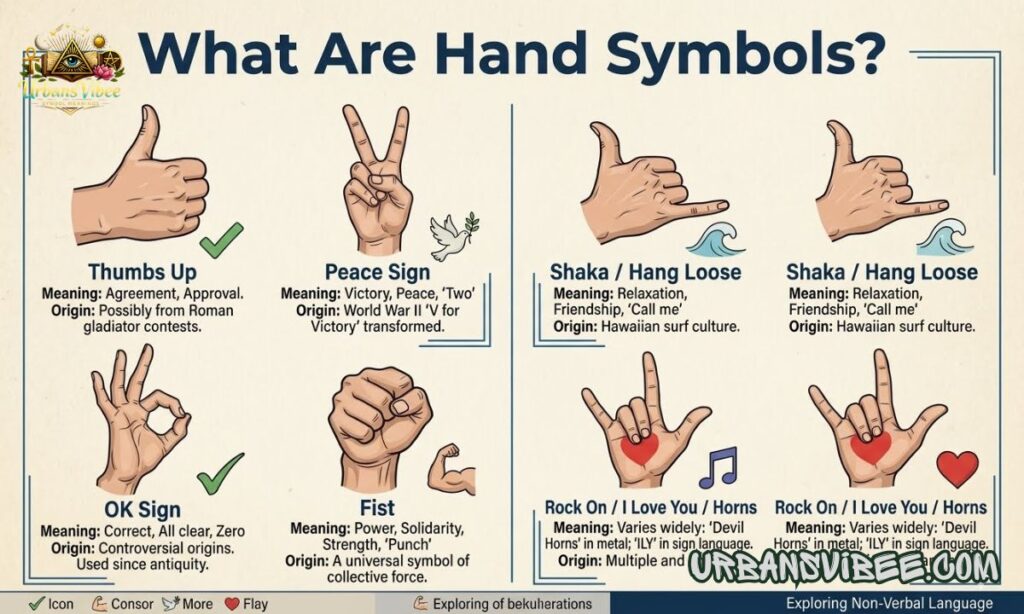
Hand symbols are gestures or visual representations of hands used to communicate ideas, emotions, beliefs, or power without a spoken word. They operate as a universal nonverbal language, crossing barriers of geography, religion, and time.
The earliest known hand symbols date back roughly 40,000 years — cave paintings in Indonesia and France feature stenciled handprints believed to represent identity, presence, and spiritual connection.
That ancient impulse hasn’t disappeared. Today, hand symbols appear in yoga studios, political rallies, courtrooms, concert halls, and on jewelry worn around the world.
Hand Symbols And Meanings Guide
Understanding hand symbols starts with recognizing that meaning is shaped by three forces: context, culture, and intention. The same open palm can mean “stop,” “I come in peace,” or “receive a blessing” depending on where you are and who is watching.
Here is a quick-reference overview of the most recognized hand symbols and their core meanings:
| Hand Symbol | Primary Meaning | Cultural Origin |
| Hamsa Hand | Protection, good luck | Middle East, North Africa |
| Open Palm | Peace, honesty, welcome | Universal |
| Raised Fist | Solidarity, resistance | Political movements |
| Peace Sign (V) | Peace, victory | Western culture |
| Namaste/Prayer Hands | Reverence, gratitude | South Asian tradition |
| Pointing Finger | Direction, accusation | Universal |
| Thumbs Up | Approval, positivity | Western, modern |
| OK Sign | Agreement, perfection | Western (context-dependent) |
| Mudras | Spiritual energy, focus | Hindu and Buddhist traditions |
| Hand of Fatima | Divine protection | Islamic and Jewish traditions |
Hand Symbol Meanings
At the core, hand symbols carry meanings tied to the most fundamental human experiences:
- Power and authority — Raised hands, extended palms, and pointing gestures have long communicated dominance or leadership.
- Protection — Symbols like the Hamsa are worn as talismans to guard against negative energy.
- Connection — Clasped hands, handshakes, and held hands express trust, love, and unity.
- Healing — In Reiki, laying-on-of-hands practices, and traditional medicine, hands are believed to channel restorative energy.
- Devotion — Prayer positions and mudras express surrender to something greater.
Hand Symbol Meaning Spiritual
Spiritually, hands are not just physical tools — they are believed to be conduits of divine energy. Across virtually every major faith tradition, hands play a central role in ritual and worship.
- In Christianity, laying hands on someone represents blessing and the transfer of divine healing power.
- In Islam and Judaism, the Hamsa (Hand of Fatima / Hand of Miriam) is a sacred protective symbol.
- In Hinduism and Buddhism, mudras — precise hand positions — channel specific forms of spiritual energy and support meditation and enlightenment.
- In Reiki healing, practitioners use their hands to transfer life-force energy to patients, balancing emotional and physical health.
The right hand is commonly associated with giving, action, and outward energy. The left hand is connected to receiving, intuition, and inner wisdom. This spiritual duality runs through dozens of traditions worldwide.
Hand Symbolism Meaning
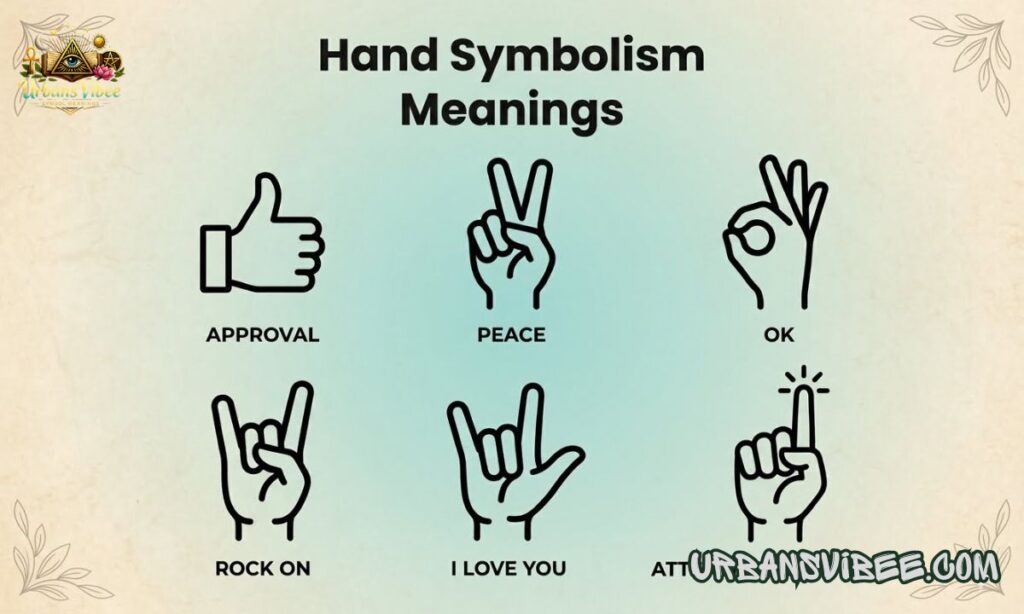
Hand symbolism operates on three distinct levels that make these symbols so compelling and enduring:
Spiritual Level
Hands represent the bridge between the human world and the divine. Whether through prayer, ritual gesture, or healing touch, the hand in spiritual traditions is always more than flesh — it is a channel.
Psychological Level
On a psychological level, hands reveal emotional states faster than words. Clenched fists signal anger or determination. Open palms indicate honesty and openness. Hands covering the face communicate shame or grief.
Humans are hardwired to read hand gestures as signals of safety and intention — an instinct rooted in prehistoric survival.
Cultural Level
Culturally, hand symbols carry collective memory. They represent identity, faith, rebellion, unity, and belonging. A raised fist at a protest, a prayer gesture at a temple, or a sorority hand sign at a campus event — each tells a story of group identity and shared values.
Hand Gestures And Modern Meanings
Modern hand gestures have taken on new layers of meaning in the digital age. Some have crossed cultural lines and gained global recognition. Others carry very different meanings depending on where you use them.
7 Powerful Hand Gestures explained:
- Open Palm — Universal gesture of peace and non-threat; signals “I am unarmed and honest.”
- Thumbs Up — Approval in the West; offensive in parts of the Middle East and West Africa.
- Peace/Victory Sign (V) — Peace or victory when palm faces outward; a rude insult in the UK when palm faces inward.
- OK Sign — Approval in the US; associated with dive culture; recently weaponized as a trolling symbol, so context matters enormously.
- Pointing Finger — Direction in most cultures; considered rude in Japan and Malaysia where an open hand gesture is preferred.
- Raised Fist — Power, resistance, solidarity; popularized globally through civil rights and labor movements.
- Namaste/Prayer Hands — Respect, gratitude, and greeting across South Asian and Buddhist cultures; widely adopted globally as a sign of mindfulness.
Bad Hand Gestures Meaning With Pictures
Some gestures that seem harmless in one culture are deeply offensive in another:
- Middle Finger — Obscene insult in Western cultures
- Backwards V-sign — Highly offensive in the UK and Australia
- Thumbs Up — Insulting in parts of the Middle East
- “OK” Circle — Considered offensive in Brazil and Turkey
- Beckoning with one finger — Rude in Japan and parts of Asia; reserved for calling animals
Always research local gesture norms before traveling internationally.
Spiritual, Ancient And Cultural Hand Symbols
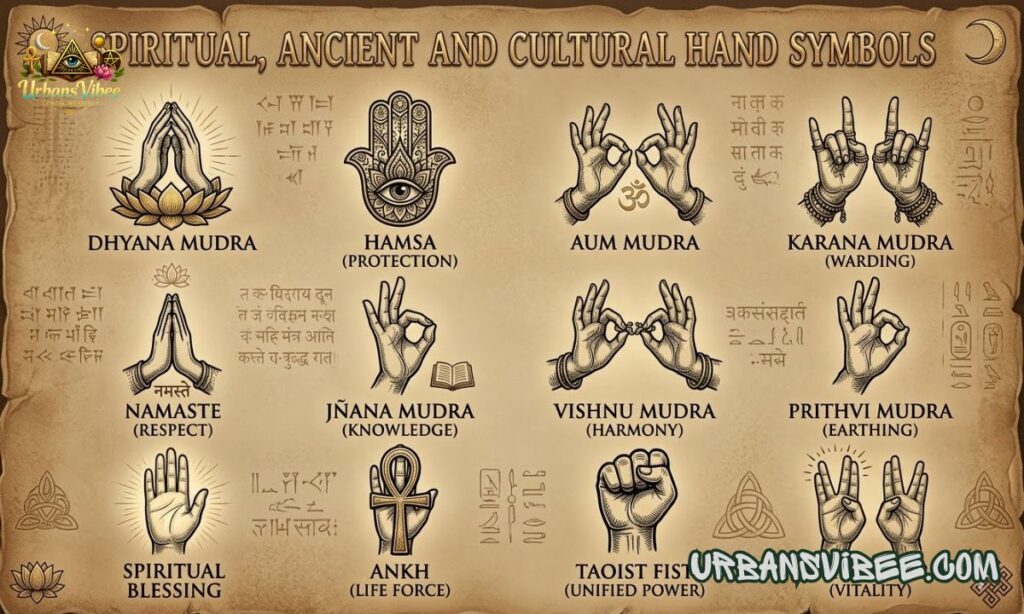
1. Hamsa Hand
The Hamsa is one of the most recognized hand symbols in the world. Originating in North Africa and the Middle East, it depicts an open right hand — often with an eye in the center — and is used as a protective talisman against the evil eye. In Islam, it is called the Hand of Fatima. In Judaism, it is the Hand of Miriam.
- Fingers pointing up: Protection, warding off negativity
- Fingers pointing down: Welcoming abundance and blessings
The Hamsa transcends any single religion. It carries meaning in Islamic, Jewish, and even Hindu traditions — making it one of the most cross-cultural hand symbols in existence.
2. Mudras
Mudras are ancient hand gestures used in yoga, meditation, Hinduism, and Buddhism. The word means “seal” or “gesture” in Sanskrit. Each position is believed to direct the flow of energy through the body.
Popular mudras and their meanings:
- Gyan Mudra (index finger meets thumb) — Knowledge, concentration, wisdom
- Abhaya Mudra (raised open palm) — Fearlessness, protection, peace
- Dhyana Mudra (hands resting in lap, palms up) — Deep meditation, inner calm
- Anjali Mudra (prayer hands) — Reverence, gratitude, unity of opposites
- Chin Mudra — Consciousness, connection of individual self to universal spirit
3. Raised Fist
A closed fist raised upward communicates solidarity and resistance. It became globally iconic during civil rights movements in the 1960s and continues to appear in labor rights, feminist, and anti-oppression movements worldwide.
4. Peace Sign
Two fingers raised in a V shape — palm outward — became the defining symbol of peace and counterculture movements in the 1960s. Winston Churchill earlier used it as a “V for Victory” symbol during World War II. Today it communicates peace, harmony, and positivity in most global contexts.
5. Handshake
The handshake is one of the oldest recorded hand symbols. In ancient Rome and Greece, clasping hands sealed agreements and demonstrated that neither party carried a weapon. Today it signifies trust, partnership, and mutual respect in both personal and professional settings.
6. Open Palm Blessing
In Christian tradition, bishops and priests extend an open palm over congregants to convey divine blessing. In many indigenous traditions, an open palm raised toward the sky calls on spiritual forces. Across cultures, the open hand pointing upward represents reception of divine grace.
Hand Symbols Across Cultures
Ancient Civilizations
In Ancient Egypt, hands appearing in hieroglyphics represented authority, craft, and divine action. Priests raised hands during sacred rituals to channel energy from the gods.
In Ancient Rome and Greece, hand gestures were integral to oratory — rhetoricians used precise gestures to emphasize and persuade.
South Asian Traditions
In India and Nepal, mudras remain central to both spiritual practice and classical dance. Bharatanatyam and Kathakali dancers use dozens of precise hand positions — called hasta mudras — to narrate entire stories without words. Each gesture communicates a specific emotion, deity, or narrative event.
Middle Eastern Cultures
The Hamsa hand dominates hand symbolism across the Middle East and North Africa. It appears on jewelry, home décor, and artwork as a shield against harm. The five fingers are said to represent the five pillars of Islam or the five books of the Torah, depending on tradition.
Western Culture
In Western societies, hand symbols have been shaped by Christianity, political movements, and popular culture. The clasped hands of prayer, the raised hand taking an oath, and the extended hand of blessing all carry deep historical roots. In modern times, gang signs, sports team gestures, and corporate brand gestures (like Jay-Z’s “Roc” diamond) have added new layers of hand symbolism.
East Asian Symbolism
In China and Japan, hand gestures appear in Buddhist rituals, martial arts, and theater. The specific positions of hands in kung fu and karate katas are not merely functional — they carry symbolic weight representing discipline, inner balance, and spiritual alignment.
Religious, Occult And Pop Culture Hand Symbols
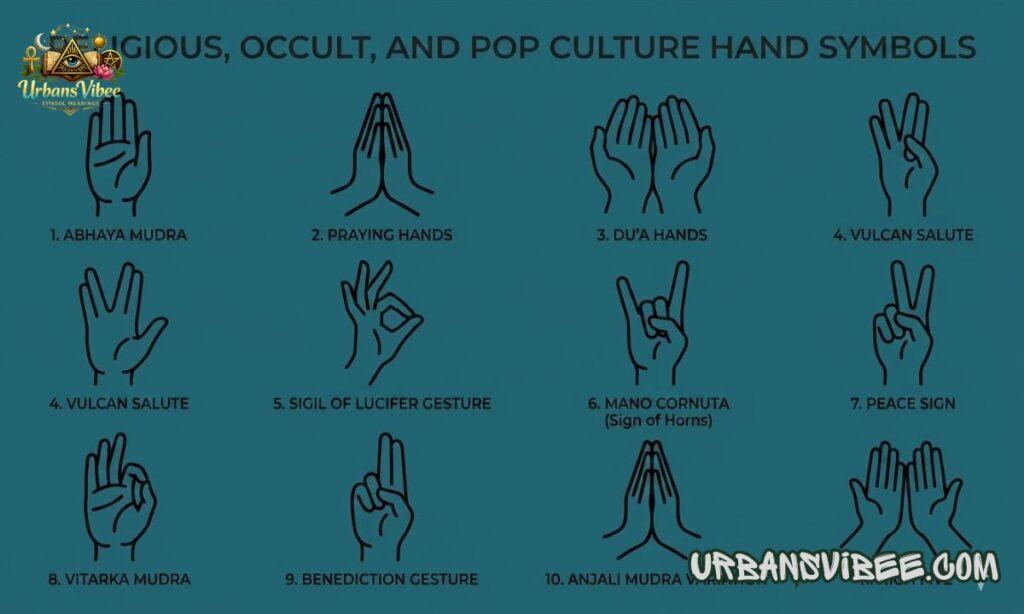
Christian Hand Symbols
In Christianity, the raised hand with two or three fingers extended is used in benediction — the formal act of blessing. Three fingers represent the Holy Trinity. The Ichthys fish drawn by tracing two curved arcs with fingers was historically used as a secret identification symbol among early Christians.
Buddhist Hand Symbols
Buddhist deities are depicted with specific mudras identifying their purpose and power. The Dharmachakra Mudra (wheel-turning gesture) represents the teaching of the dharma. The Bhumisparsha Mudra (earth-touching gesture) is associated with the moment of the Buddha’s enlightenment.
Masonic And Freemason Hand Symbols
Freemasonry uses specific hand grips and gestures as part of initiation rituals and symbolic communication between members. These include distinctive handshake variations at different degree levels.
These gestures represent loyalty, secrecy, and tradition within the fraternal organization. It’s worth noting that Freemasonry is an open fraternal society with public lodges worldwide — not a shadowy conspiracy.
Illuminati Hand Symbols
The triangle hand sign (formed by touching both thumbs and index fingers together) is often linked to the Illuminati in popular culture. Historically, the triangle with an eye (Eye of Providence) is a Christian symbol representing divine oversight, later adopted by Freemasonry and printed on the US dollar. Its association with a secret elite order is a product of modern conspiracy culture, not documented history.
Occult Hand Symbols
Occult hand symbols are used in esoteric and mystical traditions:
- El Diablo / Horned Hand — Rock culture and heavy metal; also appears in Italian folklore as the “Mano Cornuto” for warding off the evil eye
- As Above So Below — One hand pointing up, one pointing down; represents the Hermetic principle of the mirror between earthly and divine planes
- Hidden Hand — A hand concealed inside a coat, associated in conspiracy theories with secretive allegiance
Sorority Hand Symbols
Sororities and Greek letter organizations use unique hand signs as symbols of sisterhood and identity. These signs are typically shown during events, photos, or public gatherings and represent pride in membership and shared bonds within the organization.
Entertainment And Specialized Hand Signs
Naruto Hand Symbols
In the anime series Naruto, characters perform elaborate sequences of hand signs — called hand seals — to activate ninjutsu techniques. These seals are based on the twelve animals of the Chinese zodiac and are deeply embedded in the show’s lore. Fans recreate them as a form of engagement with the franchise.
Domain Expansion Hand Symbols
From the manga and anime Jujutsu Kaisen, characters perform specific hand signs to activate their “Domain Expansion” — a powerful technique. These signs have become iconic among fans and are instantly recognizable in cosplay and fan communities.
Solfege Hand Symbols
In music education, the Curwen hand signs (Solfege hand symbols) assign a distinct hand position to each note of the musical scale (Do, Re, Mi, etc.). Developed by John Curwen in the 19th century, this system helps students physically feel and remember pitch relationships. It is still widely used in choral education and the Kodály method of music teaching.
Hand Symbols in Art, Movies and Pop Culture
Artists throughout history have used hands as focal points for conveying emotion and meaning:
- Michelangelo’s “The Creation of Adam” — The nearly-touching hands of God and Adam have become one of the most reproduced images in Western art, representing the divine spark of life.
- The Titanic (film) — Hands pressed against fogged glass are an iconic image of love, longing, and separation.
- Superhero films — Heroes extend open hands to protect or heal; villains clench fists to dominate. The body language is immediate and symbolic.
- Music videos and concerts — Artists like Jay-Z popularized the “Roc” diamond triangle sign; fans replicate it as a sign of loyalty and cultural identity.
Spiritual and Dream Meaning of Hand Symbols
Dreaming of hands carries specific symbolic weight. Hands in dreams often relate to personal power, agency, and relationships:
- Clean, open hands — You are ready to give or receive; a period of openness is beginning
- Dirty or bloody hands — Guilt, responsibility, or unresolved conflict
- Reaching hands — A desire for connection or a call to take action
- Glowing or healing hands — A period of spiritual growth or healing energy entering your life
- Tied or bound hands — Feelings of helplessness or restricted personal freedom
If the hand symbol keeps appearing in waking life or dreams, many spiritual traditions interpret this as a signal to examine your power, your boundaries, or your capacity to both give and receive.
Positive vs Negative Meaning of Hand Symbols
Not all hand symbols carry universally positive meanings. Here is how they break down:
| Positive Meanings | Negative Meanings |
| Open palm = honesty, peace | Pointing finger = accusation, blame |
| Clasped hands = unity, trust | Raised fist (in aggression) = threat |
| Hamsa = protection, blessings | El Diablo = occult associations |
| Prayer hands = reverence | Hidden hand = secrecy, hidden agenda |
| Mudras = healing, focus | Obscene gestures = disrespect, insult |
Context transforms meaning. A fist raised in solidarity at a protest and a fist raised in anger at a confrontation look identical — but carry completely opposite intentions.
Why Humans Are Attracted to Hand Symbols
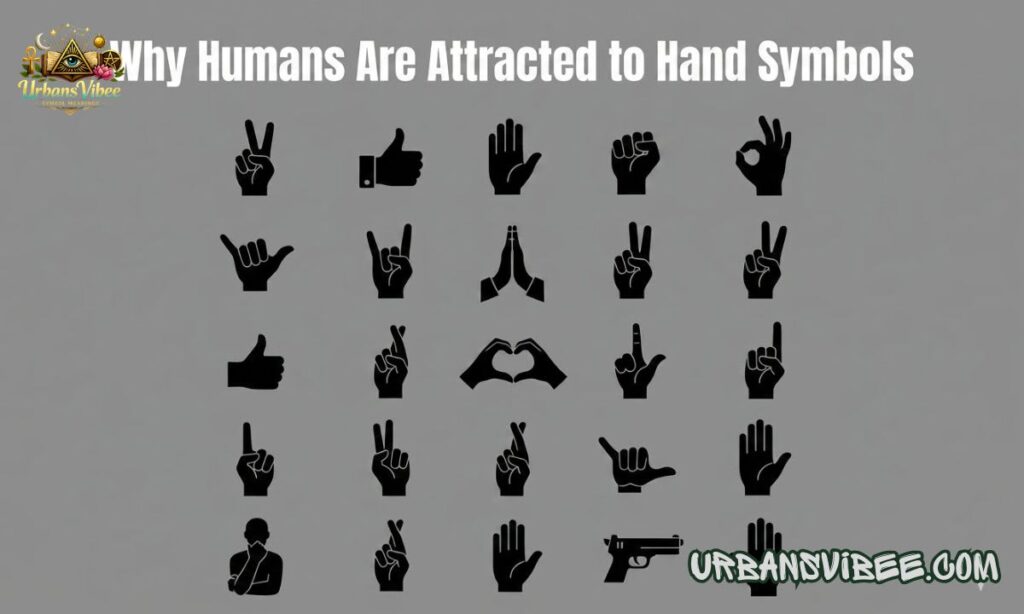
The answer lies deep in our neurology and social evolution. Humans are visually wired to track hands. Before language developed, reading a stranger’s hands was a survival skill — open hands meant safety, closed hands potentially concealed a weapon.
Today, that ancient circuit still fires. We instinctively read hands to detect trust, threat, emotion, and intention. This is why hand symbols carry such immediate emotional weight — they bypass language and speak directly to our most primal social intelligence.
Additionally, hands are the tools through which humans create, build, heal, and connect. To symbolize the hand is to symbolize human agency itself.
Conclusion
Hand symbols are far more than decorative gestures or cultural curiosities. They are one of humanity’s oldest, most universal, and most layered communication systems. From the 40,000-year-old cave handprints in Indonesia to the mudras in modern yoga studios, from the Hamsa on a protective amulet to the peace sign at a concert, hands have always told the story of who we are and what we believe.
Understanding these symbols deepens cultural literacy, sharpens awareness of nonverbal communication, and opens a window into the spiritual traditions of civilizations across time. Whether you encounter them in art, religion, dreams, or daily life, hand symbols remind us that some messages are too important — and too human — to leave to words alone.
Frequently Asked Questions
What Are Hand Symbols?
Hand symbols are gestures or visual representations of hands that communicate emotions, beliefs, power, or identity without spoken words, used across cultures for thousands of years.
What Do Hands Symbolize?
Hands symbolize power, protection, creativity, healing, connection, and action — making them one of the most universal symbols in human culture.
What Does The Hand Symbol Mean Spiritually?
Spiritually, the hand symbol represents divine energy, protection, healing, and the ability to channel blessings or transfer spiritual power between people.
What Is The Most Powerful Hand Symbol?
The Hamsa hand is widely considered one of the most powerful — recognized across Islamic, Jewish, and other traditions as a shield against negativity and a magnet for blessings.
What Do Hands Represent In Dreams?
Hands in dreams typically represent personal power, agency, relationships, and your capacity to create, give, or receive in waking life.
What Does The Raised Fist Hand Symbol Mean?
The raised fist represents solidarity, resistance, and collective power — most prominently associated with civil rights, labor rights, and social justice movements globally.
Are Mudras Real Hand Symbols?
Yes. Mudras are precise hand gestures from Hindu and Buddhist traditions, believed to direct the flow of energy through the body and support meditation, healing, and spiritual focus.
What Is The Difference Between Masonic And Illuminati Hand Signs?
Masonic hand signs are real ritual gestures used within Freemasonry’s fraternal tradition. “Illuminati hand signs” are largely a product of modern conspiracy culture; the historical Bavarian Illuminati dissolved in the 1780s and left no documented hand-sign system.
What Are Negative Hand Symbols?
Negative hand symbols include obscene gestures like the middle finger, the backwards V-sign in the UK, and culturally offensive uses of the OK sign or thumbs up in specific regions.
What Does An Open Palm Mean?
An open palm universally signals honesty, peace, non-aggression, and openness — one of the most instinctively understood hand gestures across human cultures.

Stephen Miller is a language enthusiast and symbol researcher at UrbansVibee. He specializes in uncovering the meanings, origins, and cultural significance of symbols, helping readers understand signs, icons, and symbolism from around the world.