
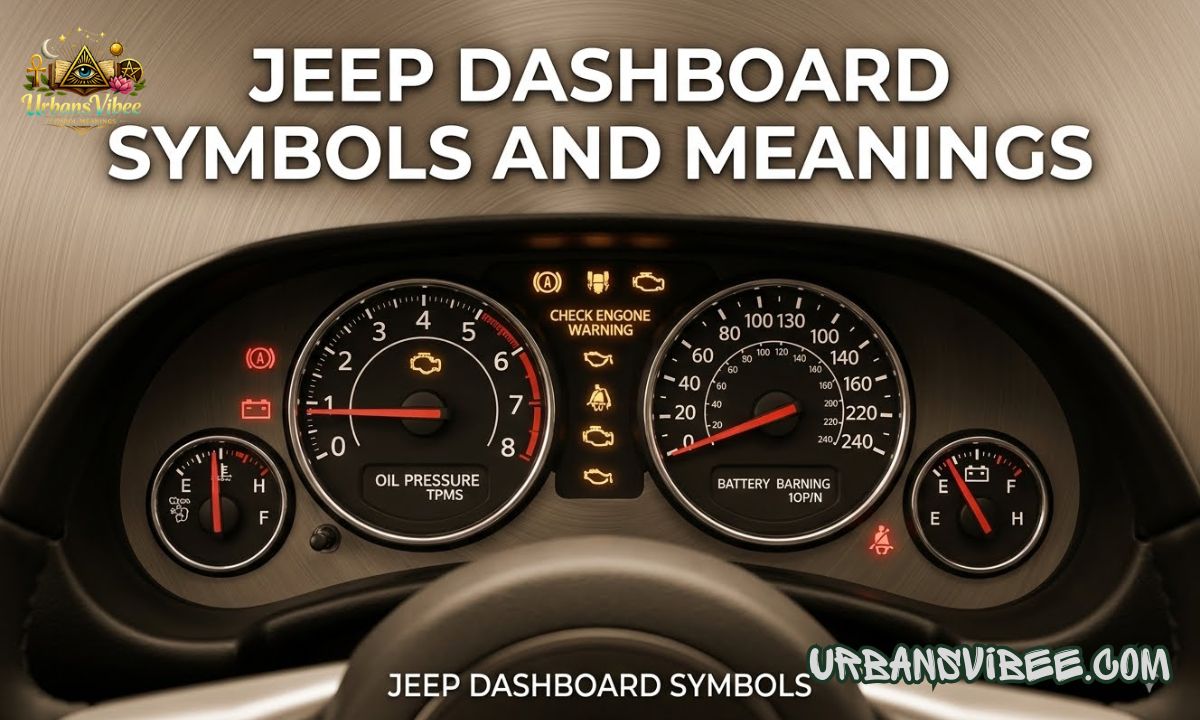
Your Jeep is constantly communicating with you. Every time a light blinks on your instrument cluster, it is delivering a message from the vehicle’s onboard diagnostic system — a message that could save your engine, your tires, your brakes, or your life.
The problem is that most drivers don’t know what those symbols mean until something has already gone wrong. Whether you drive a Jeep Wrangler tearing through trails or a Jeep Grand Cherokee on the daily commute, understanding every symbol on your dashboard is not optional — it’s essential.
This guide decodes every major Jeep dashboard symbol across all major models, explains what action to take, and gives you the confidence to respond correctly the moment any light appears.
What Are Jeep Dashboard Symbols and Meanings?
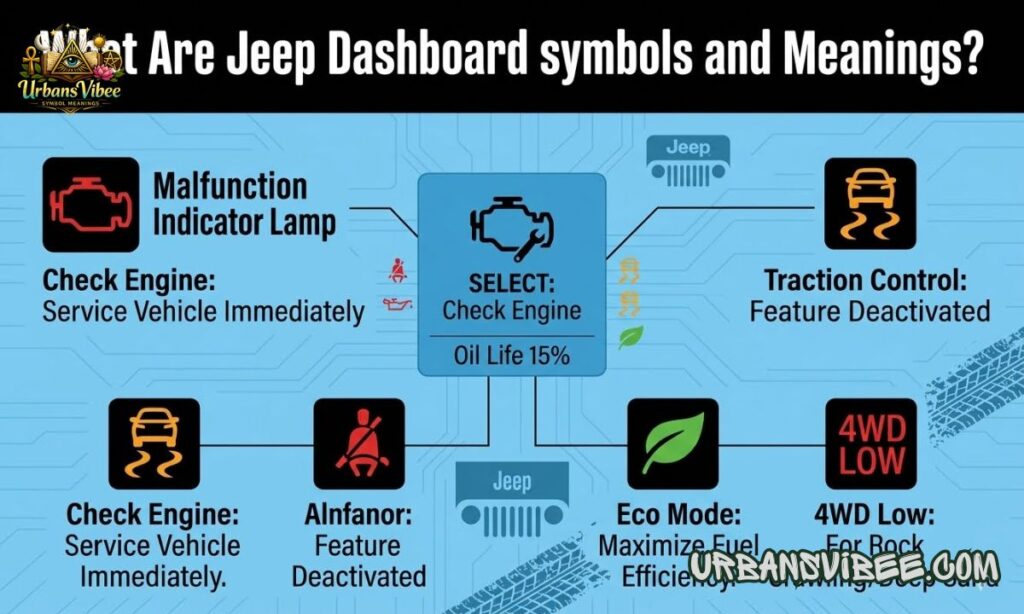
Jeep dashboard symbols are illuminated icons that appear on your vehicle’s instrument cluster to communicate real-time information about the vehicle’s mechanical health, safety systems, and operational status. They evolved as automobiles became more complex — replacing text-heavy alerts with universally understood visual icons that work regardless of the driver’s language.
Jeep follows global automotive standards for dashboard iconography, which means most symbols are consistent across Cherokee, Wrangler, Compass, Grand Cherokee, Gladiator, and Avenger models. The key to reading them correctly is understanding the color system:
- Red lights — Immediate danger. Stop the vehicle safely as soon as possible. Driving further risks severe engine damage, brake failure, or a safety emergency.
- Yellow / Amber lights — Developing issue. The system still operates, but needs attention soon. Schedule service promptly.
- Green lights — Active system confirmation. Everything is working as intended.
- Blue lights — Informational. Typically indicate high beams or temperature-related status.
- White lights — Neutral information or system notifications.
Jeep Dashboard Symbols And Meanings Guide
Jeep Dashboard Symbols And Meanings PDF
Many Jeep owners search for a dashboard symbol PDF to keep saved on their phone for quick roadside reference. Jeep’s official owner’s manual (available as a free PDF download through Jeep’s owner portal at moparownerconnect.com) contains a complete visual index of all dashboard symbols specific to your model year.
Third-party quick-reference PDFs are also widely available, but always cross-reference against your official owner’s manual since symbols can vary between model years and trim levels.
What Does A Mean On Jeep Dashboard?
The letter “A” on a Jeep dashboard refers to the Auto Stop-Start System indicator. When the “A” appears (often with a circular arrow around it), it means your vehicle’s engine has automatically shut off to save fuel while you are stopped at a traffic light or in traffic.
This is a fuel-efficiency feature standard on many modern Jeep models. If the “A” appears with a strikethrough or a warning indicator, it signals that the Auto Stop-Start system is deactivated or has detected a fault that needs attention.
Jeep Models Dashboard Symbols Explained
Jeep Cherokee Dashboard Symbols And Meanings
The Jeep Cherokee dashboard covers a comprehensive set of alerts spanning engine health, safety systems, and modern driver assistance features. Key Cherokee-specific symbols include:
- Electronic Stability Control (ESC) — A car icon with curving lines beneath it; activates when the stability system detects and corrects skidding or loss of traction
- Hill Start Assist — Helps the vehicle hold position on inclines when starting from a stop
- Blind Spot Monitoring — An alert on the side mirror when another vehicle enters your blind zone
- Oil Pressure Warning — Red oil can icon; pull over immediately and check oil level
- Transmission Temperature Warning — Thermometer inside a gear shape; indicates the transmission fluid is overheating
Jeep Wrangler Dashboard Symbols And Meanings
The Wrangler is Jeep’s most off-road-focused model, and its dashboard reflects that. Wrangler-specific symbols include:
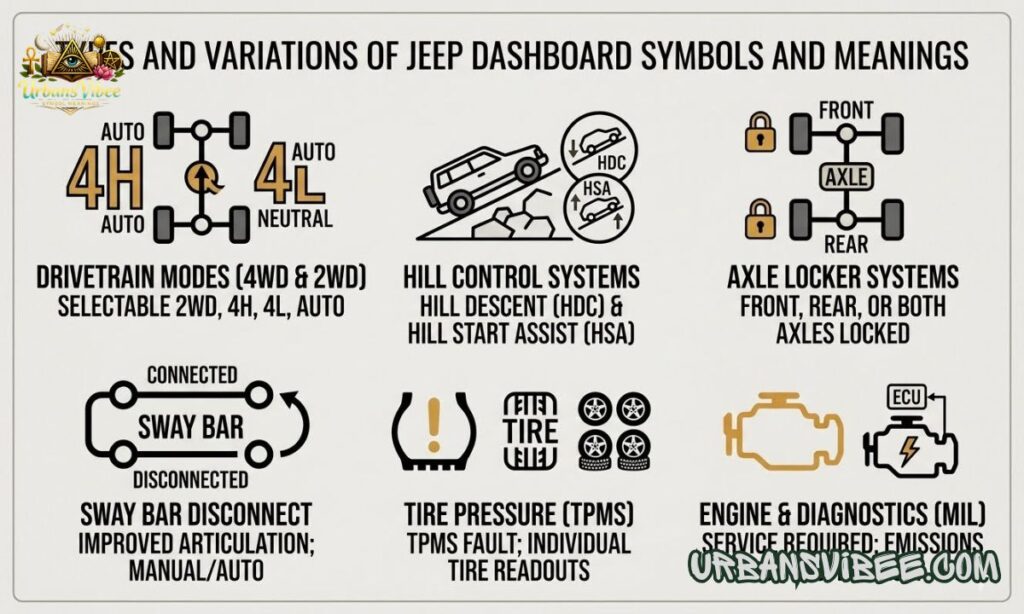
- 4WD Indicator Lights — Shows whether you are in 2H, 4H, or 4L; critical for safe off-road operation
- Hill Descent Control (HDC) — Notifies when the HDC feature is active on steep descents
- Sway Bar Disconnect — Found on Rubicon trims; indicates the front sway bar has been disconnected for improved flex on the trail
- Axle Lock Indicator — Rubicon models display this when front or rear axle locking is engaged
- TPMS Warning — Common after off-road pressure drops; adjust tire inflation per terrain and surface
Jeep Compass Dashboard Symbols And Meanings
The Compass is Jeep’s most urban and technology-forward compact SUV. Its dashboard includes many advanced driver assistance system (ADAS) alerts:
- Lane Departure Warning — Alerts when the vehicle drifts out of lane without a turn signal
- Forward Collision Warning — Cautions when you are closing in on a vehicle ahead too quickly
- Adaptive Cruise Control — Indicates the active state of ACC when engaged
- Low Fuel Indicator — Appears when fuel drops to approximately 2–3 gallons remaining
- Service Required — A wrench symbol; indicates scheduled maintenance is due
Jeep Grand Cherokee Dashboard Symbols And Meanings
The Grand Cherokee’s more complex powertrain and advanced safety suite mean its dashboard carries more symbols than most Jeep models:
- Active Driving Assist — Driver Inattentiveness Warning — Illuminates when the system detects driver inattention; hands must return to the wheel immediately
- Air Suspension Warning — Found on models with Quadra-Lift air suspension; alerts to pressure issues or height adjustment faults
- Selec-Terrain Mode Indicator — Displays the active terrain mode: Auto, Snow, Sport, Sand/Mud, or Rock
- Transfer Case Fault — Indicates an issue with the Quadra-Trac or Quadra-Drive four-wheel-drive system
- Airbag Fault — Red seated figure with a circle; must not be ignored — the airbag system may not deploy in a collision if this light is active
Jeep Gladiator Dashboard Symbols And Meanings
The Gladiator combines the Wrangler’s off-road DNA with a pickup bed, and its dashboard reflects dual-use utility:
- Trailer Tow Warning — Alerts to trailer connection faults, trailer sway detection, or trailer brake issues
- Payload Warning — Notifies when the vehicle is approaching or exceeding its rated payload capacity
- Rear Camera Fault — Indicates the backup camera system is not functioning
- Traction Control Off Indicator — Shows when traction control has been manually disabled for specific off-road terrain conditions
- Service 4WD — Signals a fault in the four-wheel-drive engagement system requiring dealership diagnosis
Jeep Avenger Dashboard Symbols Explained
The Jeep Avenger — Jeep’s first fully electric model for the European market — introduces EV-specific dashboard symbols alongside standard ones:
- Battery Charge Level — EV-style battery icon replacing the fuel gauge; indicates remaining range
- Charging Status Indicator — Shows active charging, completed charging, or charging fault
- Regenerative Braking Indicator — Displays when the regen system is actively recovering energy during deceleration
- EV Range Warning — Alerts when estimated driving range drops to a critical level
- High Voltage System Warning — A specific Avenger safety alert for the high-voltage electrical system; requires immediate professional attention
Jeep Warning Lights And Symbol Meanings
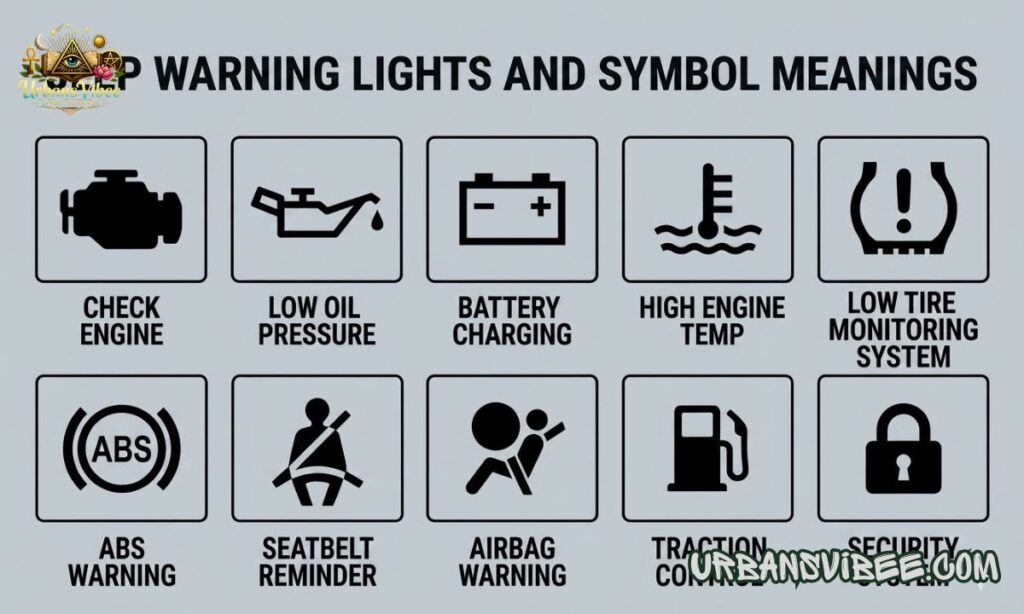
Jeep Dashboard Symbols
All Jeep dashboard symbols fall into three broad categories: warning lights (something is wrong), indicator lights (something is active), and information lights (a reminder or status update). The most critical distinction every Jeep driver must make is whether a light is red or yellow — because that single difference determines whether you stop immediately or schedule a service appointment within the week.
Jeep Warning Lights Symbols
Here is a complete quick-reference table of the most important Jeep warning light symbols:
| Symbol | Icon Description | Color | Meaning | Action Required |
| Check Engine | Engine outline | Yellow/Red | Engine or emissions fault | Diagnose with OBD scanner; service if flashing |
| Oil Pressure | Oil can with drip | Red | Oil pressure critically low | Stop immediately; check oil level |
| Battery | Battery icon | Red | Charging system failure | Reduce electrical load; drive to service |
| TPMS | Flat tire with ! | Yellow | Tire pressure low | Check and inflate all four tires |
| ABS | “ABS” in circle | Yellow | Anti-lock brake fault | Normal brakes work; schedule ABS service |
| Traction Control | Car with skid marks | Yellow | Traction control off or active | Normal if off-road; service if unexpected |
| Airbag | Seated figure, circle | Red | Airbag system fault | Immediate service; airbag may not deploy |
| Coolant Temp | Thermometer over waves | Red | Engine overheating | Stop immediately; let engine cool |
| 4WD Indicator | “4WD” or “4×4” | Green | 4WD system active | Informational; functioning normally |
| Brake Warning | “BRAKE” or (!) | Red | Brake system fault or parking brake on | Check parking brake; inspect brake fluid |
| SERV 4WD | “SERV 4WD” | Yellow | 4WD system needs service | Schedule diagnosis promptly |
| Transmission Temp | Thermometer in gear | Red | Transmission overheating | Stop; shift to Park; let cool |
| Seat Belt | Belt icon | Red | Seat belt not fastened | Buckle seat belt immediately |
| Power Steering | Steering wheel with ! | Yellow/Red | Power steering fault | Steering may be heavy; seek repair |
Jeep Warning Lights
Red warning lights that demand immediate action:
- Oil pressure warning — continuing to drive risks total engine seizure
- Engine coolant temperature — overheating can warp cylinder heads in minutes
- Brake system warning — compromised brakes are a direct safety emergency
- Airbag fault — the passive restraint system cannot protect occupants until repaired
Yellow/amber lights requiring prompt attention:
- Check engine (steady) — schedule a scan and service within the week
- TPMS — inflate tires to the PSI listed on the driver’s door jamb sticker
- ABS — brakes still function, but anti-lock assistance is unavailable
- Service 4WD — get the transfer case system diagnosed before your next off-road trip
Jeep Light Symbols / Jeep Dashboard Lights Meaning
Green and blue indicator lights are informational — they tell you a system is active, not that something is wrong:
- Green 4WD light — four-wheel drive is engaged and functioning
- Blue high beam indicator — your high beams are on
- Green cruise control indicator — cruise control is active
- Green turn signal arrows — directional indicators are working
Meaning Jeep Dashboard Symbols / Jeep Dashboard Symbol Meanings
The golden rule for any Jeep dashboard symbol: never ignore a red light, never delay addressing a yellow light, and always consult your owner’s manual before concluding a light is harmless.
Jeep Patriot Warning Lights
The Jeep Patriot (discontinued after 2017 but still widely driven) uses the same core warning light system as other Jeep models. Patriot owners should pay particular attention to:
- ESP/BAS warning — Electronic Stability Program and Brake Assist System; fault in the stability control system
- EVAP system warning — check engine related to fuel vapor emission controls; often triggered by a loose gas cap
- Tire Pressure light — Patriots did not have TPMS on all early model years; confirm your year’s equipment
Jeep Dashboard Symbols A With Circle
The “A” with a circular arrow (⟳) is the Auto Stop-Start indicator. When the engine automatically shuts off to conserve fuel at a stop, this symbol appears. When the “A” has a line through it or shows an alert color, the system is deactivated (either manually via the driver or due to a fault). Battery temperature, air conditioning load, and cabin temperature can all cause the system to suspend itself automatically — this is normal behavior.
Deep Symbolic Meaning of Jeep Dashboard Symbols
Spiritual Level
On a symbolic level, dashboard warning lights function as a form of vehicle intuition — an inner voice made visible. Just as human intuition surfaces discomfort before conscious awareness catches up with a problem, warning lights bring emerging mechanical issues into consciousness before they become crises.
Many experienced Jeep drivers describe a kind of attentiveness that develops over time — a sensitivity to what the dashboard is communicating that becomes almost instinctive. The vehicle and driver develop a language together.
Psychological Level
Dashboard warning lights trigger one of two psychological responses: anxiety or confidence — and which one depends entirely on knowledge. For a driver who understands each symbol, a yellow TPMS light is a minor, actionable task. For a driver who doesn’t, the same light can produce real stress and indecision that makes driving less safe.
Studies in automotive psychology consistently show that driver knowledge of warning systems directly reduces stress responses to dashboard events, improving driving decision quality in the moments after a warning appears.
Cultural Level
Dashboard symbols reflect a fascinating moment in automotive culture: the shift from a purely mechanical relationship between driver and vehicle to a digital, communicative one. Older drivers remember when you checked the oil manually every week and listened to the engine for problems.
Modern Jeep owners are in constant electronic dialogue with their vehicle. This shift represents a broader cultural evolution — from intuitive, hands-on knowledge to system-mediated awareness — and the dashboard is its most visible interface.
Types and Variations of Jeep Dashboard Symbols and Meanings
1. Check Engine Light
Visual: Engine block silhouette outline.
Color: Yellow (steady) or Red (flashing).
Meaning: The vehicle’s Engine Control Module (ECM) has detected a fault in the engine, emissions system, fuel system, or a related sensor. A steady yellow light means the fault is present but not immediately critical — it can range from a loose gas cap to a faulty O2 sensor to a misfiring cylinder. A flashing check engine light means the engine is misfiring severely enough to damage the catalytic converter. Pull over and reduce speed immediately if it flashes.
Action: Steady — use an OBD-II scanner or visit a service center within the week. Flashing — stop driving, call for assistance.
2. Oil Pressure Warning Light
Visual: Red oil can with a drip from the spout.
Color: Red.
Meaning: Engine oil pressure has fallen below the minimum safe operating level. Without adequate pressure, oil cannot lubricate critical engine components — bearings, camshafts, and pistons begin grinding metal-on-metal within seconds of pressure loss.
Action: Pull over immediately and safely. Turn off the engine. Check the oil level with the dipstick. If oil is present but the light remains after restarting, do not drive — call for towing. Driving with this light on risks complete engine destruction.
3. Battery Charge Warning Light
Visual: Rectangle with positive and negative terminal symbols.
Color: Red.
Meaning: The vehicle’s charging system — primarily the alternator — is not maintaining the battery at the correct voltage. This may be caused by a failing alternator, a loose or corroded battery cable, or a dying battery.
Action: Reduce electrical load (turn off AC, heated seats, radio). Drive directly to a service center. Do not turn the engine off — it may not restart. If the light appears at night, your headlights will dim as the battery drains.
4. Tire Pressure Monitoring System Light
Visual: Horseshoe-shaped cross-section of a tire with an exclamation mark inside.
Color: Yellow.
Meaning: One or more tires has dropped below the recommended inflation pressure. A 10°F drop in ambient temperature typically causes a 1 PSI drop in tire pressure — making this one of the most common winter warning lights.
Action: Check all four tires (including the spare on Wrangler and Gladiator models) with a pressure gauge. Inflate to the PSI listed on the driver’s door jamb sticker. The light will reset automatically after driving a few miles at speed. If it stays on after correct inflation, a tire may have a slow leak or the TPMS sensor may need replacement.
5. ABS Warning Light
Visual: The letters “ABS” enclosed in a circle.
Color: Yellow.
Meaning: The Anti-lock Braking System has detected a fault and has disabled itself. ABS prevents wheel lockup during hard braking — maintaining steering control in emergency stops. Without ABS active, wheels can lock under heavy braking, causing loss of steering control.
Action: Normal braking capability is still present — you can still stop the vehicle. However, ABS protection is unavailable. Schedule service promptly, especially before any winter driving or off-road use where emergency braking may be required.
6. Traction Control Light
Visual: A car silhouette with curved skid marks beneath the rear wheels.
Color: Yellow.
Meaning: Either traction control is actively intervening to prevent wheel spin (the light flashes briefly — this is normal) or the traction control system has been turned off or has developed a fault (the light stays on steadily).
Action: A brief flash during acceleration on wet or loose surfaces is normal and indicates the system is working. A steady light means the system is off — either intentionally (for off-road use) or due to a fault. If you did not manually disable traction control, have the system diagnosed.
7. Airbag Warning Light
Visual: A seated figure with a circular airbag inflating in front.
Color: Red.
Meaning: The Supplemental Restraint System (SRS) — airbags and seat belt pretensioners — has detected a fault. This light appearing means the airbags may not deploy in a collision, or may deploy unexpectedly.
Action: This is a critical safety issue. Do not transport passengers until the system is professionally inspected and repaired. The airbag system requires specialized diagnostic equipment — this is not a DIY repair.
8. Coolant Temperature Warning Light
Visual: A thermometer submerged in wavy lines (representing coolant fluid).
Color: Red.
Meaning: The engine coolant temperature has risen to a dangerous level. Engines overheat when the cooling system cannot remove heat fast enough — caused by low coolant, a failed thermostat, a broken water pump, or a blocked radiator.
Action: Stop the vehicle immediately and safely. Turn off the engine. Do not open the radiator cap while the engine is hot — scalding coolant is under pressure. Allow 30 minutes for cooling before checking the coolant level. If coolant is present but the light returns, the cooling system requires professional diagnosis.
9. 4WD Indicator
Visual: The text “4WD,” “4×4,” “4H,” or “4L” — sometimes with a vehicle icon.
Color: Green (active and functioning) or Yellow/Red (fault).
Meaning: A green 4WD indicator confirms the four-wheel-drive system is engaged and operating correctly. A yellow “SERV 4WD” message indicates a fault in the transfer case, actuator, or related sensors.
On Wrangler and Gladiator models, separate indicators distinguish between 4H (four-wheel high for light off-road) and 4L (four-wheel low for severe terrain).
Action: Green — informational, no action needed. Yellow SERV 4WD — schedule transfer case diagnosis before off-road use.
10. Brake Warning Light
Visual: The word “BRAKE” in capital letters, or an exclamation mark inside a circle (sometimes with a “P” inside for parking brake).
Color: Red.
Meaning: The brake warning light has two primary causes: the parking brake is engaged (most common and harmless), or there is a fault in the brake system — including critically low brake fluid, a hydraulic failure, or a brake line issue.
Action: First, confirm the parking brake is fully released. If the light remains after releasing the parking brake, check the brake fluid reservoir. If fluid is low, top up with the correct specification DOT fluid and inspect for leaks. If the light remains or the brake pedal feels soft or spongy, do not drive — call for towing immediately. Brake failure is a life-threatening emergency.
Jeep Dashboard Symbols Across Cultures
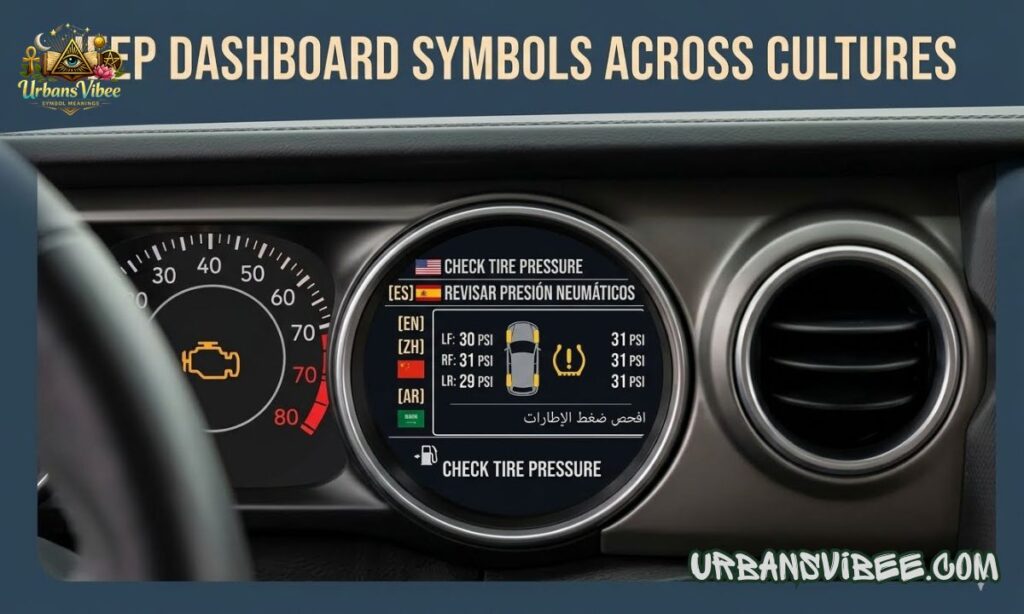
United States
In the United States — Jeep’s home market — dashboard symbols carry both technical and cultural significance. Jeep owners here are among the most trail-literate drivers in the world, meaning symbols like the 4WD indicator, hill descent control, and sway bar disconnect carry practical weight that goes beyond simple warning functions.
The American Jeep community has developed an entire culture around understanding and managing these systems for off-road performance.
Europe
In Europe, where the Jeep Avenger marks Jeep’s electric future, dashboard symbols increasingly include EV-specific indicators — battery state, regenerative braking, and charging status — alongside traditional engine warning lights.
European regulations under UNECE standards require specific icon designs, which is why dashboard symbol design is largely harmonized between American and European Jeep models.
Japan
In Japan, where Jeep models like the Grand Cherokee and Compass have strong followings, dashboard symbols are supplemented by the vehicles’ multi-information displays that translate symbol meanings into text.
Japanese drivers generally favor the informational confirmation lights — fuel economy indicators, charge status, and system-active confirmations — as primary dashboard engagement points.
Middle East
In Middle Eastern markets, where Jeeps frequently operate in extreme heat and sand conditions, coolant temperature warnings, transmission temperature alerts, and sand/mud terrain mode indicators are among the most frequently encountered dashboard symbols. Heat-related system stress makes temperature warning lights particularly critical in this context.
Modern Global Interpretation
The global standardization of automotive dashboard symbols — governed by ISO 2575, the international standard for road vehicle symbols — means that a Jeep driver in Islamabad, São Paulo, or Stockholm reads the same oil can icon with the same meaning. This visual universality is one of the most successful examples of international design standardization in any industry.
Jeep Dashboard Symbols in Art, Movies and Pop Culture
The Jeep’s dashboard has appeared in film and media as a visual shorthand for adventure, capability, and reliable toughness:
- In the original Jurassic Park, the Jeep Wrangler’s dashboard was prominently featured during the film’s iconic chase sequences — linking the Wrangler’s instrument cluster with the idea of a vehicle that could navigate genuinely dangerous, unknown terrain
- Off-road YouTube culture has created an enormous genre of content around “dashboard light diagnostics” — with Jeep-focused channels accumulating millions of views by decoding warning lights in real off-road situations
- Jeep’s own marketing consistently features dashboard close-ups during trail sequences, reinforcing the idea that knowing your warning lights is part of the Jeep identity
- The distinctive Jeep instrument cluster design has become part of the brand’s visual language — as recognizable as the seven-slot grille or round headlights
Spiritual and Dream Meaning of Jeep Dashboard Symbols
In dream interpretation, vehicle dashboard warning lights carry consistent symbolic meaning across cultural traditions:
- Dreaming of a check engine light is widely interpreted as an internal signal that something important in your life needs attention before it becomes a crisis — a relationship, a career path, or a health concern that you have been avoiding
- An oil pressure warning in a dream often symbolizes depleted personal energy — the feeling that you are running your life without adequate lubrication, pushing too hard without proper rest or replenishment
- Dreaming that your dashboard is lit with multiple warning lights typically represents a period of overwhelm — the sense that multiple areas of life are simultaneously demanding attention
- A battery warning light in a dream often connects to themes of personal power and creative energy — a fear that your internal resources are draining faster than they are being recharged
- Green indicator lights in dreams carry universally positive meaning — confirmation that systems are working, life is on track, and direction is clear
Positive vs Negative Meaning
Positive
Dashboard symbols, when understood, are profoundly positive tools:
- They give drivers advance warning before mechanical failures become catastrophic, potentially saving thousands in repair costs
- They create a direct communication channel between the vehicle’s intelligent diagnostic systems and the driver — a technological partnership
- They democratize automotive knowledge — even drivers with no mechanical training can respond correctly to a clear visual warning
- Green and blue indicator lights provide constant reassurance that critical systems are active and functioning
- Modern Jeep diagnostic systems can distinguish between minor, moderate, and critical faults, allowing drivers to make informed decisions rather than panic responses
Negative
Dashboard symbols also carry genuine negative potential when misunderstood or ignored:
- Ignored red warning lights are one of the leading causes of preventable, catastrophic mechanical failures — oil pressure ignored leads to seized engines; coolant warnings ignored lead to warped heads
- Warning light anxiety — unfamiliarity with symbols causes genuine driving stress that reduces focus on the road
- Symbol misidentification between model years or trim levels can lead to incorrect responses — a light that means one thing on a 2019 Cherokee may carry slightly different urgency on a 2025 model
- Deferred maintenance culture — treating yellow lights as indefinitely ignorable creates a dangerous false sense of security
Why Humans Are Attracted to Dashboard Symbols
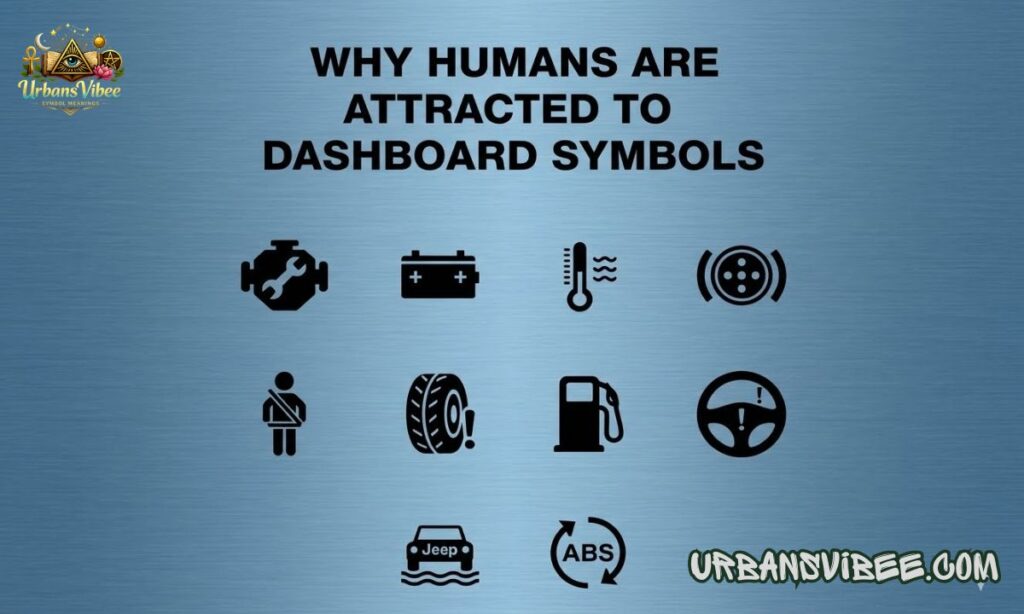
There is a deeply human quality to the relationship between a driver and their dashboard. In an age when most mechanical processes are invisible — hidden beneath panels, managed by software, executed by sensors — the dashboard warning light is the one visible moment when the machine speaks directly to the person responsible for it.
Humans are fundamentally meaning-seeking creatures. We are wired to notice unexpected visual signals — especially those in bright red or amber — and to want to understand what they mean. Dashboard symbols satisfy that instinct with clarity: this is what is happening, this is how urgent it is, this is what you should do. In a world of increasingly complex, opaque technology, that directness is genuinely satisfying.
For Jeep drivers in particular, understanding the dashboard represents a point of pride that connects to the brand’s identity. Knowing what your SERV 4WD light means before you hit the trail, understanding your hill descent control indicator during a mountain descent, and reading your transmission temperature warning during a heavy tow — these are the marks of a capable, prepared driver. The dashboard is not just a warning system. It is the interface through which driver and machine build competence and trust together.
Conclusion
Every Jeep dashboard symbol is a form of communication from one of the most sophisticated monitoring systems in modern transportation — a system that watches your engine, brakes, tires, airbags, transmission, and dozens of other components simultaneously and delivers real-time intelligence to the driver’s field of vision.
Understanding this language is the foundation of responsible Jeep ownership. Red means stop. Yellow means to attend to it promptly. Green means your vehicle has your back. The driver who knows this responds faster, makes better decisions, and keeps both their Jeep and their passengers safer — on the highway and deep on the trail where these vehicles were built to go.
Frequently Asked Questions
What does the check engine light mean on a Jeep?
The check engine light signals that the ECM has detected a fault in the engine, emissions, or fuel system — steady means schedule service soon; flashing means stop driving and seek help immediately.
What does the “A” symbol on a Jeep dashboard mean?
The “A” with a circular arrow represents the Auto Stop-Start system — the engine has automatically shut off to save fuel while stopped, which is normal operation.
What do red dashboard lights mean on a Jeep?
Red dashboard lights indicate urgent, safety-critical issues requiring immediate attention — including oil pressure loss, engine overheating, brake failure, and airbag system faults.
What is the TPMS light on a Jeep?
The TPMS (Tire Pressure Monitoring System) light — a horseshoe-shaped tire with an exclamation mark — means one or more tires is under-inflated and needs air added to the recommended PSI.
What does SERV 4WD mean on a Jeep dashboard?
SERV 4WD means the four-wheel-drive system has detected a fault in the transfer case or related components and requires professional diagnosis before off-road use.
Is it safe to drive with the ABS light on?
Yes, you can still brake normally, but the anti-lock braking assistance is disabled — schedule service promptly, especially before driving in wet or slippery conditions.
What does the airbag warning light mean on a Jeep?
The airbag light means the Supplemental Restraint System has a fault — the airbags may not deploy in a collision, making this a critical safety issue requiring immediate professional repair.
Where can I find a Jeep dashboard symbols PDF?
The official Jeep owner’s manual — available as a free PDF through Jeep’s owner portal at moparownerconnect.com — contains a complete, model-specific reference for all dashboard symbols and warning lights.

Stephen Miller is a language enthusiast and symbol researcher at UrbansVibee. He specializes in uncovering the meanings, origins, and cultural significance of symbols, helping readers understand signs, icons, and symbolism from around the world.