Voodoo symbols have stirred curiosity, wonder, and deep spiritual reverence across centuries. They appear in sacred rituals, ancient manuscripts, and modern tattoos — yet most people only scratch the surface of what these signs truly mean.
Whether you are exploring African spirituality, Haitian Vodou, or Louisiana Voodoo, understanding these symbols opens a doorway to one of the world’s most misunderstood spiritual traditions.
This guide breaks down 70+ powerful voodoo symbols, their real meanings, cultural roots, and spiritual purpose — all in one place.
What Are Voodoo Symbols?
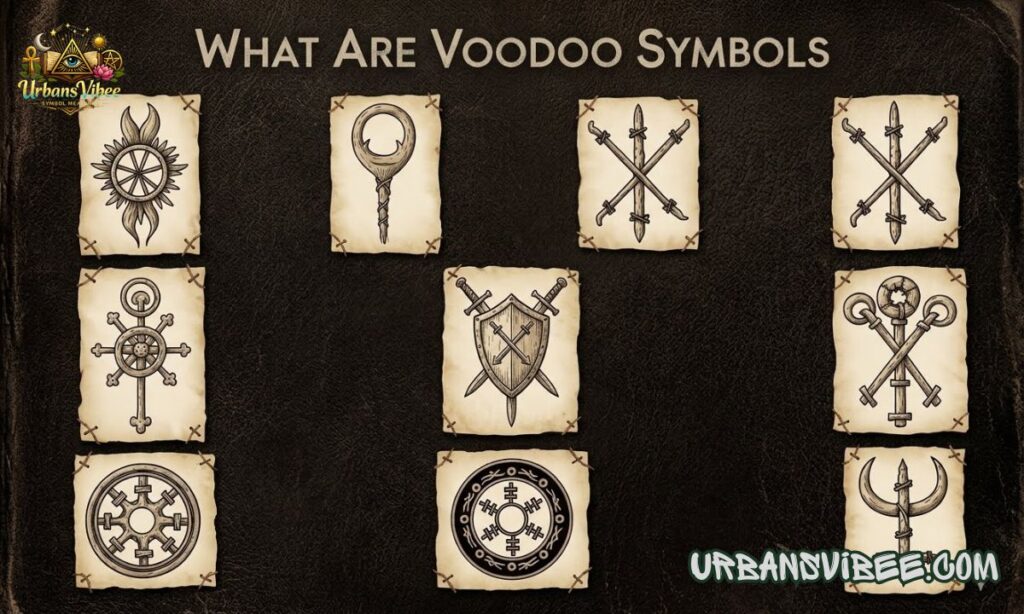
Voodoo symbols, more accurately known as veves, are sacred ritual drawings used in Haitian Vodou and related African diaspora traditions. These intricate geometric designs act as spiritual gateways between the human world and the realm of spirits.
The word voodoo itself traces back to the Fon word vodun, meaning spirit or deity. The religion emerged in Haiti during the colonial era, when enslaved Africans wove together West African spiritual systems with elements of Catholicism to preserve their faith and identity.
Practitioners draw veves on the ground using cornmeal, ash, flour, or powder during ceremonies. Each symbol represents a specific spirit — called a Lwa (or Loa) — and drawing one is essentially an invitation for that spirit to enter the ritual space. Think of it as a spiritual address or a sacred phone number dialed with intention.
Despite Hollywood myths, Vodou is not about curses or dark magic. It is a living spiritual system rooted in healing, ancestor reverence, and community connection.
Voodoo Symbols | Meanings, Uses and Types
Every voodoo symbol carries a distinct purpose depending on the Lwa it represents. Below is a structured overview of the most common categories and their spiritual roles.
| Symbol Category | Primary Purpose | Associated Lwa |
| Protection Symbols | Ward off evil, spiritual shielding | Ogou, Papa Legba |
| Love Symbols | Attract romance, strengthen bonds | Erzulie Freda |
| Death Symbols | Honor ancestors, transition rituals | Baron Samedi |
| Good Luck Symbols | Attract blessings and success | Various Lwa |
| Healing Symbols | Spiritual and physical restoration | Damballa, Simbi |
| Crossroads Symbols | Guidance, decision-making | Papa Legba |
Voodoo Symbols for Death
Death symbols in Voodoo do not carry a purely negative meaning. They represent transition, ancestral connection, and the cycle of life. Baron Samedi — the guardian of the dead — is the primary Lwa associated with death symbolism. His veve includes skull imagery, crosses, and coffin-shaped elements.
These symbols are used to:
- Communicate with ancestors during rituals
- Honor the spirits of those who have passed
- Facilitate healing that involves confronting mortality
- Request protection from Baron Samedi and the Ghede family
Voodoo Symbols PDF
A voodoo symbols PDF is a popular educational resource among practitioners and students of spirituality. These documents typically include clear drawings of veves, historical context, ritual uses, and each symbol’s associated Lwa. They serve as quick-reference guides for ceremonies and study.
Voodoo Symbols for Good Luck
Good luck voodoo symbols focus on attracting positive energy, removing obstacles, and opening pathways to success. They are commonly used in Hoodoo-influenced New Orleans Voodoo practices and often incorporated into gris-gris bags or drawn on altar cloths.
Common uses include:
- Drawing in business opportunities
- Removing spiritual blockages
- Attracting abundance and financial blessings
Voodoo Symbols Meaning
The meaning of any voodoo symbol depends entirely on the Lwa it represents. Understanding the correct meaning before using a symbol is essential — using the wrong one without knowledge can lead to unintended spiritual consequences.
Key examples:
- Hearts and mirrors → Love and beauty (Erzulie Freda)
- Serpents and coils → Creation and wisdom (Damballa)
- Crosses and keys → Crossroads and gateways (Papa Legba)
- Skulls and coffins → Death and resurrection (Baron Samedi)
- Swords and flames → Strength and justice (Ogou)
Voodoo Symbols Images
Visual representations of voodoo symbols help practitioners and learners recognize each design. Traditional veves are hand-drawn with powder on ceremonial floors. Modern depictions appear in tattoos, jewelry, artwork, and digital form. Looking at authentic images — rather than Hollywood versions — is essential for understanding their true spiritual complexity.
Voodoo Symbols Alastor
Alastor-related voodoo symbols are connected to darker spiritual energies associated with justice, vengeance, and spiritual reckoning. In various traditions, Alastor is viewed as a spirit tied to karmic balance. These symbols carry intense energy and are approached cautiously by experienced practitioners.
Voodoo Symbols for Love
Love symbols in Voodoo center on Erzulie Freda, the Lwa of love, beauty, and femininity. Her veve features hearts, mirrors, and combs — each representing different aspects of romantic and emotional energy.
Used for:
- Attracting a new romantic partner
- Healing emotional wounds in relationships
- Strengthening trust and passion between partners
- Invoking self-love and confidence
Voodoo Symbols for Protection
Protection symbols are among the most widely used veves across all Voodoo traditions. Ogou — the warrior Lwa — and Papa Legba are the primary spirits invoked for protection. These symbols act as a spiritual shield against negative forces.
People use protection veves to:
- Guard homes from negative energy
- Shield individuals during spiritual work
- Block harmful intentions from others
- Create sacred boundaries in ritual spaces
Understanding Voodoo Symbols and Their Meanings
Voodoo Symbols and Meanings
Each veve communicates a rich story about the Lwa it represents. The design elements — shapes, lines, directional patterns, and central objects — all carry layered meaning. A single veve may reference a spirit’s personality, domain, history, and powers all at once.
Vodou Symbols vs Voodoo Symbols
The terms Vodou and Voodoo are often used interchangeably, but Vodou more accurately refers to the Haitian religious tradition, while Voodoo is the broader popular term that also covers Louisiana Voodoo and West African Vodun. The symbols across these traditions share roots but carry regional variations.
Voodoo Religion Symbols
As religious symbols, veves function similarly to the cross in Christianity or the Star of David in Judaism — they are sacred representations of divine forces. They are central to worship, ceremony, and daily spiritual practice within the Vodou faith.
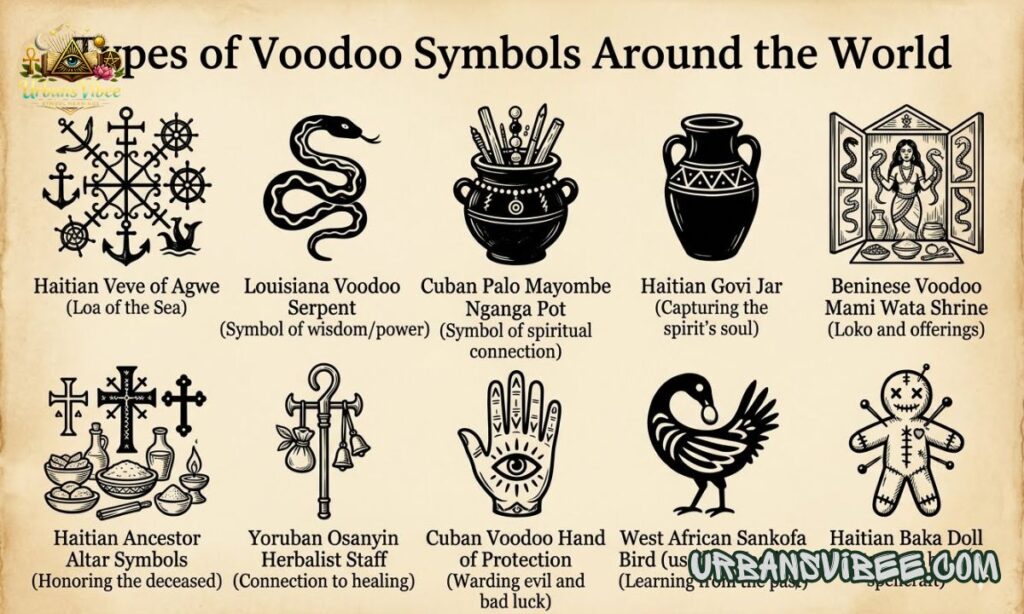
Types of Voodoo Symbols Around the World
Haitian Voodoo Symbols and Meanings
Haitian Vodou is the most structured form of Voodoo practice, with a defined pantheon of Lwa and specific veves for each one. These symbols derive partly from West African traditions and partly from the indigenous Taino people of Haiti. Each veve acts as the Lwa’s unique signature — a beacon drawn to call the spirit forth.
African Voodoo Symbols
West African Vodun (practiced in Benin, Togo, Ghana, and Nigeria) uses similar spiritual symbolism but in a distinct cultural context. The Fon and Ewe peoples developed the foundational spiritual concepts that later evolved into Haitian Vodou. African symbols tend to be more abstract and less elaborate than their Haitian counterparts.
Louisiana Voodoo Symbols and New Orleans Voodoo Symbols
Louisiana Voodoo, centered in New Orleans, blends Haitian Vodou symbols with Hoodoo practices, Catholic saint imagery, and indigenous traditions. Veves in New Orleans ceremonies look largely similar to Haitian ones — Legba’s cross and Erzulie’s heart remain consistent — but they may appear alongside Catholic icons or Hoodoo seals on the same altar.
Veve Voodoo Symbols and Meanings
| Veve Name | Lwa | Visual Element | Meaning |
| Papa Legba | Legba | Cross + cane | Crossroads, communication, gateway |
| Erzulie Freda | Erzulie | Heart + mirror | Love, beauty, femininity |
| Baron Samedi | Baron | Skull + coffin | Death, resurrection, medicine |
| Damballa | Damballa | Two serpents + egg | Creation, wisdom, life force |
| Ogou | Ogou | Sword + flame | Strength, justice, warfare |
Protection, Signs and Special Voodoo Symbols
Voodoo Protection Symbols
The most powerful protection veve is that of Ogou Feray, symbolizing fire, iron, and military strength. When drawn with proper intention and offerings, it invokes Ogou’s protective force around a person, home, or sacred space. Other protection symbols include those of Marasa (the divine twins), which represent balance and divine intervention.
Voodoo Hand Signs
Beyond drawn symbols, Voodoo also uses ritual hand gestures and signs during ceremonies. These movements communicate respect, invocation, and spiritual status within the ritual context. They are less documented publicly than veves, as they are closely guarded within initiation traditions.
Voodoo Signs and Symbols
Common voodoo signs used in everyday spiritual life include:
- The crossroads symbol for guidance
- The heart for emotional healing
- The serpent for wisdom and renewal
- The key for unlocking blocked paths
- The skull for ancestral communication
Unique and Modern Voodoo Symbol Uses
Voodoo Symbols PNG
Digital versions of voodoo symbols are widely available as PNG files, used in graphic design, spiritual apps, tattoo references, and educational materials. While their aesthetic use has grown globally, traditional practitioners emphasize that a symbol drawn with intent and knowledge carries far more power than a digital copy.
Alastor Voodoo Symbols
In modern spiritual communities, Alastor-related symbols have gained attention through pop culture and occult study. They are associated with spirits of retribution and cosmic justice. Practitioners who work with these symbols do so with extreme care, as they deal with powerful and potentially volatile spiritual forces.
Deep Symbolic Meaning
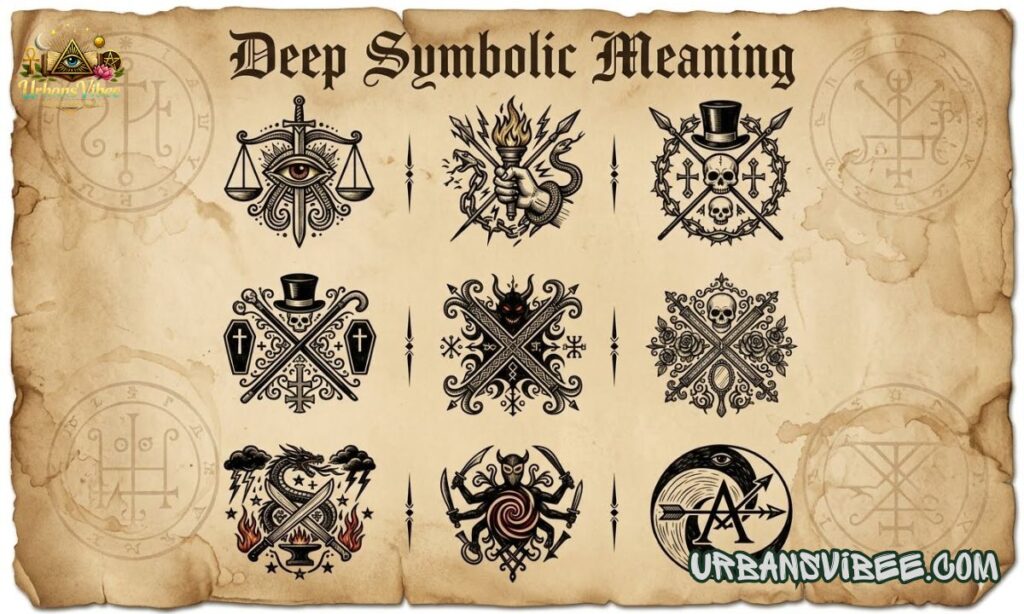
On a Spiritual Level
Every voodoo symbol is a spiritual tool — a point of contact between the practitioner and the divine. Drawing a veve with focused intention is considered an act of prayer and invocation. The symbol creates what practitioners call a magic point — a concentrated area of spiritual energy where the Lwa can manifest.
On a Psychological Level
Modern psychologists and anthropologists have noted that voodoo symbols function similarly to archetypes described by Carl Jung. They represent powerful subconscious forces — love, death, protection, creation — that resonate across all human cultures. Engaging with these symbols through ritual can have genuine psychological effects, providing clarity, comfort, and a sense of spiritual agency.
On a Cultural Level
Voodoo symbols are expressions of cultural identity and historical survival. Created by enslaved Africans who used spirituality as a form of resistance and preservation, these symbols carry centuries of pain, resilience, and hope. Understanding them in their proper cultural context is essential for respectful engagement.
Types and Variations of Voodoo Symbols
1. Papa Legba Veve
Papa Legba is the first Lwa invoked in any Vodou ceremony because no other spirit can be reached without his permission. His veve features a central cross representing the crossroads, often accompanied by a cane or crutch symbolizing his appearance as a wise elderly man. Keys or machetes may also appear, representing his ability to open pathways and grant access to other spiritual realms.
2. Erzulie Freda Veve
Erzulie Freda’s veve is one of the most ornate and widely recognized in Vodou. Adorned with hearts, mirrors, and combs, it embodies love, passion, luxury, and feminine power. She is associated with the colors white and pink and is known to wear three wedding bands representing her three husband Lwa — Damballa, Agwe, and Ogou. Her veve is drawn during rituals for love, beauty, and emotional healing.
3. Baron Samedi Veve
Baron Samedi rules over death and resurrection. His veve incorporates skull imagery, crosses, and coffin shapes, reflecting his domain over the boundary between life and death. Despite his fearsome appearance, Baron Samedi is also a spirit of medicine, sexuality, and irreverent humor. He can heal diseases that no other Lwa can cure.
4. Damballa Veve
Damballa is the primordial sky father and one of Vodou’s oldest spirits. His veve is defined by two serpents arching symmetrically around a central pole or egg, representing his companion Ayida Wedo (the rainbow). The design is fluid and curved — reflecting Damballa’s cool, peaceful nature. He symbolizes creation, the continuity of life, and the connection between earth and sky.
5. Ogou Veve
Ogou Feray is the warrior Lwa of fire, iron, and justice. His veve features swords, machetes, and flames, reflecting his role as protector and force of transformation. He aligns with all four elements — air, earth, water, and fire — and his symbol is invoked when strength, courage, or protection is needed.
Voodoo Symbols Across Cultures
West Africa
The roots of all voodoo symbols trace back to the Fon and Ewe peoples of West Africa, particularly in present-day Benin, Togo, and Ghana. Their original Vodun symbols were simpler in design but equally profound in spiritual meaning.
Haiti
Haiti is where Vodou developed its most elaborate symbolic language. The veve system grew directly out of African traditions blended with Taino and Catholic influences during the colonial period. Today, Haitian Vodou is a recognized religion with UNESCO-listed cultural heritage status.
Louisiana
New Orleans became a second major center of Voodoo practice after Haitian immigrants brought their traditions to Louisiana. The symbols adapted to local culture, merging with Hoodoo, folk magic, and Catholic iconography to create Louisiana Voodoo’s distinctive style.
Caribbean and Brazil
Similar traditions — Santería in Cuba, Candomblé in Brazil, Obeah in Jamaica — use related symbol systems rooted in the same West African origins. While the specific veves differ, the underlying spiritual logic is shared: drawn symbols invite spirits, channel energy, and create sacred space.
Modern Global Spirituality
Today, voodoo symbols appear worldwide in tattoos, jewelry, altar art, and digital media. Their spread reflects a global hunger for authentic spiritual symbolism. Traditional practitioners encourage respectful engagement and proper education before adopting these sacred signs into personal practice.
Voodoo Symbols in Art, Movies and Pop Culture
Hollywood has long distorted Voodoo symbolism, associating it with curses, zombie rituals, and horror tropes. Films, video games, and TV shows like American Horror Story and The Princess and the Frog have brought veves into popular consciousness — often with limited accuracy but undeniable visual impact.
In legitimate art contexts, voodoo symbols appear in Haitian sequin flags (drapo Vodou), paintings, sculptures, and contemporary fine art. These artistic expressions celebrate the beauty and complexity of Vodou culture rather than sensationalizing it.
Spiritual and Dream Meaning of Voodoo Symbols
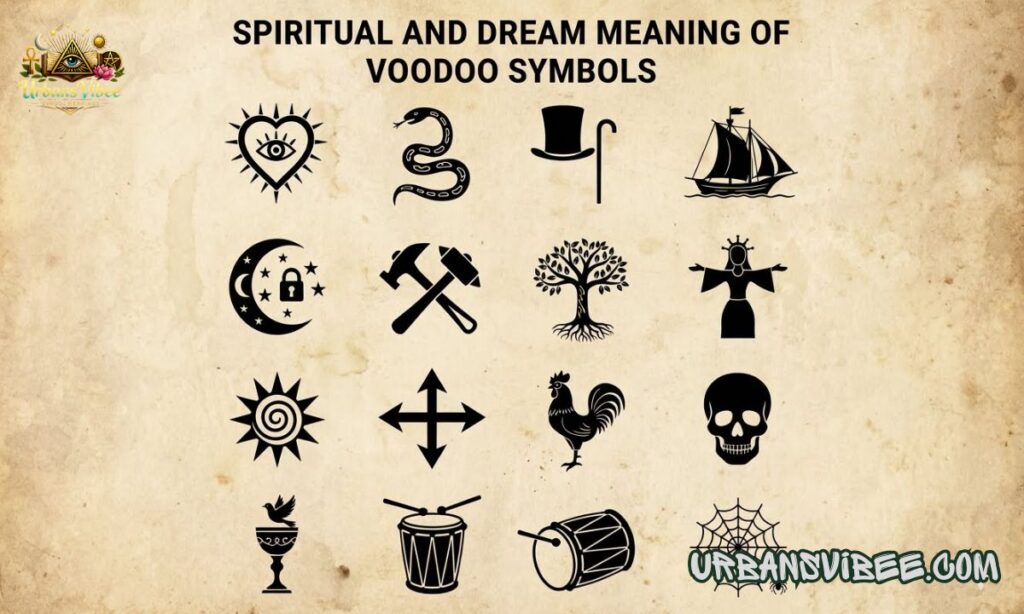
Positive vs Negative Meaning
Positive Meaning
- Seeing a veve in a dream may signal that a Lwa is reaching out to you
- Drawing symbols in dreams often represents spiritual development and awakening
- Symbols associated with specific Lwa can indicate their guidance or protection in your life
Negative Interpretation
- Distorted or broken veves in dreams may suggest spiritual imbalance
- Unfamiliar symbols appearing without context can signal a need for spiritual clarity
- Feeling trapped by a symbol in a dream might reflect unresolved spiritual or emotional conflict
Why Humans Are Attracted to Voodoo Symbols
Voodoo symbols tap into something deeply human: the desire to connect with forces beyond the visible world. Their geometric complexity suggests hidden order. Their spiritual depth promises meaning. Their cultural history speaks to resilience and survival.
In an age of information overload and spiritual disconnection, these ancient signs offer something rare — a direct, visual language for communicating with the divine. They remind us that humans have always sought ways to speak to the universe, and that these conversations leave marks.
Conclusion
Voodoo symbols are far more than mysterious drawings. They are the living language of a rich, ancient spiritual tradition that has survived colonization, persecution, and centuries of misrepresentation. From the crossroads wisdom of Papa Legba to the fiery strength of Ogou, from the tender love of Erzulie Freda to the boundary-walking power of Baron Samedi — each symbol tells a sacred story.
Whether you are drawn to these signs for spiritual practice, cultural education, or simple curiosity, approaching them with respect and informed understanding is essential. These are not decorations. They are doorways.
Frequently Asked Questions
What are voodoo symbols called?
Voodoo symbols are formally called veves — intricate ritual drawings used in Haitian Vodou to invoke specific spirits called Lwa.
What is the most powerful voodoo symbol?
Papa Legba’s veve is considered the most fundamental — no other Lwa can be invoked without him opening the way first.
Are voodoo symbols dangerous?
Used without knowledge or respect, any powerful spiritual tool can have unintended effects. Proper education and respectful intent are always recommended.
What is a veve used for?
A veve is drawn during ceremonies to invite a specific Lwa into the ritual space, directing prayers, offerings, and intentions toward that spirit.
Can anyone use voodoo symbols?
Symbols can be studied by anyone, but traditional practitioners emphasize that deep ritual use requires proper initiation, knowledge, and cultural respect.
What does the snake symbol mean in voodoo?
The serpent represents Damballa, the primordial creator spirit associated with wisdom, life, and the cosmic connection between earth and sky.
What is the difference between Haitian and Louisiana Voodoo symbols?
Haitian symbols follow a more structured Vodou system, while Louisiana Voodoo blends those symbols with Hoodoo practices and Catholic saint imagery — sharing the same roots but with local variations.
Do voodoo symbols appear in dreams?
Yes — many practitioners interpret veve appearances in dreams as spiritual messages or contact from a Lwa seeking connection or offering guidance.

Stephen Miller is a language enthusiast and symbol researcher at UrbansVibee. He specializes in uncovering the meanings, origins, and cultural significance of symbols, helping readers understand signs, icons, and symbolism from around the world.