Every culture that has ever existed developed its own visual language for healing. Ancient Egyptians inscribed the Ankh on temple walls to invoke eternal life force. Hindu sages encoded chakra maps into sacred geometry.
Celtic healers used interwoven knotwork to represent the unbreakable resilience of the living body. Japanese Reiki masters drew invisible symbols in the air above their patients to redirect universal energy.
Despite being separated by continents, centuries, and entirely different cosmologies, all of these traditions arrived at the same core understanding: that a carefully drawn symbol could carry healing power that no medicine alone could provide.
This guide explores 99+ of the most powerful healing symbols from around the world — their origins, meanings, and practical ways to use them in your life today.
What Are Healing Symbols?
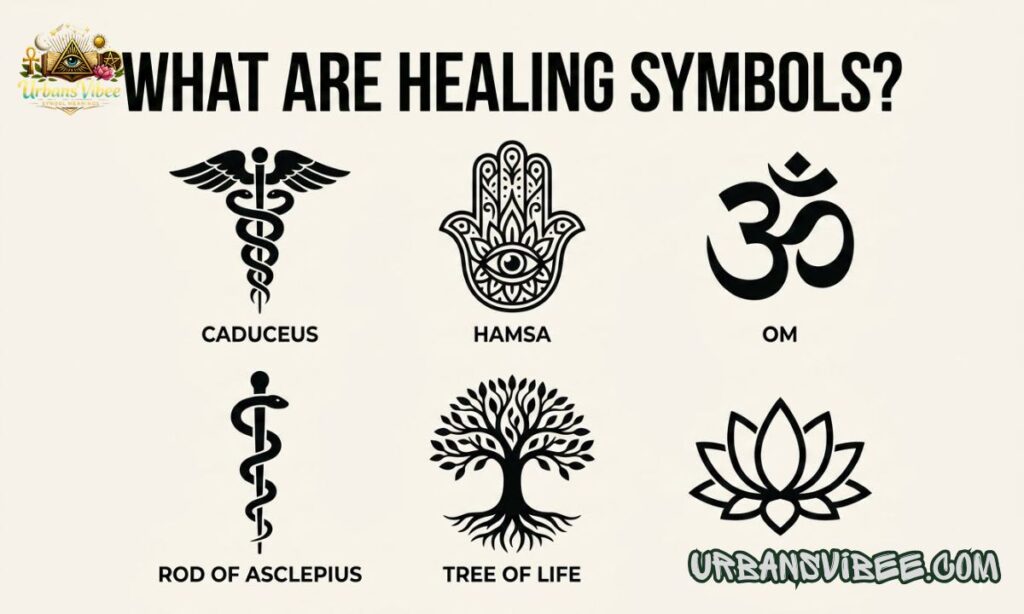
Healing symbols are visual representations — drawn, carved, tattooed, worn, or visualized — that carry spiritual, emotional, or energetic meanings linked to restoration, balance, and wholeness. They appear in every major civilization: Ancient Egypt, India, Greece, China, Celtic Europe, and Native American traditions. Each culture developed its own symbolic vocabulary, yet the underlying intention was always the same — to use a concentrated visual form as a bridge between the visible and invisible worlds, channeling healing energy where it was most needed.
Modern science supports what ancient practitioners always knew intuitively: symbols activate measurable psychological responses. When a person meditates on a healing symbol with genuine intention, their nervous system responds — stress hormones decrease, brainwave patterns shift, and the body’s natural healing processes are supported. The symbol is not magic. It is a tool for focused intention — and focused intention is one of the most powerful healing forces available to human beings.
Spiritual and Healing Symbols Tattoos
Healing Symbols Tattoos
Healing symbol tattoos have experienced an extraordinary surge in popularity over the past decade, driven by a global hunger for meaningful body art that goes deeper than aesthetics. People who have walked through illness, trauma, grief, or profound personal transformation increasingly choose healing symbols as permanent markers of their journey.
The most popular healing symbol tattoos include:
- Lotus flower — rising from muddy water into bloom; chosen by survivors of addiction, depression, and abuse as a symbol of emergence
- Spiral — representing the continuous cycle of growth, decay, and renewal that healing always involves
- Ankh — the ancient Egyptian symbol of life force and eternal vitality
- Unalome — a Buddhist symbol of the winding path from suffering to liberation
- Feather — representing the lightness that returns after shedding heavy burdens
- Semicolon — the modern mental health symbol; a sentence that could have ended but continued
- Phoenix — rising from ashes, embodying the complete destruction and rebirth that deep healing sometimes requires
- Om — the primordial sound of consciousness and healing vibration
Tattoos About Healing
Healing tattoos are more than artistic choices — they are declarations. Getting a healing symbol tattooed is often described as a ritual act: the physical discomfort of the process mirrors the discomfort of the healing journey itself, and the permanent mark becomes a visible reminder that the hardest seasons are survivable.
Placement matters to many: the wrist for symbols seen daily as a grounding reminder, the chest over the heart for symbols related to emotional healing, the spine for symbols representing strength and structure, and the ribcage for symbols meant to be private — seen only by the person and those they choose to show.
Strength Healing Symbols Tattoos
Strength and healing are inseparable in most symbolic traditions. The most powerful strength-healing tattoo combinations include:
- The raised fist with a lotus — combining resistance and transcendence
- The anchor with a Celtic knot — rootedness and eternal resilience
- The phoenix with Sanskrit script — rebirth with intentional sacred language
- The Caduceus or Rod of Asclepius — especially meaningful for healthcare workers or medical survivors
Spiritual Strength Healing Symbols Tattoos
Spiritual strength healing tattoos draw directly from sacred traditions, combining the visual power of a healing symbol with the energy of a spiritual lineage. Reiki practitioners tattooing Cho Ku Rei for continuous power amplification. Yoga teachers with chakra mandalas. Shamanic practitioners with spiral and feather combinations that encode their ceremonial heritage.
Healing Symbols And Meanings With Ancient And Spiritual Origins
Healing Symbols And Meanings
Here is a comprehensive reference table of the most powerful healing symbols and their core meanings:
| Healing Symbol | Origin | Core Meaning | How to Use |
| Ankh | Ancient Egypt | Eternal life, vital force, divine health | Wear as jewelry; meditate holding it |
| Lotus | India / Buddhism | Purity, transcendence, rising through adversity | Place in meditation space; visualize during breathwork |
| Caduceus | Ancient Greece | Balance, renewal, healing power | Common in medical contexts; meditate on for systemic healing |
| Cho Ku Rei | Reiki (Japan/Tibet) | Power amplification, energy clearing | Draw over body areas; use at start of healing sessions |
| Sei He Ki | Reiki (Japan) | Emotional and mental healing | Draw over head; use for anxiety, depression, addiction healing |
| Tree of Life | Universal | Grounding, connection, whole-body healing | Hang in healing spaces; meditate on rootedness |
| Spiral | Universal | Growth, renewal, cyclical healing | Trace during meditation; use in journaling rituals |
| Om (ॐ) | Sanskrit / Hindu | Universal vibration, consciousness, cellular healing | Chant; display in healing spaces; use in meditation |
| Yin Yang | China (Taoism) | Balance of opposing forces, systemic harmony | Display as reminder of balance; meditate on integration |
| Hamsa | Middle East / India | Protection, divine blessing, shielding from harm | Wear; place above doorways; hold during vulnerable periods |
| Eye of Horus | Ancient Egypt | Protection, restoration, health | Wear as amulet; use in visualization of wholeness |
| Feather | Native American | Freedom, lightness, spiritual communication | Carry; use in smudging ceremonies; place on altars |
| Celtic Knot | Celtic / Irish | Eternal strength, unbreakable resilience | Wear; meditate on the interconnected loops |
| Flower of Life | Sacred Geometry | Cosmic order, cellular alignment, creation | Meditate on; place under healing beds or mats |
| Sri Yantra | Hindu / Vedic | Energy alignment, higher consciousness | Meditate upon; use in chakra healing |
Symbols For Healing / Symbols Meaning Healing / Symbols That Represent Healing
The symbols that most universally represent healing across cultures share common visual qualities: they suggest wholeness (circles and closed forms), natural growth (spirals and branching trees), or the dynamic balance of opposing forces (the Caduceus’s intertwined serpents, the Yin Yang). These visual patterns communicate healing at a pre-cognitive level — the human brain processes their meaning before rational thought catches up.
Healing Symbol / Healing Symbolism
Every healing symbol functions as an intentional anchor — a visual point that calls the mind back from anxiety, pain, or confusion and redirects it toward the possibility of restoration. Their power is amplified by three factors working together: the history of the symbol (the accumulated energy of millions of people using it with the same intention), the personal meaning the user brings to it, and the quality of focused attention during use.
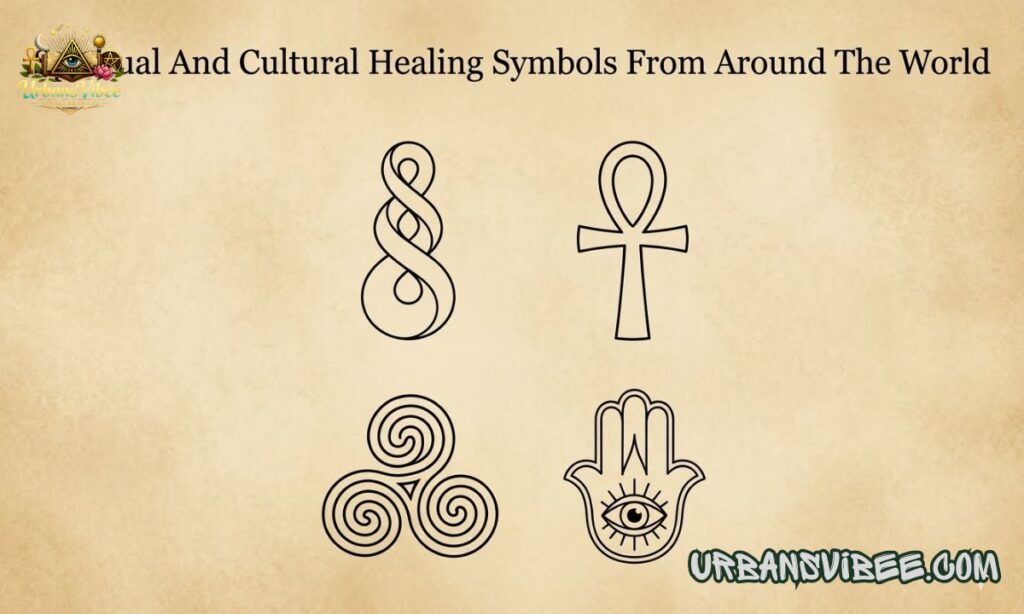
Spiritual And Cultural Healing Symbols From Around The World
Spiritual Symbol For Healing / Spiritual Healing Symbols
The most powerful spiritual healing symbols share a common function: they create a bridge between ordinary human consciousness and the healing intelligence of something greater — whether that is understood as God, universal energy, nature, or the deep unconscious. When a person works with a spiritual healing symbol with genuine reverence and intention, that bridge becomes real in the nervous system — measurable in brainwave shifts, hormonal changes, and emotional release.
Energy Healing Symbols
Energy healing symbols are used specifically to direct, amplify, or clear the flow of life force energy (prana, chi, ki) through the body’s energetic anatomy. The most widely used in contemporary energy healing practice include:
- Chakra symbols — each of the seven primary energy centers has its own symbol, used to diagnose blockages and direct healing energy
- Cho Ku Rei (Reiki) — the power switch that amplifies healing energy flow
- Flower of Life (Sacred Geometry) — used as an energetic template for cellular healing
- Sri Yantra — the supreme Vedic healing geometry, used to align all body systems with cosmic order
- Infinity symbol — used in energy work to represent the continuous flow of healing energy with no beginning or end
Pranic Healing Symbols
Pranic healing — the system developed by Master Choa Kok Sui — uses specific geometric forms and color visualizations as healing tools. The practice works with the body’s bioplasmic energy field, using sacred geometry, color pranas, and directional energy techniques to cleanse diseased energy and replenish depleted areas. Pranic healers use symbols primarily as visualization tools during scanning and treatment sequences.
Reiki Healing Symbols
Reiki is a Japanese energy healing system developed by Mikao Usui in the early 20th century. The word Reiki translates from Japanese as “spiritually guided life force energy.” Its healing symbols are taught during attunement ceremonies and are used by trained practitioners to amplify and direct healing energy.
Reiki Healing Symbols And Meanings / Healing Symbols Reiki
The five core Usui Reiki symbols and their meanings:
- Cho Ku Rei — The Power Symbol. Depicted as a horizontal line bending into a vertical, then spiraling, it functions as a “light switch” — amplifying healing energy, clearing blockages, and grounding. Used to begin sessions and address physical healing. Can be drawn clockwise (to increase energy) or counterclockwise (to remove or cleanse).
- Sei He Ki — The Harmony Symbol. Representing the union of heaven and earth, it heals emotional and mental imbalances — anxiety, depression, addiction, and unresolved trauma. Drawing this symbol beside written affirmations is believed to make them significantly more effective.
- Hon Sha Ze Sho Nen — The Distance Symbol. Translated as “no past, no present, no future” — it allows Reiki energy to be sent across physical distance, time, and space. Used to send healing to people in other locations, to heal past traumas, and to prepare for future events.
- Dai Ko Myo — The Master Symbol. The highest-frequency Reiki symbol, used during attunements (the process of initiating a student into Reiki) and for soul-level healing. It connects the practitioner to the highest available healing frequencies and facilitates spiritual growth.
- Raku — The Completion Symbol. Used at the end of attunements to ground the energy and seal the healing. It represents the grounding of spiritual energy back into the physical body.
Sekhem Healing Symbols
Sekhem is an ancient Egyptian healing system — Sekhem translated as “power of powers” in ancient Egyptian. It was rediscovered and systematized by Patrick Zeigler after an experience in the King’s Chamber of the Great Pyramid of Giza.
Sekhem healing uses symbols drawn from ancient Egyptian sacred art, combined with channeled energy that practitioners describe as fiercer and more expansive than Reiki. The primary Sekhem symbol is the Sef-sekhem — a figure-eight infinity pattern that represents the eternal flow of healing energy through all dimensions.
Sacred Geometry Healing Symbols
Sacred geometry healing operates on the principle that certain geometric forms correspond to fundamental patterns of creation — and that meditating on these forms allows the body to resonate with those patterns, supporting healing and alignment.
Key sacred geometry healing symbols:
- Flower of Life — 19 overlapping circles forming a flower pattern; believed to contain the blueprint of all creation
- Metatron’s Cube — derived from the Flower of Life; contains all five Platonic solids, believed to represent the building blocks of reality
- Sri Yantra — nine interlocking triangles forming 43 smaller triangles; used as a meditative focus for aligning all energy centers
- Vesica Piscis — two overlapping circles forming a pointed oval; represents the intersection of divine and human, used in healing to support integration
- Golden Ratio Spiral — found throughout nature; used as a healing symbol representing the natural unfolding of growth and restoration
Ancient Healing Symbols
The oldest healing symbols in recorded human history appear in:
- Indus Valley civilization artifacts (circa 2500 BCE) — spirals and geometric healing patterns
- Ancient Egyptian temple walls (circa 3000 BCE) — Ankh, Eye of Horus, and Djed pillar (stability and regeneration)
- Minoan civilization art (circa 2000 BCE) — labyrinth symbols used in healing rituals
- Ancient Chinese oracle bones (circa 1200 BCE) — early representations of the Yin Yang and Five Elements theory
Ancient Egyptian Healing Symbols / Egyptian Healing Symbols
Ancient Egypt produced some of history’s most enduring healing symbols:
- The Ankh — the looped cross representing eternal life force; carried by gods in all depictions of divine healing
- The Eye of Horus (Wadjet) — after Horus’s eye was destroyed in battle with Set and magically restored by Thoth, it became the supreme symbol of healing, wholeness, and divine protection; worn as an amulet to bestow health and wisdom
- The Djed Pillar — representing the backbone of Osiris and the stability of the body’s physical structure; used in healing rituals to strengthen the body
- The Caduceus variant — the intertwined serpent staff that predated the Greek version; used by Egyptian physicians as a symbol of their healing authority
- Sekhmet — the lion-headed goddess who simultaneously caused and healed disease; her symbol was invoked both to ward off illness and to petition for recovery
Celtic Healing Symbols
Celtic healing symbols are rooted in the tradition of the Aes Dána — the skilled ones, including druids, bards, and healers — who used nature-based symbols to connect with the healing powers of the natural world:
- The Triple Spiral (Triskelion) — found at the ancient megalithic site of Newgrange; represents the three domains of land, sea, and sky, and the healing that comes from being in right relationship with all three
- The Celtic Knot — endless interwoven lines representing the unbreakable continuity of life force energy through the body
- The Awen — three rays of light representing the inspiration of the divine breath (awen) that brings clarity, creativity, and healing
- The Green Man — representing the healing power of nature, plant medicine, and the cyclical renewal of all living things
- The Brigid’s Cross — associated with Brigid, the Celtic goddess of healing, poetry, and craft; placed in homes for protective healing energy
Native American Healing Symbols
Native American healing traditions use symbols as essential tools in ceremony, sand painting, and medicine work:
- The Medicine Wheel — a circle divided into four quadrants representing the four directions, four seasons, four elements, and four aspects of the self; used as a map for understanding and restoring holistic health
- The Feather — representing the lightness of spirit and the connection to the heavens; used in healing ceremonies and cleansing rituals
- The Bear Paw — in many nations, the bear is the great healer; its paw print symbolizes healing strength and the protective power of the medicine person
- The Sun Symbol — representing the life-giving force that sustains all health; used in healing prayers and ceremonies
- The Thunderbird — a powerful protective symbol that carries and transmits healing energy from the sky world to the earth world
Shamanic Healing Symbols
Shamanic healing traditions across Siberia, the Americas, Africa, and Australia use symbols as doorways between the ordinary world and the spirit world — where the true source of illness and healing is located:
- The World Tree — the axis connecting the underworld, middle world, and upper world through which the shaman travels to retrieve healing for the patient
- The Spiral — representing the shaman’s journey into the deep psyche and return with healing knowledge
- The Drum — the circular drum itself is a symbol of the shamanic cosmos; its rhythm carries both the healer and patient into altered states necessary for healing
- The Snake — representing shedding of old illness, skin, and identity; transformation through dissolution
Symbols Of Healers
Across cultures, certain symbols specifically identify the healer rather than just the healing:
- Rod of Asclepius — single serpent on a staff; the authentic symbol of medicine used by the World Health Organization, the American Medical Association, and most global medical bodies
- Caduceus — two serpents on a winged staff; associated with Hermes/Mercury, adopted by the U.S. Army Medical Corps in 1902 through historical confusion with the Rod of Asclepius
- Red Cross — the modern universal symbol of medical aid and humanitarian healing
- Brigid’s Flame — the eternal flame of the Celtic healing goddess, still burned at Kildare, Ireland
- The Medicine Bundle — a collection of sacred objects carried by Native American healers as their personal healing toolkit
Healing Symbols Witchcraft
In folk magic and contemporary witchcraft traditions, healing symbols are used in spell work, candle magic, and ritual:
- Sigils — personally created symbols encoding healing intentions, charged with the witch’s energy and burned or buried to release their power
- Runes — specifically the runes Uruz (vital strength), Sowilo (solar healing energy), and Laguz (emotional healing and flow)
- The Pentacle — representing the five elements in balance; used as a protective healing symbol on altars and in healing circles
- Algiz — the rune of protection and divine connection, used to shield the healing space and the healer
Healed Symbol
A number of symbols specifically represent the completion of healing — the state of having moved through illness, grief, or trauma into restoration:
- The full circle — closure, completion, wholeness achieved
- The rising phoenix — the completed journey through destruction into new life
- The blooming lotus — the flower has now fully opened above the water
- The mended heart — a heart that shows repair, stronger along its healed lines
Healing Symbols In Nature And Visual Inspiration
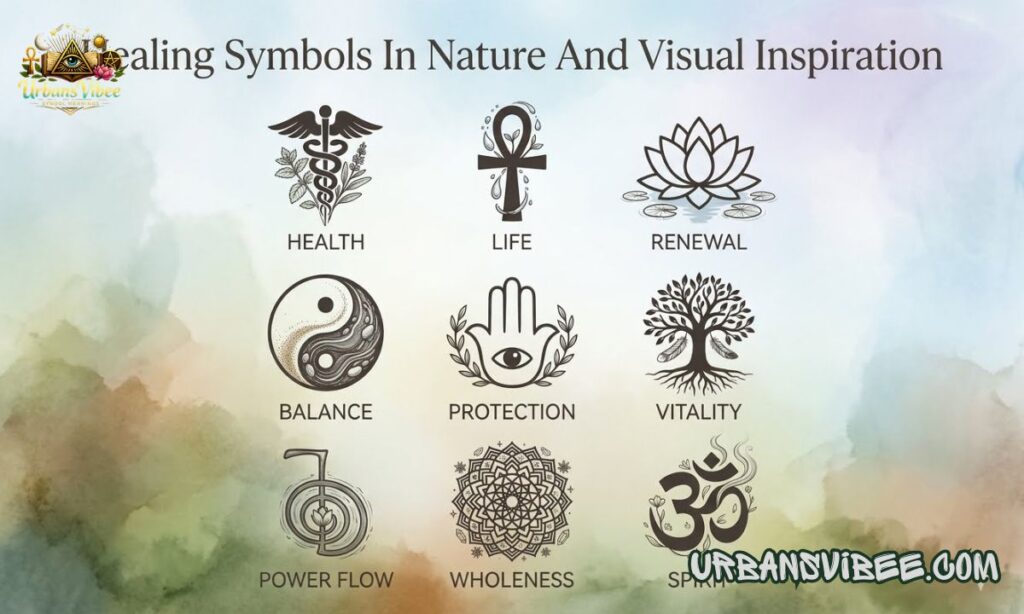
Symbols Of Healing In Nature
Nature itself is filled with healing symbols that ancient peoples observed and encoded into their traditions:
- The serpent shedding its skin — the original inspiration for both the Caduceus and the Rod of Asclepius; regeneration made visible
- The seed in winter soil — healing potential waiting in apparent stillness
- Water flowing over stone — the gradual but inevitable softening of even the hardest resistance
- The dawn after darkness — the most universal natural healing symbol; the promise of light’s return
- The tree after storm — standing, rooted, sometimes bent but unbroken
- Bioluminescent fungi — light emerging from decay; a natural metaphor for the spiritual illumination that can emerge from suffering
Healing Symbols Pictures / Symbols Of Healing
Visual immersion in healing symbols — through art, photography, sacred space design, and meditation — creates neurological effects that support healing. The brain cannot fully distinguish between experiencing a thing and vividly imagining it, which is why visualizing a healing symbol during meditation produces real physiological effects.
Surrounding yourself with images of healing symbols — in your home, on your altar, on your phone wallpaper — creates a constant, gentle environmental dose of healing intention that accumulates over time.
Deep Symbolic Meaning
Spiritual Level
At the spiritual level, healing symbols function as tuning forks — they carry the vibrational frequency of healing, and when a person engages with them with genuine intention, their own energy field begins to resonate with that frequency. This is why the same lotus symbol carved in Buddhist Cambodia, painted in Hindu India, and tattooed on a secular Western body continues to carry healing power — because it encodes a pattern that speaks directly to something in human consciousness that transcends cultural boundaries.
Many healing traditions also understand symbols as inhabited — not merely representing healing energy, but actually containing it. The Ankh is not just a reminder of life force — in ancient Egyptian understanding, it was life force, condensed into visual form. The Reiki symbol Cho Ku Rei is not just a diagram of healing intention — it is a channel for Reiki power that practitioners activate through drawing.
Psychological Level
The psychological mechanisms behind healing symbol effectiveness are well-documented. Symbols activate the right hemisphere of the brain — the hemisphere associated with emotion, intuition, and holistic pattern recognition — which is precisely the part of the brain most involved in the healing process. When a person meditates on a healing symbol, they shift from the analytical, problem-solving mode of left-brain dominance to the receptive, integrating mode of right-brain engagement. This shift is measurable in EEG readings and correlates with reduced cortisol, improved immune function, and greater emotional regulation.
Healing symbols also work through the mechanism of associative memory — linking the present moment to stored memories of healing, hope, and wholeness. A cancer survivor who meditated on the lotus through their treatment does not merely see a flower when they encounter that symbol later. They experience a full-body memory of resilience — a neurological reactivation of the healing state they cultivated through the most difficult experience of their life.
Cultural Level
Culturally, healing symbols are how communities transmit their understanding of health, resilience, and the relationship between visible and invisible worlds across generations. When a Native American grandmother teaches her granddaughter the meaning of the Medicine Wheel, she is transmitting an entire medical philosophy.
When a Reiki master passes attunement symbols to a student, she is transmitting a healing lineage that stretches back through Mikao Usui to Japanese Buddhist medicine. The symbols are the vessels — compact enough to carry across time, potent enough to retain their charge.
Types and Variations of Healing Symbols
1. The Ankh
Visual: A cross with a teardrop-shaped loop at the top instead of an upper arm.
Origin: Ancient Egypt, circa 3000 BCE — one of the oldest written symbols in human history.
Meaning: The Ankh — also called the Key of Life or Breath of Life — represents eternal existence and the vital life force that animates all living beings. The loop at the top represents the sun rising above the horizon; the cross represents the earth plane. Together, they represent the meeting of divine and earthly, spirit and matter, heaven and earth. In Egyptian art, gods are always depicted holding the Ankh by its loop — offering it to the pharaoh’s nostrils as the literal breath of life.
How to use it: Wear as jewelry for continuous vitality and life force support. Hold during meditation to connect with the energy of eternal healing. Place in rooms where healing or rest is primary.
2. The Lotus Flower
Visual: A flower with symmetrical petals opening from a central point, rising above water on a single stem.
Origin: Ancient India, Vedic tradition — also central to Egyptian and Buddhist sacred art.
Meaning: The lotus grows in muddy, stagnant water yet emerges perfectly clean and radiant. This biological fact made it the supreme symbol of spiritual transcendence across cultures: the soul’s capacity to rise through any conditions and bloom into its fullest potential. In Ayurvedic medicine, the lotus is associated with the heart chakra (Anahata) — the center of love, compassion, and emotional healing.
How to use it: Place images in healing spaces to invoke the possibility of emergence from difficult circumstances. Meditate on a lotus image during recovery, visualizing yourself rising through the murk into clear air and light. Consider a lotus tattoo as a permanent healing declaration.
3. The Caduceus
Visual: A staff with two serpents coiled upward around it, topped by a pair of wings.
Origin: Ancient Greece — associated with Hermes, the messenger god; also has Sumerian and Egyptian precursors.
Meaning: The two intertwined serpents represent the dynamic balance of opposing forces — masculine and feminine, active and receptive, disease and health — while the wings represent the swiftness of healing when balance is restored. Note: the Caduceus is often confused with the Rod of Asclepius (one serpent, no wings), which is the authentic symbol of medicine. The Caduceus is more accurately a symbol of balance and negotiation — the conditions that allow healing to occur.
How to use it: Meditate on the Caduceus when seeking balance between opposing forces in your health, relationships, or creative life. It is particularly powerful for practitioners who work at the intersection of multiple healing modalities.
4. The Reiki Symbols
Visual: Japanese and Sanskrit-derived calligraphic symbols drawn with specific stroke sequences.
Origin: Japan, early 20th century — Mikao Usui, drawing from Japanese Buddhist tradition and Sanskrit healing knowledge.
Meaning: As detailed above — Cho Ku Rei (power), Sei He Ki (emotional harmony), Hon Sha Ze Sho Nen (distance and time healing), Dai Ko Myo (master/soul healing), Raku (completion/grounding).
How to use them: Reiki symbols are transmitted through attunement by a Reiki master — they cannot be fully activated through self-study alone. However, visualizing these symbols during meditation, drawing them in journals, or tracing them over specific body areas is accessible to anyone and carries genuine calming, grounding effects even without formal attunement.
5. The Tree of Life
Visual: A large tree with deep roots extending into the earth and branches stretching toward the sky — depicted across traditions from the Norse Yggdrasil to the Celtic Crann Bethadh to the Kabbalistic Tree of Sephiroth.
Origin: Universal — appears independently in Norse, Celtic, Ancient Egyptian, Mesoamerican, Native American, Hindu, and Kabbalistic traditions.
Meaning: The Tree of Life represents the complete, integrated human being — rooted in the physical body and the earth, reaching toward the heavens and the spirit, with the trunk representing the present moment and the living consciousness. Its healing power lies in its image of totality: this symbol says that healing is not the eradication of disease but the restoration of complete, grounded, reaching aliveness.
How to use it: Place a Tree of Life image or pendant in your healing space as a constant reminder of your fundamental wholeness. Meditate with the Tree of Life, imagining your own roots growing deeper while your awareness expands toward light. The image works particularly well for people recovering from illness that has made them feel fragmented or unrooted.
6. The Spiral
Visual: A line that curves around a central point, moving either inward or outward, in single or expanding form.
Origin: Universal — the spiral appears as one of the oldest human-made symbols, found at Newgrange in Ireland (circa 3200 BCE), at Nazca in Peru, in Australian Aboriginal art, and in Minoan, Celtic, and Native American traditions.
Meaning: The spiral is the shape of growth itself — from nautilus shells to galaxies, from DNA to hurricanes. As a healing symbol, the inward spiral represents the journey into the self (introspection, shadow work, the healing of hidden wounds), while the outward spiral represents emergence — healing expressing itself into the world. The spiral also encodes the principle that healing is not linear: it moves in cycles, returning to the same wounds at deeper levels each time, not because the healing failed, but because deeper healing was always possible.
How to use it: Trace a spiral on paper or in the air as a grounding ritual during anxious or overwhelmed moments. Visualize a golden spiral of light moving through your body during meditation. Consider a spiral tattoo as a permanent acknowledgment of your own growth through difficulty.
Healing Symbols Across Cultures
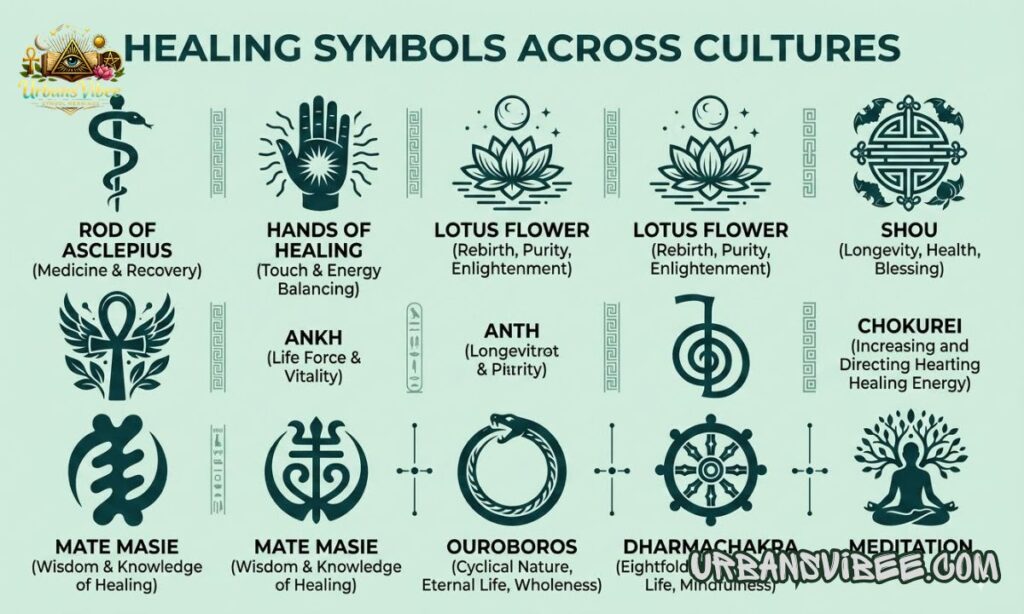
Ancient Egypt
Ancient Egypt approached healing as fundamentally a spiritual endeavor — physical illness was understood as a disruption in the person’s relationship with divine order (Ma’at), and healing meant restoring that alignment.
Egyptian physicians were also priests, and their healing tools included prayers, amulets, and sacred symbols as primary interventions alongside plant medicine. The Ankh, Eye of Horus, and Djed Pillar were as essential to Egyptian medicine as any herb or surgical instrument.
India
India’s healing traditions — Ayurveda, Yoga, and Tantric medicine — developed the most sophisticated map of the body’s energetic anatomy in history: the chakra system with its seven primary energy centers, each with its own healing symbol, color, element, and Sanskrit bija mantra.
Indian healing symbols operate simultaneously as meditation objects, sonic tools (through mantra), and geometric healing forms (through yantra). The integration of symbol, sound, and geometry in Indian healing is unmatched in depth and sophistication by any other tradition.
China
Traditional Chinese Medicine healing philosophy uses symbols rooted in the Taoist understanding of Qi (life force) and the dynamic balance of Yin and Yang. The Yin Yang symbol is the primary healing image — encoding the principle that health is not the absence of the dark side but the dynamic, flowing balance of both.
The Five Elements (Wu Xing) — Wood, Fire, Earth, Metal, and Water — each have their own symbols and are used diagnostically and therapeutically in acupuncture, herbal medicine, and Qigong.
Celtic Culture
Celtic healing was inseparable from the natural world. Healing occurred in sacred groves, at healing springs (such as those sacred to Brigid), and in the company of plant and animal spirits. Celtic healing symbols — the Triple Spiral, the Celtic Knot, the Green Man — all encode the healing intelligence of nature as the primary medicine.
The Celtic concept of Imbas Forosnai — the fire of inspiration and healing wisdom — was understood as flowing through sacred symbols and into the healer who worked with them.
Native American Traditions
Native American healing traditions vary significantly across nations, but share the understanding that healing is a community event, a sacred ceremony, and a spiritual restoration — not merely a physical repair. Healing symbols in Native American traditions appear in sand paintings (Navajo healing ceremonies use intricate sand mandalas created specifically for the patient and then dismantled after the ceremony), in vision quest imagery, in drum circles, and in the Medicine Wheel that provides the framework for understanding health across all four dimensions of being.
Healing Symbols in Art, Movies and Pop Culture
Healing symbols have moved from sacred spaces into mainstream visual culture with remarkable acceleration:
- The lotus has become one of the most tattoo-requested symbols globally — its healing meaning largely intact even when chosen for purely aesthetic reasons
- The Eye of Horus appears in fashion, music videos, and jewelry across cultures as both a protective amulet and a fashion statement
- The Reiki symbol Cho Ku Rei has appeared in mainstream wellness product branding, crystalware design, and meditation app imagery
- The Tree of Life is among the best-selling jewelry designs globally — worn by people of all faiths as a universal healing and wholeness symbol
- In cinema, healing symbols appear in films like Doctor Strange (sacred geometry and chakra-inspired visuals), Black Panther (Vibranium healing technology encoded in African geometric symbols), and countless wellness-themed documentaries
- The recent explosion of sacred geometry as an aesthetic trend in interior design, fashion, and digital art carries — often unknowingly — the healing mathematics of ancient traditions into contemporary spaces
Spiritual and Dream Meaning of Healing Symbols
When healing symbols appear in dreams, many traditions interpret them as significant messages from the deeper self or from spiritual guides:
- Dreaming of a lotus blooming is widely interpreted as a signal that a period of suffering is completing and a new phase of clarity and beauty is emerging — trust the timing
- The Ankh appearing in dreams may signal that your vitality is being renewed at a deep level — rest, receive, and allow the life force to replenish
- A spiral in a dream often indicates that you are returning to an old wound, not because you have failed to heal it, but because you are now ready to heal a deeper layer of it
- Reiki symbols appearing in dreams — particularly for non-practitioners — are interpreted in many spiritual traditions as a spontaneous attunement from a healing guide or ancestor
- The Tree of Life in dreams typically signals a need to reconnect with your roots — with your body, your ancestry, your home, or the earth itself — as the foundation of whatever healing you seek
- The Caduceus or Rod of Asclepius in dreams may signal that an important healing is being orchestrated at a level beyond your conscious control — that you need to trust the process more than direct it
Positive vs Negative Meaning
Positive Meaning
The healing power of these symbols, used with genuine intention and cultural respect, is extraordinary:
- They provide portable comfort — a symbol worn on the body is a continuous energetic reminder of healing intention
- They create community — shared healing symbols build bonds between people on similar healing journeys
- They encode wisdom that would take pages of text to fully express, making that wisdom instantly accessible through a single image
- They support the nervous system by providing a stable point of focus during anxious, overwhelming, or grief-stricken periods
- They honor ancestral healing lineages — connecting modern practitioners to thousands of years of healing wisdom
Negative Meaning
Used without knowledge or respect, healing symbols can carry shadow:
- Cultural appropriation — using sacred healing symbols from traditions you have no relationship to, without understanding or reverence, can be extractive and disrespectful to living communities who depend on these symbols as core cultural identity
- Magical thinking substitution — using healing symbols as a replacement for necessary medical care, therapy, or difficult personal work creates dangerous false comfort
- Commercial dilution — mass-produced healing symbol merchandise that strips symbols of their context reduces them from powerful spiritual tools to empty decoration, misleading people about their true nature and use
- Symbol confusion — the Caduceus/Rod of Asclepius confusion that has persisted for over a century in American medical branding demonstrates how misidentification of symbols creates real-world consequences
Why Humans Are Attracted to Healing Symbols
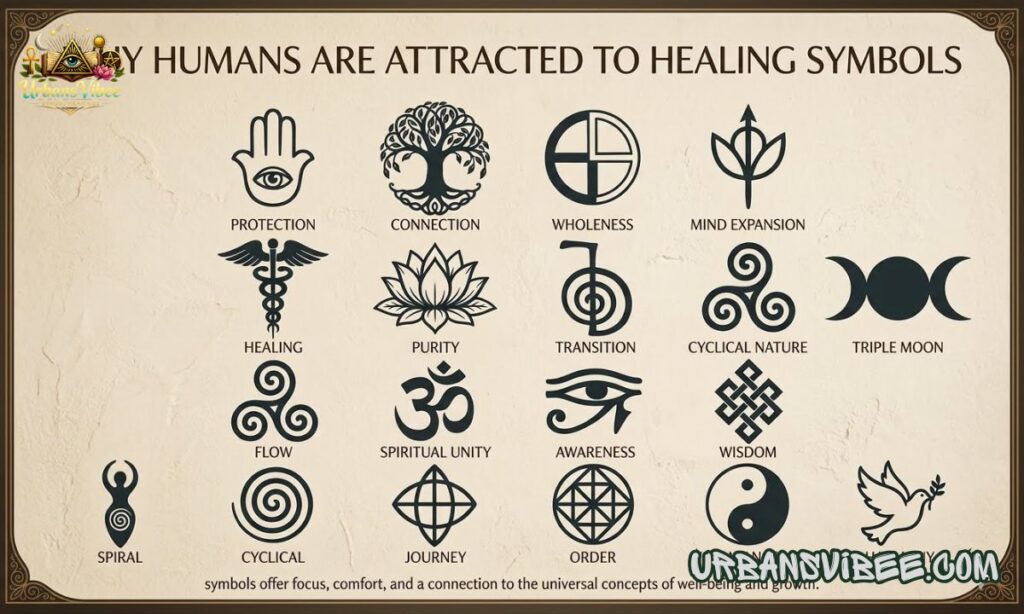
The answer is ancient and neurological in equal measure. Human beings are pattern-recognition creatures — we see faces in clouds, stories in constellations, and meaning in shapes. This visual meaning-making capacity evolved because it was survival-relevant: being able to quickly read environmental patterns was the difference between finding food and becoming it.
Healing symbols redirect this same pattern-recognition intelligence toward the inner world. When we are ill, grieving, or overwhelmed, we are pattern-seeking in our suffering — trying to find the thread that makes sense of the experience. A healing symbol provides that thread. It says: this kind of pain has been survived before. This kind of wound has been healed. This shape — spiral, lotus, tree — is the shape that the healing path takes. It offers not false certainty but genuine hope grounded in the testimony of every human who worked with these symbols across the millennia before us.
The attraction to healing symbols is ultimately the attraction to the evidence that healing is possible. And across 5,000 years of human history, that evidence is overwhelming.
Conclusion
From the Ankh carved in an Egyptian pharaoh’s tomb to the Cho Ku Rei drawn by a Reiki practitioner’s hand, from the Celtic Triple Spiral etched at Newgrange to the lotus tattooed on a cancer survivor’s wrist — healing symbols have served the same function across all human history: they make the invisible forces of restoration visible, tangible, and accessible to every person who needs them.
They are not magic. They are concentrated wisdom, accumulated intention, and the visual testimony of every human being who has ever moved through suffering into healing and left a mark so that those who came after would know the way. In 2026, as in 3000 BCE, that testimony is both needed and available — in every symbol on this list.
Frequently Asked Questions
What are healing symbols?
Healing symbols are visual representations from spiritual, cultural, and indigenous traditions that carry energetic meanings linked to restoration, balance, and wholeness — used in tattoos, meditation, ritual, and healing practice.
What is the most powerful healing symbol?
The Ankh and the Lotus are widely regarded as the most universally powerful healing symbols, with the Ankh representing eternal life force and the Lotus representing transcendence through any suffering.
What are Reiki healing symbols?
The five core Reiki symbols are Cho Ku Rei (power), Sei He Ki (emotional harmony), Hon Sha Ze Sho Nen (distance healing), Dai Ko Myo (master/soul healing), and Raku (completion) — used by practitioners to channel and direct healing energy.
What do Celtic healing symbols mean?
Celtic healing symbols — including the Triple Spiral, Celtic Knot, and Awen — represent the healing power of nature, the eternal resilience of life force, and the divine inspiration that flows through all living things.
What are Native American healing symbols?
Native American healing symbols include the Medicine Wheel, Feather, Bear Paw, Sun Symbol, and Thunderbird — each representing different dimensions of holistic health across body, mind, spirit, and community.
How do I use healing symbols in daily life?
Use healing symbols by wearing them as jewelry, placing images in your home or meditation space, tattooing personally meaningful ones, meditating while focusing on their form, or drawing them in journals during difficult periods.
What is the Eye of Horus healing meaning?
The Eye of Horus — restored to Horus after being destroyed in battle — represents the miraculous restoration of what was lost, making it a powerful symbol of healing, protection, and the return of wholeness after damage.
Are healing symbol tattoos respectful?
Healing symbol tattoos are most respectful when chosen with genuine understanding of the symbol’s cultural origin, meaning, and appropriate use — rather than purely for aesthetic appeal without knowledge of the tradition they come from.

Stephen Miller is a language enthusiast and symbol researcher at UrbansVibee. He specializes in uncovering the meanings, origins, and cultural significance of symbols, helping readers understand signs, icons, and symbolism from around the world.