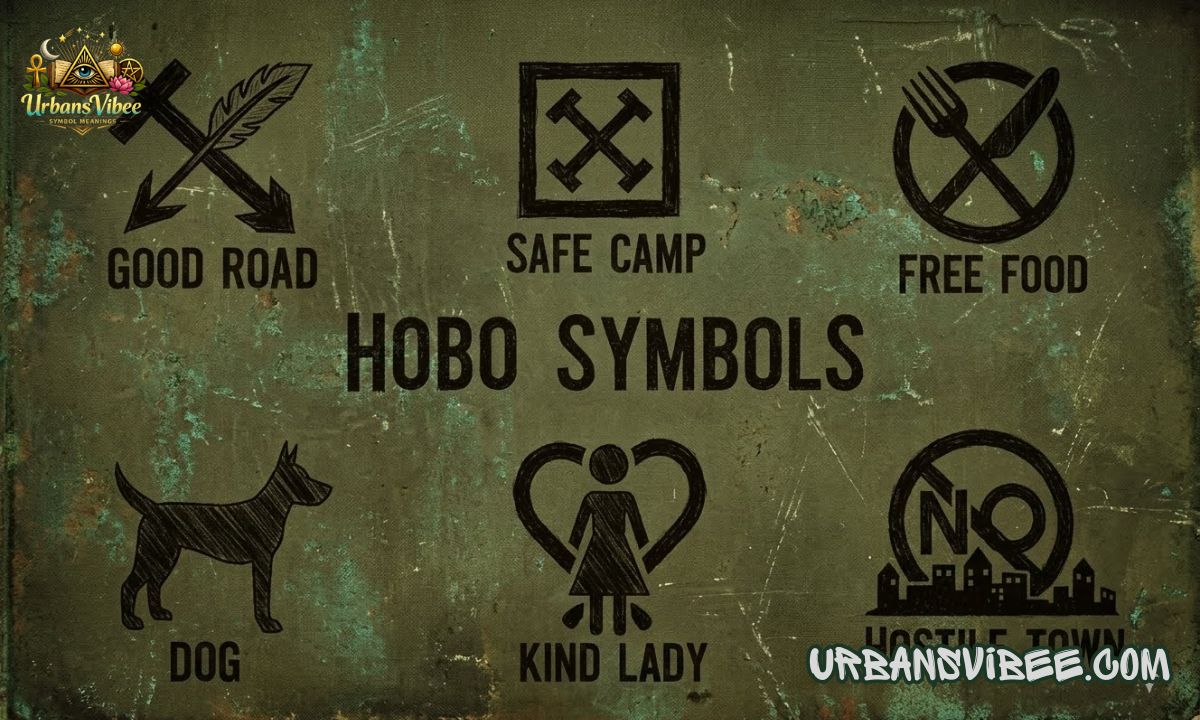
Long before text messages or social media existed, struggling travelers had their own secret language. They scratched it into fences. They chalked it onto walls. They carved it into wood near railroad tracks.
These were hobo symbols — a hidden communication system that helped wandering workers survive some of the hardest years in American history. Today, these mysterious markings still fascinate historians, artists, tattoo lovers, and anyone drawn to hidden meanings.
This complete guide explains every major hobo symbol, its history, and why these simple drawings still matter today.
What Are Hobo Symbols?
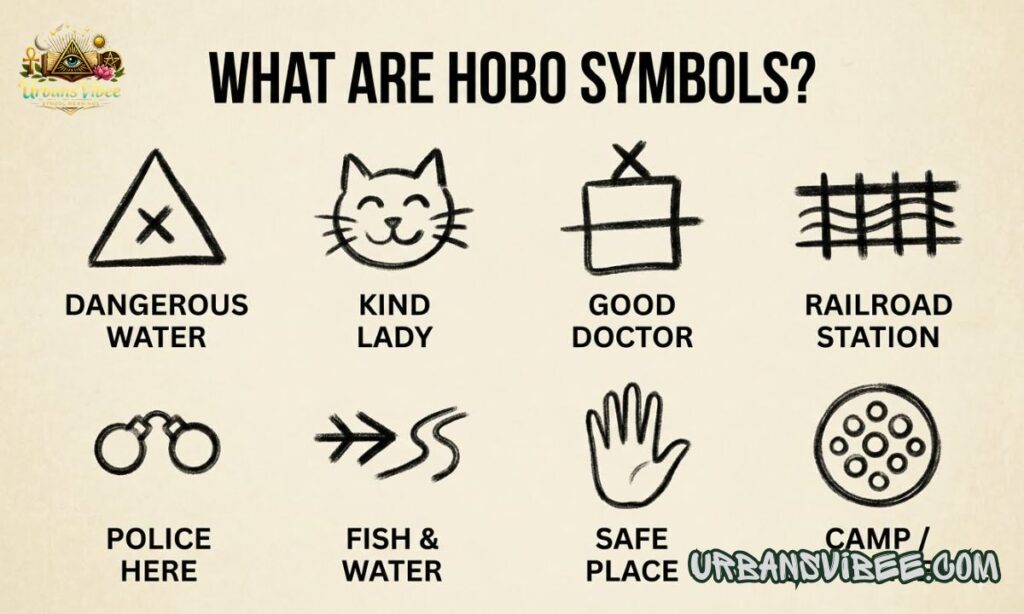
Hobo symbols are simple drawings or markings used by traveling workers during the late 1800s and early 1900s. They worked like a coded language. Each symbol shared important information with other travelers passing through the same area. These marks were made using chalk, charcoal, coal, or carved into surfaces near roads, fences, train stations, bridges, and buildings.
Life on the road was dangerous. Travelers faced hunger, bad weather, hostile towns, aggressive dogs, and police who treated homelessness as a crime. Hobo symbols became a survival tool. One small mark could warn someone of danger or point them toward a hot meal.
The Hidden History Behind Hobo Symbols
Hobo Symbols And Meanings
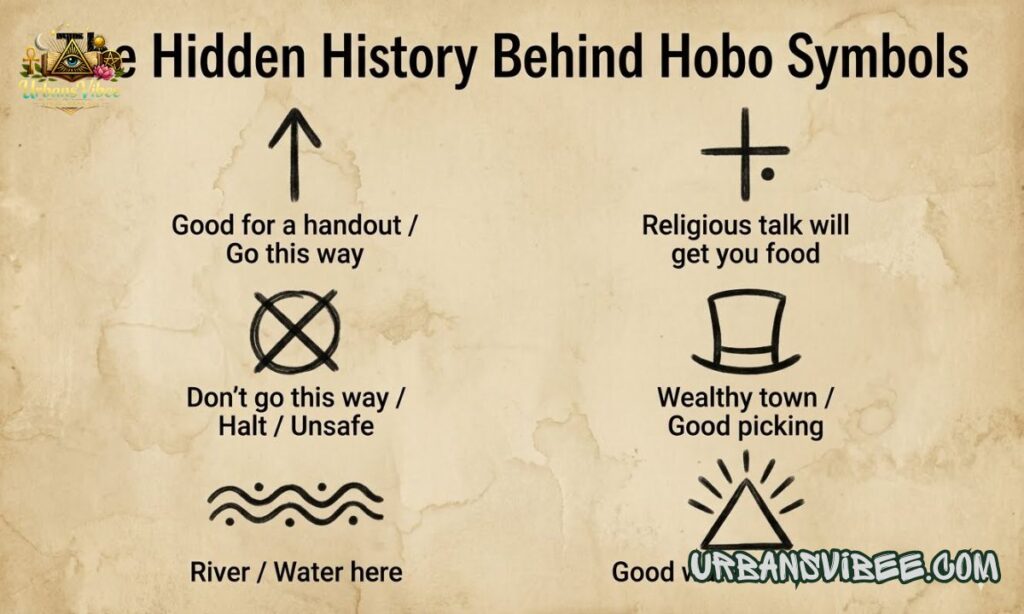
Hobo symbols were secret signs shared between traveling workers to communicate survival information. Each mark had a specific message — about food, shelter, danger, friendly people, or places to avoid. They were quick to draw and easy to read for anyone who knew the code.
History Of Hobo Symbols
The history of hobo symbols goes back to the late 1800s. As railroads expanded across America, workers followed the tracks from town to town looking for jobs. They needed a way to share information quickly without speaking aloud or writing long notes. Simple symbols solved that problem perfectly.
Hobo Symbols Great Depression
The Great Depression changed everything. Millions of Americans lost jobs, homes, and savings overnight. Many hit the road out of desperation. During this period, hobo symbols spread widely as more and more people needed help surviving in unfamiliar places.
Hobo Symbols During The Great Depression
During the Great Depression, these symbols helped travelers avoid dangerous towns and find households willing to offer food or shelter. Some marks pointed toward churches or charitable organizations. Others warned about police activity or hostile locals. The symbols created an invisible safety network during one of the darkest chapters in American history.
Great Depression Hobo Symbols
Great Depression hobo symbols focused heavily on three things — safety, food, and shelter. Travelers used whatever materials were available: chalk, coal, stones, or even scratched marks with a nail. These simple drawings created a hidden support system when no other help existed.
Hobo Code Symbols
The hobo code was essentially a visual language. Each symbol carried one clear meaning that travelers could understand at a glance. Unlike written words, symbols worked even for people who could not read. That made the system accessible to nearly everyone on the road.
Hobo Symbols System
The full hobo symbols system included dozens of unique signs. Travelers memorized them and passed the knowledge to others they trusted. The system covered directions, warnings, opportunities, and social information about specific locations along major railroad routes.
Hobo Language Symbols
Hobo language symbols created a silent way to pass life-saving messages across towns, fences, and rail yards. The drawings were deliberately simple so they could be made quickly and understood instantly. Over time, they became recognized as an important part of American folk tradition.
Secret Hobo Symbols
The secrecy of these symbols was part of their power. Locals rarely noticed them. Authorities could not read them. Only fellow travelers understood what they meant. That invisibility protected the entire network of wandering workers who depended on it.
Hobo Alphabet
The hobo alphabet was not made of letters or words. It used small sketches and shapes to represent warnings, directions, and opportunities. Historians today compare it to an early visual code system — practical, efficient, and surprisingly sophisticated for its time.
Hobo Signs
Hobo signs appeared on fences, sidewalks, trees, and walls. They were placed where travelers would naturally look while passing through a town. Some marked individual homes. Others gave broader warnings about an entire area.
Hobo Signs Meaning
The meaning of each hobo sign depended on its shape and sometimes its placement. A single symbol could communicate something as specific as “the homeowner will give you work in exchange for food” or as urgent as “get out of town immediately.”
Hobo Signs And Symbols
Together, hobo signs and symbols formed a complete communication network among wandering workers. Every mark served a practical purpose. The system reduced the need for direct conversation and helped strangers help one another without ever meeting face to face.
Modern Culture And The Mystery Of Hobo Markings
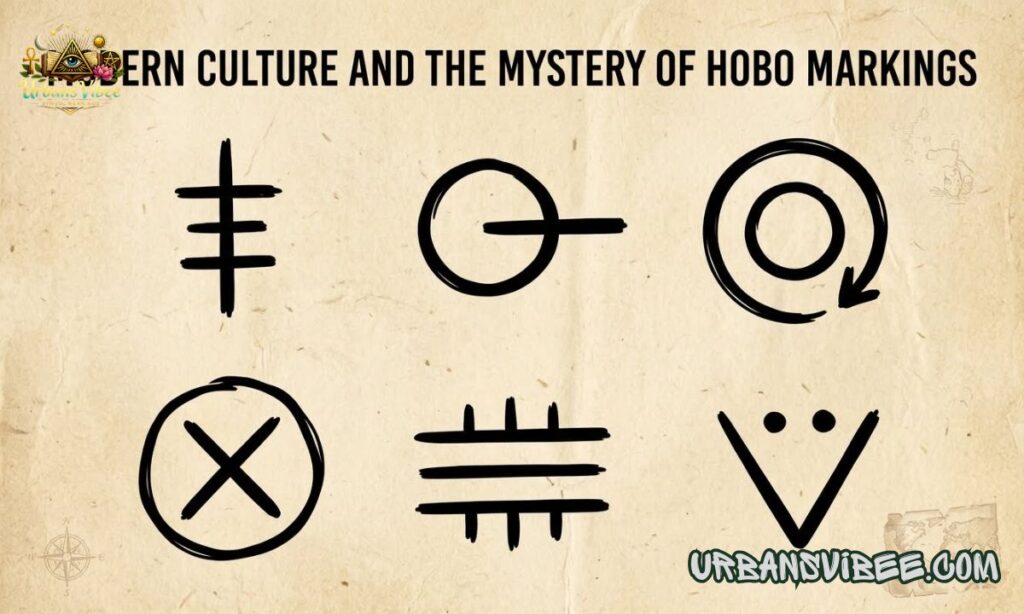
Modern Hobo Symbols
Modern hobo symbols appear in history books, documentary films, educational resources, and online discussions. Artists and writers continue to draw inspiration from these markings because of their deep emotional connection to survival and freedom.
Modern Day Hobo Symbols
Modern day hobo symbols sometimes appear in street art and urban exploration communities. Some travelers who still ride freight trains reference the old symbols as a form of tradition and identity. These updated references keep the old culture alive for new generations.
Real Life Hobo Symbols
Real life hobo symbols can occasionally still be found near abandoned railroad areas, historical freight routes, and old bridge underpasses. Researchers and urban explorers document these discoveries as rare windows into early traveler life.
Train Hobo Symbols
Train hobo symbols were placed specifically near freight depots, rail yards, and tracks. Hobos relied entirely on freight trains to move across the country. Symbols near train areas helped travelers know where to board safely, where to hide, and which routes to avoid.
Hobo Markings
Hobo markings were simple by design. They had to be drawn quickly and read quickly. Even a few rough lines communicated important survival information. Their simplicity also made them easy to overlook — which was exactly the point.
Hobo Symbols PDF
Many researchers and history enthusiasts look for hobo symbols PDF guides to study these markings in detail. Downloadable reference charts are popular in academic, survival, and history communities. They include visual examples, symbol descriptions, and historical context.
Hobo Symbols Chart
| Symbol | Meaning |
| Cat | Kind woman lives here — likely to help |
| Cross | Free food available |
| Circle with X | Do not stop here |
| Wavy Lines | Water nearby |
| Triangle pointing up | Safe camp nearby |
| Angry dog drawing | Dangerous dog — stay away |
| Circle with two arrows | Leave immediately |
| Crescent moon | Safe to sleep outside |
| Horizontal lines | Unsafe area |
| Man with hat | Wealthy household — may give work |
| Two shovels | Work available but hard labor |
| Star of David | Kind people live here |
| Three diagonal lines | Beware of police |
| Skull | Dangerous location |
| Bull’s eye | Good place to get water |
| Cross with circle | Charitable religious household |
| Upward arrow | Go this direction |
| House outline | Reliable household — safe to knock |
| Fence symbol | Stay away from this property |
| Broken circle | Town not safe for travelers |
Hobo Symbols Meaning
Each hobo symbol’s meaning was tied directly to real survival needs. Travelers needed to know who would feed them, who would call the police, and where they could sleep safely. These symbols answered those questions without a single spoken word.
Hobo Symbols Triangle
The triangle is one of the more debated symbols in hobo code history. Some interpretations suggest it pointed toward safe camps or shelters. Others use it to signal a warning. Triangle placements and variations in shape often changed the meaning depending on the community using them.
Hobo Symbols Tattoo
Hobo symbol tattoos have become increasingly popular among people interested in travel, freedom, and hidden histories. Common choices include the cat symbol for kindness, the safe camp triangle for shelter, and railroad inspired imagery for independence. These tattoos carry personal meaning alongside historical depth.
Hobo Symbols Mad Men
The television series Mad Men introduced hobo symbols to a new generation of viewers. The show used these mysterious markings to explore themes of identity, escape, and reinvention. For many people, Mad Men was their first introduction to the concept of traveler codes and their emotional history.
Hobo Symbols Walking Dead
The Walking Dead drew clear parallels between survivor communication and hobo symbols. Characters in the series left markings to warn or guide others through dangerous territory — exactly the same purpose the original hobo codes served. The connection felt natural and emotionally resonant.
Hobo Symbols Used In COD Zombies
Call of Duty Zombies incorporated mysterious symbols into its map environments, sparking player discussions about their possible hobo code origins. Some fans noticed visual similarities between game symbols and historical hobo markings. Their inclusion added atmospheric depth and hidden survival themes to the gameplay.
Read This: 85+ Unique Symbols To Represent Yourself And Express Your True Identity
The History Behind Hobo Symbols
The roots of hobo culture grew during the Industrial Revolution. Railroads expanded rapidly across America, creating temporary labor opportunities from coast to coast. Workers followed those opportunities wherever they led — hopping freight trains, moving between harvests, and surviving between jobs.
The economic collapse of the 1930s made that lifestyle involuntary for millions. People who had never imagined living on the road suddenly had no other option. In that environment, communication between strangers became essential for survival.
Hobo symbols emerged organically from that need. They crossed barriers of literacy, language, and regional accent. A simple drawing worked where words would fail. And they built something unexpected — a sense of community among people who had lost almost everything else.
Deep Symbolic Meaning of Hobo Symbols
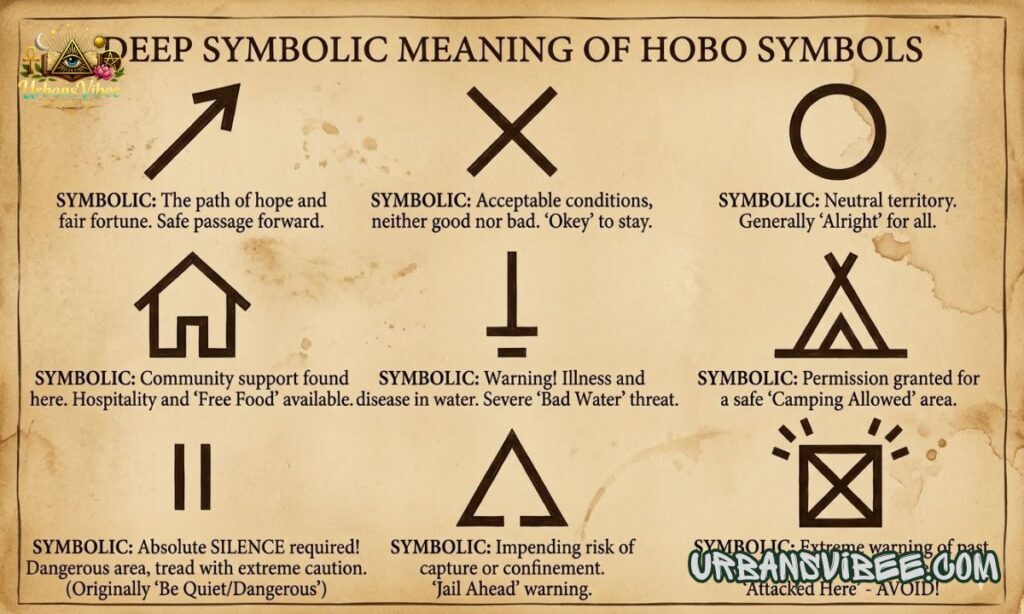
Spiritual Meaning
Spiritually, hobo symbols represent guidance during times of uncertainty and hardship. Many symbols reflected a belief that human kindness still exists even in the darkest circumstances. Finding a safe symbol after hours of walking alone through an unfamiliar town felt like more than information — it felt like grace.
The wandering road itself carries spiritual weight. Many traditions across history treat the journey as a metaphor for spiritual growth, and hobo symbols fit naturally within that framework.
Psychological Meaning
Psychologically, hobo symbols reflect the deep human need to communicate and feel protected. People naturally create coded systems when living under threat. Prison populations do it. Wartime resistance movements do it. Underground communities do it.
Hobo symbols reduced fear. A single chalk mark telling a tired traveler that safety was nearby could restore enough confidence to keep moving. They turned isolation into shared experience.
Cultural Meaning
Culturally, hobo symbols became powerful icons of resilience and rebellion. They represented an entire community of people living outside conventional society while still maintaining their own ethics, rules, and networks. Over time, they evolved into symbols of freedom, independence, and the romantic idea of life on the open road.
Common Types of Hobo Symbols and Their Meanings
Cat Symbol
The cat symbol told travelers that a kind woman lived nearby who would likely offer food or assistance. It appeared on fences and gates near welcoming homes. For many hungry travelers, this small drawing represented safety and compassion.
Cross Symbol
A cross meant free food or charitable help was available nearby. It was often placed near churches, shelters, or homes known for offering meals to strangers. This simple shape carried enormous emotional weight during the hardest years of the Depression.
Circle With Two Arrows
This symbol was a warning. It meant leaving this area immediately. The circle with outward pointing arrows indicated police presence, hostile locals, or immediate danger. Travelers who spotted this mark knew to keep moving without stopping.
Wavy Lines
Wavy lines indicated that clean water was available nearby. For travelers covering long distances on foot or freight train, finding water was a daily priority. This symbol pointed them in the right direction without drawing attention.
Angry Dog Symbol
A rough drawing of a barking or aggressive dog warned travelers to avoid a particular property. Some homes kept large guard dogs trained to attack strangers. This symbol saved many travelers from dangerous encounters.
Safe Camp Symbol
The safe camp symbol marked a secure location to rest overnight. It appeared near abandoned buildings, wooded areas, or hidden spaces along rail routes. For exhausted travelers, this marking was one of the most welcome sights imaginable.
Hobo Symbols Across Cultures
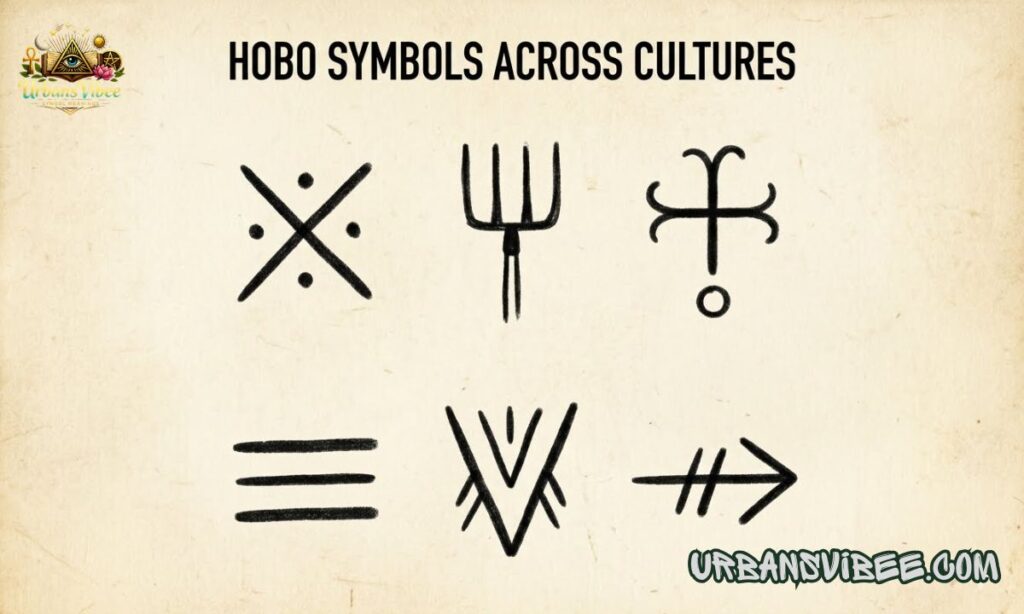
American Railroad Culture
In the United States, hobo symbols are inseparable from railroad history and the Great Depression. They became part of American folklore and continue to appear in museums, history books, and popular culture. Stories of wandering workers and coded messages remain part of the national imagination.
Ancient Nomadic Cultures
Nomadic groups across Asia, the Middle East, and North Africa developed trail markings long before American hobos existed. These groups used natural materials — stacked stones, carved trees, scratched rocks — to guide others through deserts and trade routes. The fundamental purpose was identical.
Medieval Europe
Wandering workers and pilgrims in medieval Europe carved symbols into inns, churches, and road markers to communicate warnings and opportunities. Stonemasons developed their own system of coded marks, called mason marks, to identify their work and communicate with fellow craftsmen.
Indigenous Trail Markings
Many Indigenous communities across North America used trail signs and natural markings to communicate directions, water locations, and danger zones. These systems respected the environment and blended naturally into the landscape in ways that outsiders could not read.
Modern Urban Symbolism
Contemporary street art and urban graffiti echo the spirit of hobo symbols. Modern artists use hidden messages, coded imagery, and public markings to express identity and community. The desire to leave messages for strangers has never disappeared — only the tools have changed.
Hobo Symbols in Art, Movies and Pop Culture
Movies
Films set during the Great Depression or railroad era frequently feature hobo symbols as part of their visual storytelling. These markings create atmosphere and emotional texture. They remind viewers how precarious survival once was for millions of ordinary Americans.
Literature
Writers use hobo symbols in novels about journeys, outsiders, and hidden wisdom. The symbols add layers of mystery and emotional authenticity to stories about people living on the margins of society. American literature has returned to this imagery repeatedly across generations.
Tattoos
Hobo symbol tattoos appeal to people who value independence, resilience, and personal history. Common choices include the cat for compassion, the safe camp symbol for finding peace after struggle, and railroad imagery for freedom and endurance.
Fashion and Design
Vintage Americana fashion frequently draws on hobo inspired imagery — rough maps, coded signs, railroad aesthetics, and weathered materials. Graphic designers use the raw hand-drawn quality of hobo symbols because it feels authentic and emotionally direct in a way that polished digital design rarely achieves.
Street Art
Modern graffiti artists occasionally reference hobo symbols to create secretive messages in public urban spaces. The idea of communicating hidden truths through simple public markings remains culturally compelling across generations.
Also Read This: 99+ Best Healing Symbols From Around the World and How to Use Them
Spiritual and Dream Meaning of Hobo Symbols
Dreaming about hobo symbols often reflects personal uncertainty or a search for guidance during difficult times. A dream involving a safe symbol may signal that emotional support or relief is approaching. Warning symbols in dreams can reflect anxiety about an upcoming decision or fear of the unknown.
Spiritually, hobo symbols encourage attention to subtle signs in everyday life. Guidance rarely announces itself loudly. Sometimes it appears as a small mark on a wall — if you know how to read it.
Positive and Negative Meanings of Hobo Symbols
Positive Meaning
- Represent human kindness and solidarity during hardship
- Celebrate survival, resilience, and community support
- Inspire modern creativity in art, tattoos, and design
- Connect people to a rich and emotional piece of American history
- Remind us that strangers can help one another through difficult times
Negative Meaning
- Emerged from poverty, homelessness, and economic collapse
- Many symbols warned of violence, exploitation, and discrimination
- Reflect a time when millions of people had no safety net or stable home
- Some hobo code claims are exaggerated or historically unverified
- Connected to a period of deep social inequality and institutional neglect
Why Humans Are Drawn to Hobo Symbols
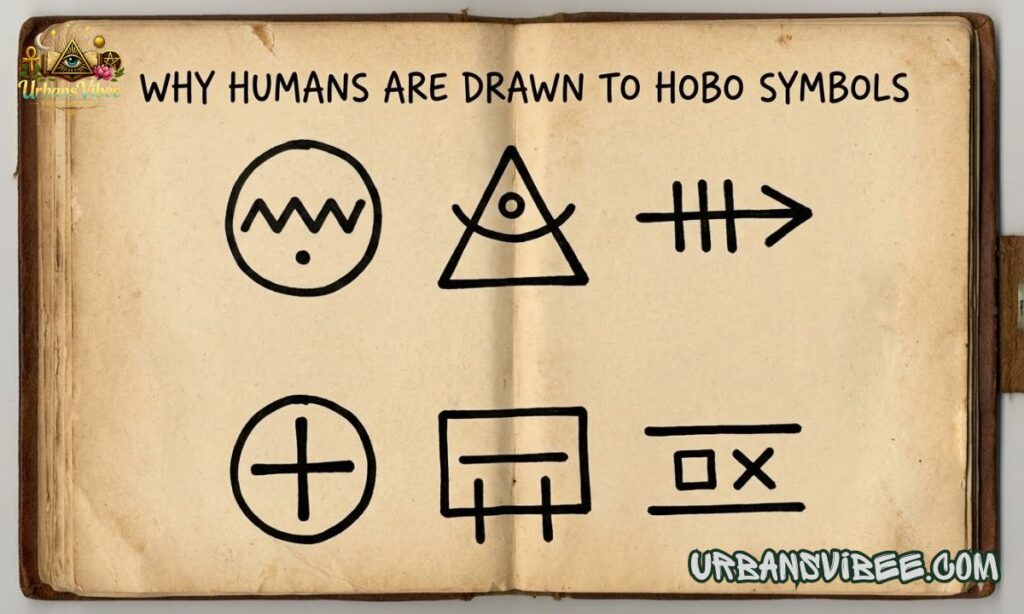
People feel naturally attracted to hobo symbols because they touch something deep in the human mind. Curiosity about hidden messages is universal. When a simple drawing carries a secret meaning, it becomes fascinating rather than ordinary.
Hobo symbols also connect to emotional experiences almost everyone understands — fear of the unknown, hope during hardship, the relief of finding help when it feels impossible. These are not distant historical emotions. They are immediate and human.
There is also beauty in simplicity. A few rough chalk lines carrying the weight of someone’s survival feels more powerful than elaborate art. These symbols remind us that meaning does not require complexity — only intention.
Are Hobo Symbols Still Used Today?
True historical hobo symbols are rarely used in everyday modern life. However, their influence continues in several ways:
- Small train-hopping communities still reference old symbols as cultural tradition
- Historians and museums actively preserve original hobo markings as cultural artifacts
- Artists and designers incorporate hobo imagery into contemporary creative work
- Games, films, and television series continue to draw on hobo code symbolism
- The underlying human instinct — creating coded signs to share hidden messages — lives on in modern emoji, memes, and digital shorthand
The tools have changed entirely. The human instinct has not changed at all.
Conclusion
Hobo symbols are far more than old chalk drawings fading from forgotten fences. They are emotional records of survival, community, and human resilience during some of the harshest years in American history. Every mark carried a real story — hunger, hope, fear, or the quiet generosity of a stranger who left a warning for someone they would never meet.
These symbols remind us of something timeless. People survive best when they help one another. That message, written in chalk on a Depression-era fence post, is just as true today as it was a hundred years ago.
Frequently Asked Questions
What are hobo symbols?
Hobo symbols are simple coded drawings used by traveling workers in the late 1800s and early 1900s to share survival information about food, shelter, danger, and safe locations.
Are hobo symbols historically real?
Many hobo symbols are rooted in real historical practices, though some popular lists have been romanticized or exaggerated over time by storytellers and newspapers.
What does the cat symbol mean in hobo code?
The cat symbol meant a kind woman lived nearby who would likely offer food or help to travelers passing through.
When were hobo symbols most commonly used?
Hobo symbols were most widely used during the Great Depression era of the 1930s, when millions of Americans traveled in search of food and work.
What does a cross mean in hobo symbols?
A cross typically meant free food or charitable assistance was available nearby, often near churches or generous households.
Are hobo symbols still used today?
True hobo symbols are rarely used in modern daily life, but they continue to influence art, tattoos, film, games, and street art culture.
What materials did hobos use to draw symbols?
Hobos typically used chalk, charcoal, coal, nails, or stones to draw or carve their symbols on walls, fences, trees, and wooden surfaces.
What is the hobo symbol for danger?
Several symbols indicated danger, including a skull for a dangerous location, three diagonal lines for police presence, and a circle with two arrows meaning leave immediately.
What does the triangle mean in hobo symbols?
The triangle is one of the less consistent symbols in hobo code history. It has been interpreted as indicating a safe camp or a warning, depending on the community and region.
Why are hobo symbols used in tattoos?
People choose hobo symbol tattoos because they represent independence, resilience, survival, and a deep connection to the hidden history of American wandering culture.

Stephen Miller is a language enthusiast and symbol researcher at UrbansVibee. He specializes in uncovering the meanings, origins, and cultural significance of symbols, helping readers understand signs, icons, and symbolism from around the world.