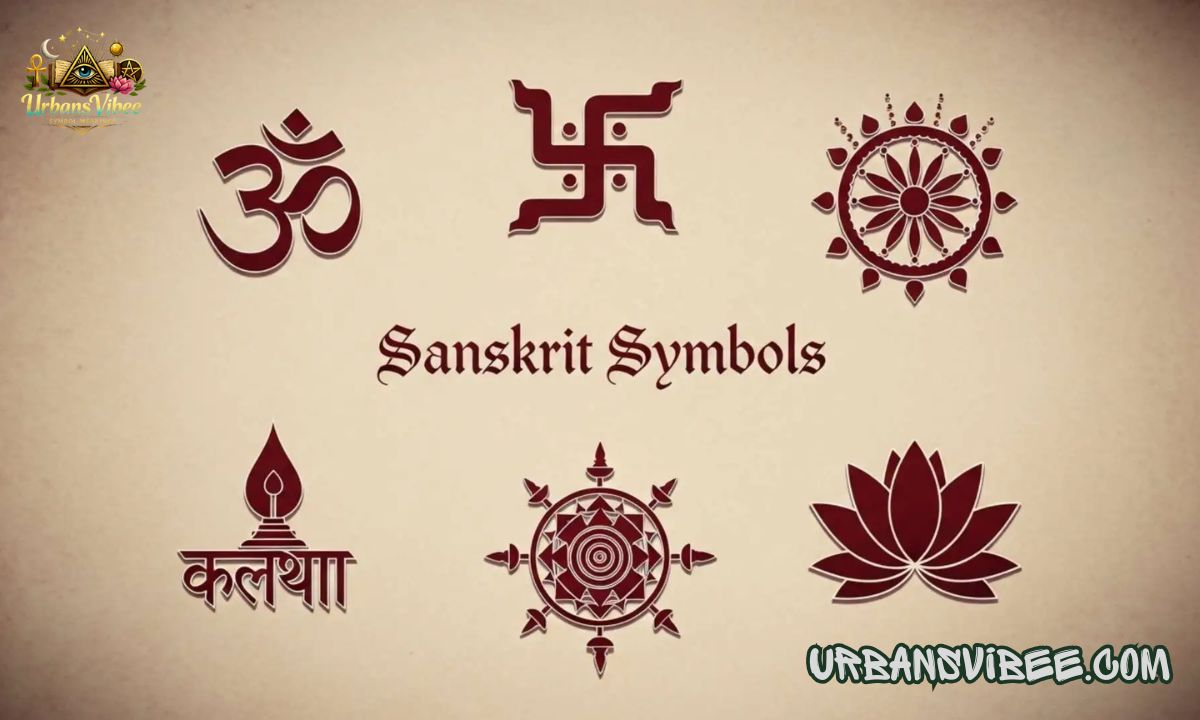
Some languages carry weight that goes beyond words. Sanskrit is one of them. For over 3,500 years, Sanskrit has served as the sacred language of Hinduism, Buddhism, and Jainism — and its symbols have never stopped speaking.
From the cosmic hum of Om carved into ancient temple walls to the chakra symbols drawn on modern yoga mats, Sanskrit symbols are experiencing a remarkable global renaissance in 2026.
People are embedding them in tattoos, painting them in homes, and using them in meditation — not as decoration, but as daily reminders of deeper truth. This guide decodes 89+ Sanskrit symbols, their ancient origins, spiritual meanings, and the quiet power they carry into modern life.
What Are Sanskrit Symbols?
Sanskrit symbols are sacred visual emblems rooted in one of the world’s oldest known languages — Sanskrit (Saṃskṛtam) — the classical language of ancient India first documented over 3,500 years ago in the Vedic scriptures. These symbols encode philosophical, spiritual, and cosmic principles in compact visual form.
Unlike ordinary written characters, Sanskrit symbols function simultaneously as:
- Phonetic representations — each character carries a precise sound vibration
- Spiritual tools — believed to activate specific states of consciousness when seen, chanted, or meditated upon
- Cultural transmitters — carrying thousands of years of Hindu, Buddhist, and Jain wisdom embedded in a single image
As the Mandukya Upanishad teaches about Om: the syllable encompasses all of existence — past, present, and future. That depth of meaning behind a single symbol is what makes the entire Sanskrit symbolic system extraordinary.
Ancient Sanskrit Symbols And Their Spiritual Meanings
Sanskrit Symbols And Meanings
Here is a comprehensive reference table of the most important Sanskrit symbols and their core meanings:
| Sanskrit Symbol | Sanskrit Name | Core Meaning |
| ॐ (Om/Aum) | Omkara | Universal sound, divine consciousness, creation |
| 卍 (Swastika) | Svastika | Well-being, good fortune, cosmic balance |
| Lotus | Padma | Purity, spiritual awakening, transcendence |
| Unalome | Unalome | Life’s path, spiritual journey to enlightenment |
| Mandala | Mandala | Universe, wholeness, cosmic cycles |
| Chakra Wheel | Dharmachakra | Buddha’s teachings, cycle of life, liberation |
| Shri Yantra | Shri Yantra | Divine feminine energy, abundance, cosmic geometry |
| Trishula | Trishula | Shiva’s trident — past, present, future |
| Aum Namah Shivaya | Panchakshara | Devotion to Shiva, liberation, divine presence |
| Bindu | Bindu | The origin point of creation, pure consciousness |
| Hamsa | Hamsah | Divine grace, the “I am” of pure consciousness |
| Gayatri | Gāyatrī | Divine light, wisdom, illumination of mind |
| Pranayama | Prāṇāyāma | Breath control, life force, vitality |
Buddhist Sanskrit Symbols And Meanings
Buddhism adopted and transformed many Sanskrit symbols, embedding them with additional layers of meaning tied to the Dharma:
- Om Mani Padme Hum — The most famous Buddhist mantra in Sanskrit, meaning “the jewel in the lotus.” Each syllable purifies a specific negative quality: pride, jealousy, desire, ignorance, greed, and aggression — transforming them into six wisdoms. It is the mantra of Avalokiteshvara, the Bodhisattva of Compassion.
- Dharmachakra (Wheel of Dharma) — The eight-spoked wheel representing the Buddha’s Eightfold Path to liberation, the foundation of Buddhist ethical and spiritual life.
- Unalome — A curling spiral symbol rising to a straight line, representing the winding path of human life that eventually straightens into enlightenment. Widely used in Buddhist temples across Thailand, Cambodia, and Myanmar.
- Lotus with Vajra — The lotus represents purity; the vajra (thunderbolt) represents indestructible wisdom. Together they symbolize the union of compassion and insight.
- Endless Knot (Shrivatsa) — Representing the interconnection of wisdom and compassion, and the cyclical nature of samsara (existence).
Ancient Sanskrit Symbols
The oldest Sanskrit symbols appear in the Vedic texts (circa 1500 BCE) and Indus Valley artifacts (circa 2500 BCE). Archaeological findings at Mohenjo-daro and Harappa show proto-Sanskrit symbols engraved on seals — including early swastika forms and geometric patterns that directly link to later classical Sanskrit symbolism.
The Rig Veda uses symbolic imagery — lotus, fire, cosmic wheel — as visual metaphors for the same truths the symbols later came to embody directly. By the time of the Upanishads (circa 800–200 BCE), Sanskrit symbols had been elevated to full philosophical instruments, each encoding complete cosmological principles.
Sanskrit Symbol For Life
The Sanskrit symbol most closely associated with life itself is the Jiva — the individual living soul — represented through the Om symbol’s three curves, which map directly onto the three states of consciousness: waking (jagrat), dreaming (svapna), and deep sleep (sushupti). The fourth state, turiya, is represented by the dot above the Om — the witnessing awareness that underlies all life.
The Trishula (Shiva’s trident) also encodes a life symbol: its three prongs represent creation, preservation, and dissolution — the complete cycle of existence that every living being participates in.
Sanskrit Symbols For Breathe
The most direct Sanskrit symbol connected to breath is Pranayama (प्राणायाम) — combining prana (life force/breath) and ayama (extension/control). Prana is the vital energy that rides on the breath — the bridge between the physical body and spiritual consciousness. When inscribed as a symbol or tattoo, Pranayama serves as a constant reminder of the sacred nature of each breath.
The Hamsa symbol (हंस — not to be confused with the Middle Eastern hand symbol) in Sanskrit refers to the sound of the breath: ham (inhalation) and sa (exhalation). Every human being unconsciously chants this sacred mantra approximately 21,600 times per day through breathing alone.
Popular Sanskrit Symbols In Tattoos And Modern Design
Sanskrit Symbols Tattoos
Sanskrit tattoo culture has grown significantly across the West, South Asia, and East Asia over the past decade, driven by yoga culture, mindfulness movements, and a global appetite for meaningful body art. The most popular Sanskrit symbol tattoos include:
- Om (ॐ) — Minimalist Om tattoos on wrists, inner arms, and behind the ear remain perennially popular
- Unalome — One of the fastest-growing Sanskrit tattoo designs globally; its elegant spiral-to-straight-line form represents personal growth from confusion to clarity
- Lotus — Often combined with Om or chakra symbols in larger compositions
- Chakra symbols — The Heart Chakra (Anahata) and Third Eye Chakra (Ajna) are most popular for tattoos
- Mandala — Back and thigh placements for intricate mandala designs that can incorporate multiple Sanskrit symbols
- Sanskrit script mantras — Om Namah Shivaya, Soham, and personal name translations remain among the most requested Sanskrit text tattoos
Sanskrit Symbols And Meanings Tattoos
Understanding a symbol’s meaning before committing it to skin is essential — and Sanskrit symbols carry specific cultural weight that deserves respect. A lotus tattoo on someone who has risen through genuine adversity carries entirely different weight than the same design chosen purely for aesthetics.
The most trusted placements:
- Wrist and inner arm — for mantras and Om symbols that serve as daily reminders
- Chest (near the heart) — for heart chakra and devotional symbols
- Spine — for sequential chakra symbol columns that run root to crown
- Forearm — for Sanskrit script mantras like Pranayama or Om Mani Padme Hum
- Shoulder — for mandala and lotus compositions
Spiritual Sanskrit Symbols
Every Sanskrit symbol is inherently spiritual — the distinction between sacred and decorative barely exists in Sanskrit tradition. The symbols most specifically used in active spiritual practice include:
- Shri Yantra — The most complex and revered geometric Sanskrit symbol, used as a meditation tool for connecting with divine feminine energy (Devi/Shakti)
- Om — Chanted at the beginning and end of all Hindu rituals and yoga practices
- Gayatri Symbol — The visual representation of the Gayatri Mantra, invoking divine illumination
- Chakra symbols — Used in chakra healing, kundalini yoga, and energy medicine as maps of the body’s spiritual anatomy
Sanskrit Symbols Text
Sanskrit script (Devanagari) is itself symbolic — each letter is believed to have its own energetic quality. The most commonly used Sanskrit symbol texts include:
- ॐ — Om
- 卍 — Swastika
- ☸ — Dharmachakra
- श्री — Shri (auspiciousness)
- ॐ नमः शिवाय — Om Namah Shivaya
- सोहं — Soham (“I am That”)
- प्राणायाम — Pranayama
Symbols Of Sanskrit / Sanskrit Symbols Meaning
All Sanskrit symbols share a unifying principle: they are not just visual representations — they are believed to carry the actual vibrational energy of the concepts they represent. Seeing the Om symbol is understood in Sanskrit tradition not as a reminder of Om, but as an actual encounter with its energy.
Sanskrit Symbol For Balance
The symbol most directly associated with balance in Sanskrit tradition is the Shri Yantra — a complex geometric pattern of nine interlocking triangles, four pointing upward (Shiva/masculine) and five pointing downward (Shakti/feminine).
Their precise intersection creates perfect geometric balance — visually encoding the principle that all existence is sustained by the dynamic equilibrium of opposing forces.
The Yin-Yang equivalent in Sanskrit tradition is the Ardhanarishvara — the half-Shiva, half-Parvati deity representing the indivisible union of masculine and feminine energies as the source of cosmic balance.
Breathe Sanskrit Symbol
The Pranayama symbol (प्राणायाम) is the most used Sanskrit breathe symbol in modern wellness and tattoo culture. Beyond Pranayama, the Hamsa breath mantra (हंस) — representing the inhale (ham) and exhale (sa) — carries the deepest symbolic meaning for breath in Sanskrit tradition.
It teaches that every breath is a form of unconscious prayer — the universe breathing itself into and out of existence through every living being.
Deep Symbolic Meaning
Sanskrit symbols operate simultaneously on three levels of meaning that distinguish them from ordinary visual symbols in almost every other tradition:
The first level is sonic — each Sanskrit symbol encodes a specific sound vibration, and that vibration is believed to have independent power. The Om symbol is not just the image of a sound — in Sanskrit cosmology, it is the sound that preceded and underlies all creation.
The second level is geometric — symbols like the Shri Yantra and chakra mandalas encode precise mathematical and geometric relationships that are understood as maps of cosmic structure.
The third level is semantic — every Sanskrit symbol carries layers of philosophical meaning, philosophical texts, mythological narratives, and practical spiritual instructions compressed into a single image.
This triple compression of sonic, geometric, and semantic meaning is what sets Sanskrit symbols apart from virtually every other symbolic system on Earth.
Types / Variations of Sanskrit Symbols
Om Symbol
Visual: A stylized Devanagari numeral 3 with a curved tail, a curved stroke, and a dot overhead.
Meaning: Om (also written Aum) is the primordial sound from which, according to Sanskrit cosmology, the entire universe emerged. The three curves of the Om symbol represent the three states of consciousness — waking, dreaming, and deep sleep. The horizontal line represents maya (illusion), and the dot above represents the fourth state: turiya, pure consciousness beyond the three.
Pronounced “Aum,” the three phonemes A-U-M correspond to the Hindu Trinity: Brahma (creation), Vishnu (preservation), and Shiva (dissolution). The Mandukya Upanishad dedicates its entire content — 12 verses — to decoding the full meaning of this single syllable.
Modern use: Yoga studio branding, meditation spaces, tattoos, jewelry, home décor, and the opening and closing of every formal Hindu and Buddhist ceremony.
Lotus Symbol
Visual: A stylized flower with symmetrical petals opening from a central point, depicted in varying numbers of petals (4, 6, 8, 12, 16, or 1000 depending on the associated chakra or deity).
Meaning: The lotus grows in muddy water yet rises above it — blooming clean, beautiful, and untouched by the conditions of its origin. This visual fact made it the perfect Sanskrit symbol for spiritual transcendence: the soul’s capacity to grow toward enlightenment regardless of material circumstances. In Hindu tradition, Brahma, Vishnu, and Lakshmi are each depicted seated on or holding a lotus, encoding the divine quality of transcendent purity in their very posture.
In Buddhism, the lotus represents the Buddha-nature present in every being — the capacity for awakening that exists within everyone, regardless of where they started.
Swastika Symbol
Visual: A cross with four arms bent at right angles — clockwise (right-facing) or counterclockwise (left-facing).
Meaning: Derived from the Sanskrit svastika, meaning su (good) + asti (to be) + ka (making) — literally “that which makes things good.” The clockwise swastika represents the sun, forward motion, prosperity, and auspiciousness. The counterclockwise form represents night, the goddess Kali, and transformative introspection.
One of the oldest known symbols in human history — appearing in Indus Valley artifacts from 2500 BCE — the swastika predates its 20th-century misuse by over 4,000 years. In its original Sanskrit context, it remains a sacred symbol of well-being, continuity, and divine blessing, used in Hindu wedding ceremonies, Diwali celebrations, temple entrances, and auspicious rituals throughout South and Southeast Asia.
Chakra Symbols
Visual: Each of the seven chakras has its own mandala-like symbol — a lotus flower with a specific number of petals, containing geometric shapes and a central Sanskrit bija (seed) syllable.
The seven chakra symbols and their Sanskrit names:
- Muladhara (Root Chakra) — 4 red lotus petals, earth element, bija syllable LAM — survival, stability, grounding
- Svadhisthana (Sacral Chakra) — 6 orange petals, water element, bija syllable VAM — creativity, emotion, sensuality
- Manipura (Solar Plexus Chakra) — 10 yellow petals, fire element, bija syllable RAM — willpower, confidence, identity
- Anahata (Heart Chakra) — 12 green petals, air element, bija syllable YAM — love, compassion, healing
- Vishuddha (Throat Chakra) — 16 blue petals, ether element, bija syllable HAM — communication, truth, expression
- Ajna (Third Eye Chakra) — 2 indigo petals, light element, bija syllable OM — intuition, wisdom, inner sight
- Sahasrara (Crown Chakra) — 1000-petaled violet lotus, consciousness itself, bija syllable AH — divine union, enlightenment, liberation
Chakra symbols were first systematically described in the Vedas over 3,000 years ago and remain central to kundalini yoga, Ayurveda, and energy healing practices globally.
Mandala
Visual: A complex, radially symmetric geometric design composed of concentric circles, squares, and intricate patterns — always organized around a central point (the Bindu).
Meaning: From Sanskrit maṇḍala, meaning “circle” — mandalas represent the universe itself: complete, self-contained, and organized around a sacred center. In both Hindu and Buddhist traditions, creating or meditating upon a mandala is understood as a process of aligning oneself with the cosmic order.
In Tibetan Buddhism, monks spend days creating intricate sand mandalas — then deliberately destroy them — as a teaching about impermanence. Carl Jung, the Swiss psychologist, used mandala drawing therapeutically, recognizing it as a universal symbol of psychological wholeness that arises spontaneously in the human unconscious across all cultures.
Sanskrit Symbols Across Cultures
Sanskrit symbols traveled the ancient Silk Road and maritime trade routes, transforming as they encountered new cultures while retaining their essential power:
- India (origin) — Sanskrit symbols remain deeply embedded in daily religious practice, architecture, and ceremony across Hinduism, Jainism, and Buddhism
- Tibet — Adopted Sanskrit symbols into a rich Vajrayana Buddhist tradition; Om Mani Padme Hum is carved into mountains, prayer wheels, and monastery walls across the Himalayan region
- Southeast Asia — Thailand, Cambodia, Indonesia, and Myanmar integrated Sanskrit symbols into temple architecture and traditional tattoo practice (Sak Yant), where they are believed to carry protective spiritual power
- China and Japan — Sanskrit characters (called Siddham in Japanese Buddhist tradition) appear in esoteric Buddhist art and temple inscriptions; the chakra system influenced traditional Chinese medicine’s understanding of energy meridians
- Modern West — Through yoga, mindfulness culture, and global spiritual seeking, Sanskrit symbols entered Western culture from the 1960s onward, accelerating dramatically from 2000 to today
The global spread of Sanskrit symbols represents one of the most significant cross-cultural transmission of spiritual knowledge in human history.
Sanskrit Symbols in Art, Movies & Pop Culture
Sanskrit symbols have moved from sacred spaces into mainstream culture with remarkable grace:
- The Om symbol appears in studio logos, album artwork, festival branding, and wellness product design globally — its visual simplicity and universal recognition make it one of the most reproduced spiritual symbols in 21st-century design
- Mandala art entered Western mainstream consciousness through the Tibetan Buddhist sand mandala exhibitions at major Western museums in the 1980s, igniting a global interest that today drives an enormous market in art therapy, coloring books, and meditative design
- In cinema, Sanskrit symbols appear in films like Doctor Strange (chakra-inspired sacred geometry), the Indiana Jones series (Hindu temple iconography), and multiple Bollywood and South Indian productions where they are embedded in ceremonial and mythological storytelling
- The 2023 and 2024 Grammy ceremonies saw multiple artists incorporating Sanskrit script into stage design and personal expression
- Yoga wear brands from Lululemon to Manduka have built entire visual identities around Sanskrit symbols, driving a multibillion-dollar mindfulness aesthetic industry
Spiritual & Dream Meaning of Sanskrit Symbols
When Sanskrit symbols appear in dreams or arise spontaneously in meditation, many spiritual traditions interpret them as significant messages:
- Dreaming of Om is widely understood as a contact with pure consciousness — an invitation to rest in your deepest nature rather than the constant movement of the thinking mind
- A lotus appearing in dreams often signals the emergence of something beautiful and meaningful from a difficult period — growth that has been happening beneath the surface is preparing to bloom
- Seeing chakra symbols in dreams may point to which specific energy center needs attention — a glowing heart chakra may signal the need for more love or forgiveness; a blocked throat chakra may reflect suppressed truth that needs expression
- A mandala forming in a dream is frequently interpreted as a signal of psychological integration — the dreaming mind organizing scattered parts of the self into a coherent whole
- The Swastika in its original Sanskrit context appearing in dreams carries its original meaning: a blessing, the auspicious rotation of cosmic forces, and a confirmation that you are moving in alignment with your highest good
Positive vs Negative Meaning
| Symbol | Positive / Traditional Meaning | Cautionary Note |
| Om (ॐ) | Universal consciousness, sacred creation | Use with genuine reverence; avoid trivializing as mere decoration |
| Swastika (卍) | Good fortune, cosmic balance, auspiciousness | Western misuse in WWII requires cultural context when displayed |
| Lotus | Purity, transcendence, resilience | No negative meaning; universally auspicious |
| Chakra Symbols | Energy, healing, spiritual balance | Oversimplification in wellness industry loses depth |
| Unalome | Growth, path to enlightenment | Buddhist sacred symbol; deserves respectful use |
| Mandala | Wholeness, cosmic order, inner peace | Commercial overuse risks diluting its meditative power |
| Shri Yantra | Divine abundance, sacred geometry | Complex symbol requiring proper understanding before use |
Why Humans Are Attracted to This Symbol
The answer sits at the intersection of neuroscience, psychology, and ancient wisdom. Sanskrit symbols are optimized by thousands of years of contemplative use to produce specific effects in human consciousness — and modern research is beginning to confirm what practitioners have known for millennia.
Mandala symmetry activates the brain’s default mode network in ways associated with deep rest and integration. The Om vibration at 136.1 Hz corresponds to the vibrational frequency of the Earth’s rotation around the sun — a correspondence that may explain why hearing or seeing Om produces a measurable calming response in the nervous system.
Beyond neurological effects, humans are drawn to Sanskrit symbols because they offer something increasingly rare in modern life: concentrated meaning. A single Om symbol carries 3,500 years of philosophical inquiry, spiritual practice, and lived human experience in one elegant image. In a world saturated with disposable visual content, that depth is magnetic.
People who encounter Sanskrit symbols in authentic contexts — whether in a yoga class, a museum, or a serious conversation with someone who understands them — often describe the experience as recognition rather than discovery. Something in the symbol speaks to something that was already present, waiting to be awakened.
That recognition is the deepest reason Sanskrit symbols continue to transform lives — not by adding anything new, but by reminding us of what was always there.
Conclusion
Sanskrit symbols are not relics of an ancient past. They are living tools — tested across 3,500 years of human experience and found effective enough to travel across continents, centuries, and entirely different cultural contexts without losing their essential power.
Whether you encounter them in a temple carving, a tattoo studio, a meditation app, or on the cover of a notebook, they carry the same invitation: to pause, look deeper, and remember that the visible world is not all there is.
Used with knowledge and respect, these 89+ Sanskrit symbols are among the most powerful personal transformation tools available to any human being in 2026.
Frequently Asked Questions
What are Sanskrit symbols?
Sanskrit symbols are sacred visual emblems from the ancient Sanskrit language, encoding spiritual, philosophical, and cosmic principles — used in Hinduism, Buddhism, and Jainism for meditation, ritual, and personal transformation.
What is the most powerful Sanskrit symbol?
The Om (ॐ) symbol is universally considered the most powerful Sanskrit symbol, representing the primordial sound of creation and the totality of universal consciousness.
What does the Om symbol mean in Sanskrit?
Om (Aum) represents the sound from which all creation emerged — its three curves encode the three states of consciousness (waking, dreaming, deep sleep), and the dot represents pure awareness beyond all states.
What is the Sanskrit symbol for life?
The Om symbol most directly encodes the principle of life — its three-curve structure maps the complete cycle of conscious existence, while the Trishula represents creation, preservation, and dissolution of all life.
What is the Sanskrit symbol for breathe?
Pranayama (प्राणायाम) is the Sanskrit symbol/word most associated with breath, representing life force extension through conscious breathing; the Hamsa (हंस) symbol encodes the sound of each breath — ham (inhale) and sa (exhale).
What do chakra symbols mean in Sanskrit?
Each of the seven chakra symbols is a Sanskrit mandala encoding an energy center of the body — from Muladhara (root/survival) to Sahasrara (crown/enlightenment) — with specific lotus petal counts, geometric shapes, and bija (seed) syllables.
Are Sanskrit tattoos disrespectful?
Sanskrit tattoos are not inherently disrespectful, but they carry deep cultural and spiritual weight — choosing them with genuine understanding of their meaning and respect for their origins honors the tradition they come from.
What is the Sanskrit symbol for balance?
The Shri Yantra is the most direct Sanskrit symbol for balance — its nine interlocking triangles (four masculine, five feminine) create perfect geometric equilibrium representing the dynamic balance of all opposing cosmic forces.

Stephen Miller is a language enthusiast and symbol researcher at UrbansVibee. He specializes in uncovering the meanings, origins, and cultural significance of symbols, helping readers understand signs, icons, and symbolism from around the world.